
6th century·Feast June 28 (Brittany); Thursday of Whitsun (Cornwall)
St. Austol
Cornish-Breton Holy Man
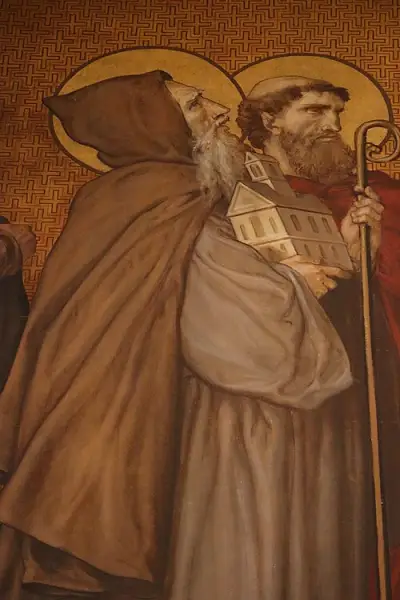
Overview
Austol — Welsh Austel, Latin Austolus — was a holy man of sixth-century Cornwall who passed much of his life in Brittany. His inseparable friend and companion was Mewan (Méen), founder of the Saint-Méen Abbey in Brittany, who is said to have been his godfather — a bond of spiritual kinship that shaped his whole story. Austol shared Mewan's work at the abbey that grew from his foundation, and the Life of St. Mewan relates that his own death came within a week of Méen's — so close a companionship that even their deaths were almost one. His chief monument is in his homeland: the parish and town of St Austell in Cornwall are named in his honor, one of the great Cornish place-name saints. He is reckoned a saint, with a Breton feast on 28 June and a Cornish one on the Thursday of Whitsun. Before the Reformation, the parishes of St Austell and St Mewan kept a joint celebration, preserving the friendship of the two saints in the liturgy of two neighboring churches.
The Complete Life
A Cornishman in Brittany
Austol was a sixth-century holy man of the Cornish-Welsh world who lived most of his life in Brittany — one of the British saints of the great migration to Armorica, in which the clergy of the island crossed the Channel in numbers after the Saxon conquest of lowland Britain and founded the monasteries that made Brittany a land of saints. The ties this migration created between Cornwall and Brittany lasted a thousand years, in language, trade, and the calendar of the saints; Austol belongs to both sides of it.
§ Introduction
Companion of Mewan
Austol's whole recorded life is companionship. He was the friend of Mewan — later Méen — the founder of the abbey in central Brittany that bears that saint's name, and Mewan, tradition says, stood godfather to him: a spiritual fatherhood received in baptism and honored for a lifetime. At the growing house that became Saint-Méen Abbey, Austol served in the second place — the companion, not the founder — and the Life of St. Mewan records that he died within a week of Méen's death. In the economy of the saints' lives, that nearness of deaths was read as the seal of their friendship.
§ Introduction
Veneration
Austol is regarded as a saint in the Eastern Orthodox, Roman Catholic, and Anglican traditions. In Brittany his feast is kept on 28 June, close to Méen's own; in Cornwall it was kept on the Thursday of Whitsun, a movable rogation-like feast of the parish. Before the Reformation the neighboring parishes of St Austell and St Mewan in Cornwall celebrated together, a liturgical friendship of two churches mirroring the friendship of the two saints.
§ Introduction
Legacy
Austol's legacy is written on the map of Cornwall: St Austell, the parish and town — later the china-clay capital of the county — carries his name, as St Mewan's nearby carries his friend's. For a saint of whom almost nothing is recorded, that is a large inheritance; it testifies to a cult strong enough in Cornwall to name one of the county's chief parishes, kept alive by the Channel-wide devotion of the medieval Breton church. His friendship with Mewan remains the one fact of his life, and the reason he is remembered: the saint as companion.
§ Introduction
The Record
- Patron of
- St Austell, Cornwall
- Symbols
- Monk's habit·Companion of St. Mewan
- Canonization
- Pre-congregation; venerated in the Eastern Orthodox, Roman Catholic, and Anglican traditions
Prayer
Bibliography
Show 2 sources
- ↑ Hutchinson-Hall Orthodox Saints p. 209
- ↑ Ellis, P. B. (1992) The Cornish Saints . Penryn: Tor Mark Press, p. 5
Profile text adapted from the Wikipedia article, licensed CC BY-SA 4.0.
Pray with this saint every day
Save St. Austol to your favorites, read the full profile, and get feast-day reminders in the Saints app.
Get the Saints AppFree on the App Store for iPhone and iPad