
630-704·Feast February 10
St. Austrebertha
Abbess of Pavilly
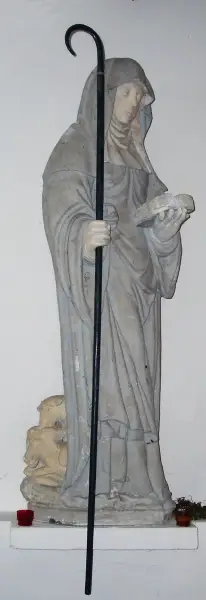
Overview
Austrebertha — Austreberta, Eustreberta — was a Frankish nun and abbess of the seventh century, daughter of the Count Palatine Badefrid and of Saint Framechildis, born around 630 at Thérouanne in Artois. Refusing the marriage arranged for her, she took the veil around 656 at the monastery of Port-le-Grand in Ponthieu, receiving it — the tradition says — from St. Omer, the bishop of Thérouanne. She went on to found a monastery at Marconne on her parents' land in Artois, and later another at Pavilly in the Seine valley, where she served as abbess and where she died on 10 February 704, at about seventy-four. Though little known outside Upper Normandy, she was credited in her lifetime with miracles: a spring that rose in a chapel was said to have fed a river with healing properties for the lame and disabled. Two French towns, in Pas-de-Calais and Seine-Maritime, bear her name. Her most famous legend belongs to the beloved stock of medieval hagiography: the tale of Austrebertha and the wolf, in which a wolf that killed the donkey carrying the nuns' laundry was forgiven by the abbess and took up the donkey's work for the rest of its life.
The Complete Life
A Count's Daughter
Austrebertha was born around 630 at Thérouanne, into the highest rank of the Frankish aristocracy of the region: her father Badefrid held the office of count palatine; her mother Framechildis is herself honored as a saint. It was a household, then, of the kind that filled the abbeys of seventh-century Neustria with daughters — families wealthy enough to endow monasteries and pious enough to found them. The Life that survives was written late, and its details of childhood belong to the conventions of Merovingian hagiography: the pious mother, the daughter drawn to prayer, the arranged marriage approaching like weather. What the historian takes from it is structural: a woman of the landholding class who, at the threshold of a marriage meant to bind two houses, chose instead the new option her world had lately made available — the monastery.
Veil, Marconne, Pavilly
Around 656, refusing the husband selected for her, Austrebertha entered the monastery of Port-le-Grand in Ponthieu, where — the tradition records — she received the veil from St. Omer himself, the aged bishop of Thérouanne. Her career then followed the classic sequence of the aristocratic nun: foundation on family land. At Marconne, in Artois, she established a monastery in her parents' house; the move turned a private estate into a religious community, the standard Merovingian form of both conversion and property settlement. Her major work, however, came at Pavilly, west of Rouen in the Seine valley, where she established the monastery she would govern until her death — one of the women's houses that, in the generations after the founding generation of Frankish nuns, consolidated the Christian landscape of northern Gaul.
Abbess and Wonderworker
Austrebertha's ministry as abbess is remembered in two registers. The first is the institutional: the government of a double community of women, the maintenance of its estates, and — through the liturgy, the schools, and the house's hospitality — the Christianization of the countryside between Rouen and the sea. The second is the legendary: the miracles credited to her in her lifetime and after. The most durable tells of a spring that rose within a chapel through her prayers and fed a river whose waters healed the lame and the disabled — the standard hydrology of Gallic sanctity, attaching the abbey's holiness to the actual waters of its valley. Pilgrimage to her relics at Pavilly continued through the Middle Ages; a chapel in open country at Saint-Denis-le-Ferment, in the Eure, kept a Whit Monday pilgrimage in her name, and some of her relics were said to have been carried to Canterbury by the Normans.
The Wolf
The legend for which Austrebertha is best remembered belongs to her years at Pavilly. Her nuns washed the sacristy linens for the abbey of Jumièges, some leagues distant, and a donkey carried the laundry between the houses. One day, searching for the missing animal, the abbess met a wolf — who confessed to having killed the donkey and begged forgiveness. Austrebertha scolded him, forgave him, and ordered him to take up the donkey's work; and the wolf, the story concludes, carried the laundry between the monasteries for the rest of its life. A chapel was raised where the donkey died; when it fell to ruin a cross replaced it, and an oak with a statue of the Virgin stands there now. The tale is literature, not history — a cousin of the wolf of Gubbio — but it carried the abbess's memory to every generation since, and the stained glass of Sainte-Austreberthe still shows the wolf with his bundle.
Cult
Austrebertha's canonization is of the pre-congregation kind: a tomb at Pavilly, a spreading regional cult, and a feast — 10 February — in the calendars of Normandy and Artois. Two towns carry her name, one in Pas-de-Calais and one in Seine-Maritime, an onomastic legacy that guaranteed her survival in the landscape when the documents failed. She is venerated in the Catholic Church and among the pre-schism saints honored in Orthodox calendars as well.
Legacy
Austrebertha's legacy is that of the Merovingian abbess as a class: the woman who, in a society that married its aristocratic daughters for land, took the one route by which a woman could govern — the monastery — and used it to shape a region. Her houses at Marconne and Pavilly carried the faith and the economy of their valleys for centuries. For the modern reader she is probably the wolf's saint: the woman whose mercy, in the story, was powerful enough to make a predator into a beast of burden. The legend is an invention; the invention is a theology — the claim that the peace of a holy community extends even to what kills it — and it has kept her name alive from the marshes of Ponthieu to the stained glass of Normandy.
Timeline
- 630
Born at Thérouanne, Artois, daughter of Count Palatine Badefrid and St. Framechildis
§ Life
- 656
Refuses an arranged marriage and enters the Port-le-Grand Monastery in Ponthieu
§ Life
- 10 Feb 704
Dies at Pavilly, aged seventy-four
§ Introduction
The Record
- Patron of
- Pavilly·Sainte-Austreberthe (Pas-de-Calais and Seine-Maritime)
- Symbols
- Nun's habit·Wolf (from the legend)
- Canonization
- Pre-congregation; cult in Upper Normandy and Artois
Prayer
Profile text adapted from the Wikipedia article, licensed CC BY-SA 4.0.
Pray with this saint every day
Save St. Austrebertha to your favorites, read the full profile, and get feast-day reminders in the Saints app.
Get the Saints AppFree on the App Store for iPhone and iPad