
died 624·Feast May 20
St. Austregisilus
Bishop of Bourges
Overview
Austregisilus — Outrille or Aoustrille in the French village forms of his name — headed the Frankish see of Bourges as bishop from 612 until his death in 624. Bourges was his birthplace; groomed as a courtier, he joined the household of King Gontram at Chalon-sur-Saône before the pull of the monastic life redirected him: he entered the abbey of Saint-Nizier at Lyon, where in time he became abbot. In 612 he was elected bishop of his native city, the metropolitan see of Aquitaine, and governed it for twelve years. His episcopate is remembered chiefly for the men he formed: he ordained Sulpitius the Pious, who would succeed him after an interval and become one of the most venerated bishops of Gaul, and Saint Amand, the apostle of Belgium, studied under him. The Catholic Church numbers him among its saints; his feast falls on 20 May, and the Berry villages of Saint-Outrille and Saint-Aoustrille, among others, keep his name in the French landscape. In art he appears as a knight on horseback, at times wearing a religious habit over his armor, with a man falling from a horse before him.
The Complete Life
From Court to Cloister
Austregisilus was born at Bourges, the capital of the Bituriges and the metropolitan see of Aquitaine, and his first career was worldly: trained as a courtier, he joined the household of King Gontram at Chalon-sur-Saône. Gontram's court, in the second half of the sixth century, was unusually churchly for a Merovingian establishment — the king was a son of Clotaire I who took seriously the counsel of bishops, and his court nourished the young Gregory of Tours among others. It was presumably in that atmosphere that Austregisilus's desire to become a monk took hold. He left the court for the abbey of Saint-Nizier at Lyon, the house that would soon be governed in succession by several of the century's best-known churchmen, and there he rose to be abbot. Gontram's court was unusually open to episcopal counsel, and the king himself was remembered for his churches and for his respect for bishops, an atmosphere that marked the young courtier.
Bishop and Formator
In 612 the clergy and people of Bourges elected Austregisilus, the native son, as their bishop. The twelve years of his episcopate coincided with the final unraveling and then the brief reunification of the Frankish kingdoms — the reigns of Theuderic II, Chlothar II, and the rise of Dagobert — years in which the Aquitanian church had to be governed with both pastoral and political skill. What the tradition remembers, though, is not politics but formation: he ordained Sulpitius the Pious — Sulpice-le-Dévot, the bishop whose cult spread across France — and Saint Amand, who would evangelize Flanders and the Moselle, studied under him. A bishop's household as a school of bishops was a Merovingian institution, and Austregisilus's is one of the clearest cases of it: two of the greatest names in the Gallic episcopate of the next generation passed through his service. A bishop's household as a school of bishops was a Merovingian institution, and Bourges under Austregisilus is one of the clearest documented cases of it in Gaul.
The Saint of the Berry Villages
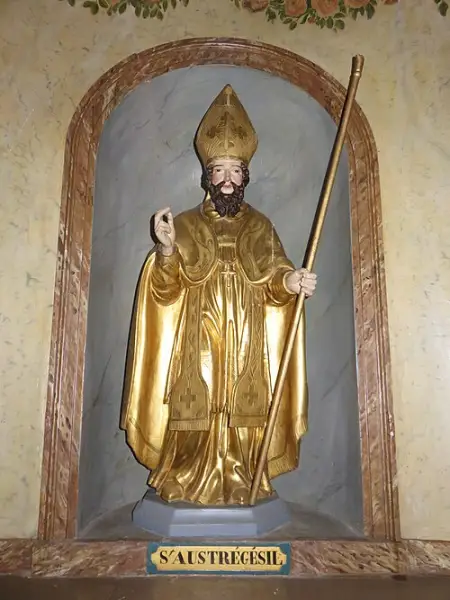
Austregisilus died in 624 and was venerated as a saint from an early period, his feast kept on 20 May in the martyrologies and in the local tradition of Bourges. His name survived in the land most visibly through the villages named for him — Saint-Outrille and Saint-Aoustrille — where local devotion kept his cult when the written record thinned. The iconographic tradition is unusually specific for so obscure a saint: he appears in art as a knight on horseback, at times wearing a religious habit over his armor, and with a man falling from a horse in front of him, an image presumably fixed by a legend of a rider saved or judged at his intercession that no longer survives in writing. Between the courtier-bishop of the annals and the horseman of the statues lies the whole distance of medieval memory, and both are kept. The statue of the knightly bishop in the church of Frontenas keeps the iconographic tradition, and his day is still noted in the calendars of central France.
An Ancient Cult
Austregisilus belongs to the pre-congregation saints of Gaul: no process canonized him, and none was needed, for his standing rests on the immemorial cult of the church of Bourges confirmed by entry into the martyrologies. His feast of 20 May has been the anchor of the commemoration throughout, kept in the local calendars of the Berry and in the general lists. The Greek synaxarist tradition carries him as well, under a hellenized form of his name, with the same day — evidence that his cult circulated in the eastern calendars of the Latin tradition before the parting of the churches. The Ramsgate Benedictines' Book of Saints records him, the older notices of the Catholic Encyclopedia mention him within the entries on his disciples Sulpitius and Amand, and the Biographisch-Bibliographisches Kirchenlexikon preserves a scholarly account of him. The villages named for him — Saint-Outrille and Saint-Aoustrille — are the durable popular memorial of the cult.
Timeline
- 612
Elected bishop of Bourges, after earlier service at King Gontram's court and as abbot of Saint-Nizier in Lyon
§ Life
- 624
Died as bishop of Bourges, having governed the see for twelve years
§ Introduction
The Record
- Patron of
- Bourges, France·Saint-Outrille and Saint-Aoustrille, France
- Symbols
- Knight on horseback·Religious habit worn over armor·A falling horseman
- Canonization
- Pre-congregation (ancient cult in the archdiocese of Bourges)
Prayer
Profile text adapted from the Wikipedia article, licensed CC BY-SA 4.0.
Pray with this saint every day
Save St. Austregisilus to your favorites, read the full profile, and get feast-day reminders in the Saints app.
Get the Saints AppFree on the App Store for iPhone and iPad