
3rd century·Feast November 1
St. Austromoine
First Bishop of Clermont, Apostle of Auvergne
Overview
Austromoine — also Stremonius, Austremonius or Stramonius — is honored as the apostle of Auvergne and the first bishop of Clermont. The legend, transmitted by Gregory of Tours, sets him among the seven bishops dispatched from Rome to preach in Gaul during the consulship of Decius and Vettius Gratus, around 250 — Gatien taking Tours, Trophimus Arles, Paul Narbonne, Saturninus Toulouse, Denis Paris, Martial Limoges, and Austromoine Clermont. At Clermont he is credited with the conversion of the senator Cassius and of the pagan priest Victorinus; Serenus went out from him to Thiers, Marius to Salers and Antoninus to other parts of Auvergne; and his end, tradition says, was beheading. A further tradition makes him the master who ordered Nectarius to Christianize the plain of Limagne. Later medieval piety moved him back into the first century altogether, making him one of the seventy-two disciples, a converted Jew who came from Palestine with Peter. Modern scholarship places him more plausibly among the generation of the Aquitanian bishops who attended the Council of Arles in 314. He was first buried at Issoire on the Couze, and his body translated to the abbey of Mozac in 761.
The Complete Life
The Seven Bishops of Gaul
The founding legend of the Gallic church, given by Gregory of Tours in his Historia Francorum, has Pope Fabian, in the consulship of Decius and Vettius Gratus — about 250 — dispatching seven bishops from Rome to preach the Gospel: Tours received Gatien, Arles Trophimus, Narbonne Paul, Toulouse Saturninus, Paris Denis, Limoges Martial, and Clermont Austromoine. The scheme is too tidy to be history — one apostle for one metropolitan city apiece: it is the Gallic church of the sixth century writing its own apostolic charter. Within it, Austromoine — Gregory calls him Stremonius — is the apostle of Auvergne.
§ Legend
Mission in Auvergne
What the tradition gives him as work is coherent: at Clermont he brought the senator Cassius of Clermont as well as the pagan priest Victorinus to the faith; St. Serenus was sent to Thiers, St. Marius entrusted with Salers, and Antoninus given the rest of Auvergne — a missionary organization, with the bishop at Clermont sending priests out to the towns about; and one strand of tradition gives him a martyr's death by beheading, though the cult that followed is essentially episcopal rather than martyrial. Another tradition makes him give Nectarius of Auvergne the task of Christianizing the Limagne plain, in the Massif Central.
§ Legend
The Rewriting of a Saint
Austromoine's dossier is a case study in hagiographic inflation. Local devotion at Clermont moved him back into the first century AD, alongside other 'Apostles to Gaul' such as Martial of Limoges, and claimed him as one of the seventy-two disciples of Christ — a Jew, converted out of his old faith, who had traveled with St. Peter from Palestine to Rome before becoming apostle of Auvergne, Berry and Nivernais. The likelier kernel of the tradition is that he belonged to the generation of the three bishops of Aquitaine present at the Council of Arles in 314. His Vita was written in the tenth century at the abbey of Mozac — his body had been brought there in 761 — and was later reworked and enlarged by the monks of Issoire, custodians of the saint's head as their relic; a late eleventh-century Vita added new episodes alongside a forged charter of Pippin. The tomb was opened in 1197.
§ Veneration
Legacy
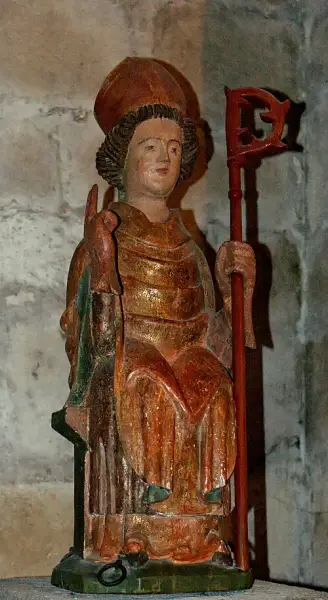
Austromoine remains the apostle of Auvergne in the church's memory: patron of the region, first bishop of a see that continues at Clermont, his statue — like the seventeenth-century wood figure at Issoire — dotting the Auvergnat churches. For historians he is a warning and a window: a saint whose historical details lapsed so completely that each generation supplied what local pride required, from Gregory's seven missionaries to Mozac's apostle of the seventy-two.
§ Veneration
Timeline
- 250
Sent by Pope Fabian with six other bishops from Rome to evangelize Gaul, receiving Clermont, during the consulship of Decius and Vettius Gratus
§ Legend
- 314
Now more plausibly dated as living at the same time as the three Aquitanian bishops present at the Council of Arles
§ Veneration
- 761
His body was transferred to the Abbey of Mozac
§ Veneration
- 900
A life of Austremonius was written in the 10th century at Mozac and later amplified by the monks of Issoire, who kept his head as a relic
§ Veneration
- 1197
His tomb at Issoire was opened
§ Veneration
The Record
- Patron of
- Auvergne·Clermont
- Symbols
- Bishop's crozier·Apostolic mission from Rome·Martyr's palm
- Canonization
- Pre-congregation
Prayer
Bibliography
Show 5 sources
- ↑ Gregory of Tours. Historia Francorum , i.30
- ↑ Melton, J. Gordon. Faiths across Time: 5,000 Years of Religious History , Bloomsbury Publishing USA, 2014, p. 342 ISBN 9798216083061
- ↑ Goyau, Georges. "Diocese of Clermont." The Catholic Encyclopedia Vol. 4. New York: Robert Appleton Company, 1908. 12 April 2019 This article incorporates text from this source, which is in the public domain .
- ↑ Van den Akker S.J., A. (2009). "Nectarius van St-Nectaire" . Heiligen-3s.
- 1 2 Havey, Francis. "St. Austremonius." The Catholic Encyclopedia Vol. 2. New York: Robert Appleton Company, 1907. 12 April 2019 This article incorporates text from this source, which is in the public domain .
Profile text adapted from the Wikipedia article, licensed CC BY-SA 4.0.
Pray with this saint every day
Save St. Austromoine to your favorites, read the full profile, and get feast-day reminders in the Saints app.
Get the Saints AppFree on the App Store for iPhone and iPad