
c. 400-473·Feast February 14
St. Auxentius of Bithynia
Hermit of Mount Scopas, Priest and Archimandrite
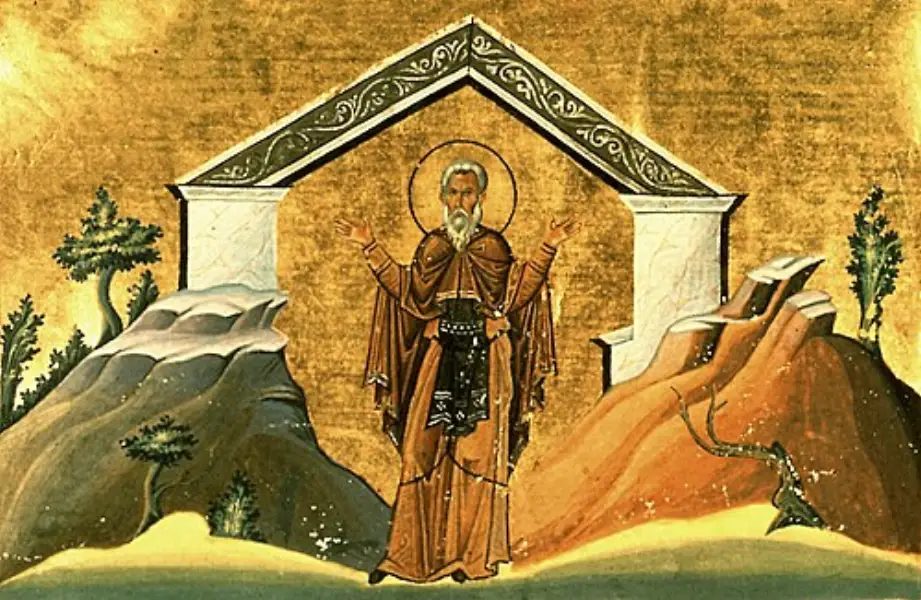
Overview
Auxentius of Bithynia was a hermit of the fifth century, born of Persian ancestry in Syria around the year 400, who died on February 14, 473, on the mountain east of Constantinople that came to bear his name. Entering the service of the Byzantine state, he served in the Equestrian Guard of the emperor Theodosius II, then abandoned the court for the life of a solitary monk on Mount Oxia near Constantinople. Shepherds out searching for their strayed sheep lighted on his hermitage, and thereafter the sick began to come to him for healing, forcing on him the reputation he had fled the capital to escape. In 451 he attended the Council of Chalcedon, the defining council of the age, which confessed the two natures of Christ; afterward he established a new hermitage on Mount Scopas in Bithynia, close by Chalcedon; many sought him out there for counsel, and there he devoted the remainder of his life to mortification and the instruction of a growing body of disciples. The Roman Martyrology commemorates him as a priest and archimandrite who, keeping to a hill as though it were a cathedra, upheld the Chalcedonian faith with a powerful voice. Vendemianus, his disciple, lived forty-two years on a cliff near his hermitage. He is venerated in the Eastern Orthodox, Byzantine Catholic, and Roman Catholic churches.
The Complete Life
Early Life
Auxentius was born about the year 400 in Syria, of Persian ancestry, a detail that places his family among the many Iranians, Christian, Jewish, and Zoroastrian, who lived within and around the Roman frontier in the generations of peace and war between the empires. The fourth and fifth centuries saw a steady movement of such families into Roman service, and Auxentius followed that path: he entered the Equestrian Guard, the mounted imperial guard, under Theodosius II, the long-reigned emperor under whom Constantinople consolidated its institutions and its walls. A soldier of the guard lived at the centre of the world's power and spectacle; that Auxentius exchanged it for a cave on a mountain says much about the direction of his inner life, which the tradition describes as an early and deep attraction to solitude. The transition from guardsman to monk was common enough in the fifth century to form a recognized type, the soldier-saint, but Auxentius belongs to its contemplative rather than its military branch: he laid down arms entirely, and his warfare thereafter was the invisible one of the desert tradition.
Vocation
Auxentius' vocation was tested, like most hermits' vocations, by success. Leaving the court, he settled as a solitary on Mount Oxia near Constantinople, intending to be unknown; the plan failed when shepherds, searching for their lost sheep, found him instead, and the discovery could not be kept. Sufferers from illness made their way to him for healing, and the reputation he had fled the capital to avoid grew around his cave. His response was not to exploit the fame but to move: after attending the Council of Chalcedon in 451, he withdrew to a new hermitage atop Mount Scopas in Bithynia, across from Chalcedon on the Asian side, further from the crowds of the capital, a mountain that became known from him as Mount Auxentius, whose modern Turkish name is Kayış Dağı. Even there the world followed, and the second half of his life became a compromise the tradition regards as heroic: he remained the solitary, but accepted ordination as priest and the office of archimandrite, becoming the spiritual father of a mountain of disciples and visitors who resorted to him for advice, while keeping his own cell and his own discipline unchanged.
Mission
Auxentius' mission had a public and a private face. The public face was doctrinal: the Roman Martyrology's notice, drawing on his life, commemorates the man who held a hill as though it were a cathedra and with a powerful voice defended the Chalcedonian faith. His presence at the Council of Chalcedon in 451, and his subsequent settlement near the city of the council, made him a living link between the conciliar definition and the ascetic world whose support the definition needed; in the decades after Chalcedon, when monastic opinion was dangerously divided over the two natures of Christ, a hermit of Persian birth who taught the council's doctrine on a mountain overlooking the capital performed a real service to the church's unity. The private face of his mission was the forming of disciples through example. Mortification and instruction claimed the rest of his life, and his hermitage became the nucleus of a monastic settlement. The most famous of his students, Vendemianus of Bithynia, spent forty-two years on a mountain cliff beside Auxentius' hermitage — a life modelled on the master's and proving the durability of his teaching.
Final Years
Auxentius died on February 14, 473, on Mount Scopas, though the tradition also gives the year as about 470; he would have been in his early seventies. His last years were the full pattern of the elderly hieromonk-hermit: the cell kept, the discipline unrelaxed, the stream of visitors received, the disciples instructed, and the body gradually worn down by the mortifications of a lifetime. The mountain that had received him as an unknown guardsman-turned-monk now bore his name, and the community that had grown up around his cell would continue after his death as a monastery, one of the many foundations of the Bithynian monastic landscape between Constantinople and Nicomedia that made the region a second desert for the capital's devout. He was buried on his mountain, and his cult began there immediately, confirmed by the healing reputation that had followed him through life. His feast on February 14 has been kept in the Byzantine and Roman traditions, the Roman Martyrology preserving the summary of his life and doctrine in its entry for the day.
Legacy
The legacy of Auxentius is the mountain that bears his name and the monastic lineage it sustained. Mount Auxentius, modern Kayış Dağı, kept his memory through the Byzantine centuries, and the sketes and houses of the Bithynian Olympus country to which he belonged formed one of the heartlands of Orthodox monasticism until the Turkish conquests ended them. His disciple Vendemianus, whose forty-two years on the neighbouring cliff continued the master's pattern, was himself honoured as a saint, so that the Auxentian tradition shaped at least two generations of Bithynian solitaries. The Roman Martyrology's phrase, that he lived on his hill as if on a cathedra, has fixed his image for the western church: the hermit whose solitude was a pulpit, teaching by presence what councils define by words. He is honoured in the Eastern Orthodox, Byzantine Catholic, and Roman Catholic churches, and his life remains a standing reminder that the defence of doctrine was once carried as much by the reputations of holy men as by the pens of theologians.
Timeline
- 400
Born in Syria of Persian ancestry, around this year
§ Introduction
- 451
Attends the Council of Chalcedon
§ Life
- 451
After the council, establishes a new hermitage atop Mount Scopas in Bithynia, near Chalcedon
§ Life
- 14 Feb 473
Dies on Mount Scopas on 14 February; one source says about 470
§ Introduction
The Record
- Major works
- Bithynian monastic community on Mount Scopas (as priest and archimandrite)
- Patron of
- Mount Auxentius (Kayış Dağı), near Constantinople
- Symbols
- Soldier's cloak laid aside·Mountain and cave of Scopas·Archimandrite's staff
- Canonization
- Pre-congregation; venerated in Eastern Orthodox, Byzantine Catholic, and Roman Catholic Churches
Prayer
Profile text adapted from the Wikipedia article, licensed CC BY-SA 4.0.
Pray with this saint every day
Save St. Auxentius of Bithynia to your favorites, read the full profile, and get feast-day reminders in the Saints app.
Get the Saints AppFree on the App Store for iPhone and iPad