
8th century
St. Aventin
Hermit of the Valley of Larboust
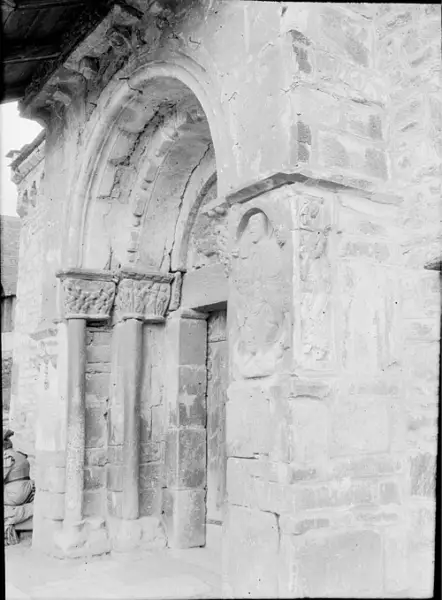
Overview
Saint Aventin was a Frankish hermit of the eighth century, born near Bagnères-de-Luchon in the central Pyrenees, who lived as a hermit in the valley of Larboust, the high-walled valley above Luchon. The legends that gathered at his shrine credit him with many wonders. In one, he was captured by Saracen invaders — the Arab and Berber raiders who harried the southern slopes of the Pyrenees in the eighth century — and locked in the tower of Castel-Blancat at Saccourvielle; he made his escape by leaping from the tower's summit, sailing over the whole valley, and landing unhurt on the far side, leaving his footprint printed in a stone still shown at the threshold of the chapel built on the spot. In another, he was beheaded and picked up his head, walking to the place of his tomb; centuries later the spot was revealed to a shepherd, and the remains were loaded onto a cow-drawn sledge, which halted at the spot where the village of Saint-Aventin stands today. After his death the region suffered plague, and the people invoked his protection. His Romanesque church at Saint-Aventin keeps his memory.
The Complete Life
Hermit of Larboust
Aventin was born near Bagnères-de-Luchon, the spa town under the central Pyrenees, and lived in the eighth century, in the Frankish duchy of Aquitaine's mountain marches. His choice of life was the oldest in the region's Christianity: the hermit's cell in the valley of Larboust, the glacial trough that climbs from Luchon toward the Spanish frontier, walled by peaks whose passes the Saracens and the Basques both used. What he did there is what hermits do — prayed, fasted, worked a little ground, and received the mountain people who came for counsel — and the valley's memory made him the father of its Christianity. The eighth century in these valleys was also the era of the Muslim raiders' presence on the south slopes and of the wars that ended at Poitiers; the legends that grew around Aventin carry the memory of that violence, transformed by the confidence that the hermit was beyond its reach.
The Legends
The legends of Aventin are of the classic mountain type, borrowed freely from the great repertoire. Captured by Saracen invaders, he was shut up in the tower of Castel-Blancat at Saccourvielle; he escaped by leaping from the tower's summit, clearing the whole valley in a single bound, and landing unharmed on the far side, his footprint printed in a stone — still visible, so the local tradition holds, at the threshold of the chapel built on the landing-place. In another story he was beheaded, and the cephalophore walked, head in hands, to the place where he wished to be buried. Centuries later the location was revealed to a shepherd, and the saint's remains were loaded onto a sledge drawn by cows, which halted of its own accord at the spot where the village of Saint-Aventin stands today — the oxen-drawn cart of the inventio, standard equipment of the medieval relic.
Cult
Aventin's cult belongs wholly to the upper Garonne country. After his death the region suffered an outbreak of plague, and the population appealed to his protection, founding the pilgrimage that became the village of Saint-Aventin; the invocation against plague and, in the pastoral economy, for the health of livestock, made him the valley's practical patron. The Romanesque church of Saint-Aventin, with its celebrated carved porch and its images of the saint, stands over the shrine and is counted among the mountain churches of the Luchon country. His feast belonged to the local calendars, and the valley's parishes kept his memory into modern times. He was never formally canonized, his is the pre-congregation sanctity of the Pyrenean hermits, whose histories are legends and whose shrines are stones.
Legacy
Aventin is one of the band of Pyrenean hermits — with Exupère, Gaudens and their fellows — whose names mark the high valleys and whose legends blend the desert fathers with the mountain folklore of jumps, footprints and self-drawn sledges. For the history of the region he documents the Christian settlement of the Luchon country in the Frankish period, the memory of the Saracen raids kept in stone, and the plague-era devotions that fixed the map of the cult. The village and church of Saint-Aventin carry his name, and the footprint in its chapel still receives the credulous and the curious. This profile is marked thin_source: the written record is the legend and the landscape, and no more honest account can be given.
The Record
- Patron of
- Luchon and the Larboust valley·Against plague and illness of livestock
- Symbols
- Wolf·Hermit's staff·Stone bearing his footprint
- Canonization
- Pre-congregation
Prayer
Profile text adapted from the Wikipedia article, licensed CC BY-SA 4.0.
Pray with this saint every day
Save St. Aventin to your favorites, read the full profile, and get feast-day reminders in the Saints app.
Get the Saints AppFree on the App Store for iPhone and iPad