
died 1180·Feast May 5
St. Aventinus of Tours
Hermit of Tours and friend of Thomas Becket
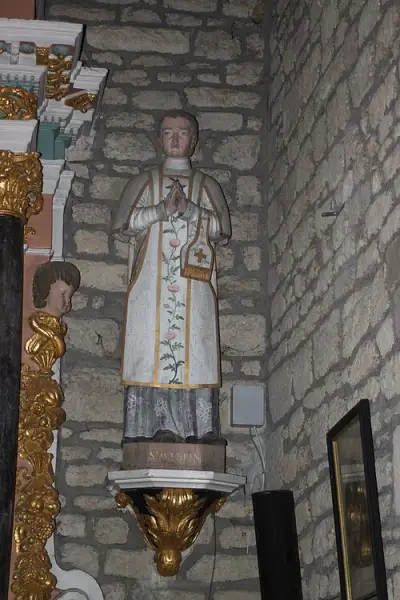
Overview
Aventinus of Tours was a French hermit of the twelfth century whose memory is inseparable from that of Saint Thomas Becket. He lived a solitary, prayerful existence at Tours, in the Loire valley, devoting himself to contemplation apart from the world. His reputation for holiness drew the attention of Becket, then archbishop of Canterbury, who ordained Aventinus to the diaconate. The new deacon remained close to the archbishop and traveled with him to the Synod of Tours in 1163, standing beside one of the most consequential churchmen of medieval Europe. When Becket was cut down in his cathedral in 1170, Aventinus withdrew to Touraine, the countryside around Tours, where he passed the remainder of his days in quiet retirement and prayer until his death in 1180. The Roman Catholic Church honors him with a feast on 5 May. Although the surviving record of his life is brief, it preserves the picture of a man who chose the desert of the hermitage over preferment, who served a martyred archbishop as friend and deacon, and who closed his life in the same region of France where his holiness had first become known. His cult belongs to that numerous company of humble medieval solitaries whose sanctity was witnessed less by written works than by the esteem of the saints who knew them.
The Complete Life
The Hermit Who Became Becket's Deacon
The vocation of Aventinus unfolded in two movements: first the solitude of the hermit's cell, then the service of the diaconate. Before anything is recorded of his public life, Aventinus appears as a solitary at Tours in France, a man who had given himself to prayer and penance outside the structures of ordinary clerical career. This eremitical beginning matters, for it explains the freedom with which he later attached himself to Thomas Becket. He was not a courtier seeking advancement but a contemplative who recognized holiness when he encountered it. Becket, archbishop of Canterbury and the most embattled churchman of his generation, ordained Aventinus to the diaconate, receiving into sacred orders a man already formed by long discipline of silence. The ordination joined the hermit to the archbishop's household, and Aventinus became his companion in the struggles that filled Becket's exile-ridden episcopate. In 1163 the deacon traveled with the archbishop to the Synod of Tours, an assembly that gathered the church of Gaul while Becket's contest with King Henry II over the liberties of the Church was gathering force. Aventinus thus stood near the center of the great church-state conflict of the twelfth century, not as a polemicist but as a praying deacon beside a besieged prelate. His friendship with the archbishop was the decisive relationship of his life, and it was sealed, in the providence of God, by the blood Becket would shed in 1170. For Aventinus, the martyrdom of his friend and ordinand became the hinge that turned him back toward the solitude from which he had come.
§ Aventinus of Tours
Retirement in Touraine
After Thomas Becket was murdered in Canterbury Cathedral on 29 December 1170, Aventinus left the circles in which he had moved and settled in Touraine, the fertile province of which Tours is the center. There he remained for the last decade of his life, until his death in 1180. The sources do not detail the manner of his retreat, whether he resumed a hermit's enclosure or lived simply as a religious recluse among the people of the countryside, but the shape of the choice is clear: the deacon of a martyred archbishop withdrew from publicity into obscurity. These years coincide with the period in which Becket's cult was exploding across Europe — the archbishop was canonized in 1173, only three years after his death, and pilgrims began streaming to Canterbury. Aventinus, who had known the martyr personally and had received orders at his hands, lived out those same years in the comparative quiet of the Loire valley. His own death in 1180 closed a life that had touched greatness without claiming any of its rewards. The Church remembers him on 5 May, honoring a man whose holiness was attested less by documents than by the company he kept. His story survives chiefly because of that connection, and it invites the reader to consider how many obscure servants of God stand, unrecorded, beside the great figures of history. Aventinus of Tours remains a patron-like witness to friendship with the saints, to the dignity of the diaconate, and to the hermit's vocation lived to the end.
§ Aventinus of Tours
Timeline
- 1163
Ordained a deacon by Thomas Becket, then went with him to the Synod of Tours.
§ Introduction
- 1170
After Becket's martyrdom, withdrew to Touraine, where he settled permanently.
§ Introduction
- 1180
Died in Touraine, having lived there as a hermit until his death.
§ Introduction
The Record
- Symbols
- Hermit's habit·Deacon's stole
- Canonization
- Pre-congregation; venerated in the Roman Catholic Church
Prayer
Bibliography
Show 1 sources
Profile text adapted from the Wikipedia article, licensed CC BY-SA 4.0.
Pray with this saint every day
Save St. Aventinus of Tours to your favorites, read the full profile, and get feast-day reminders in the Saints app.
Get the Saints AppFree on the App Store for iPhone and iPad