
c. 525 – c. 600·Feast August 21
St. Avitus I of Clermont
Sixth-century Bishop of Clermont and apostle to the Jews of Auvergne
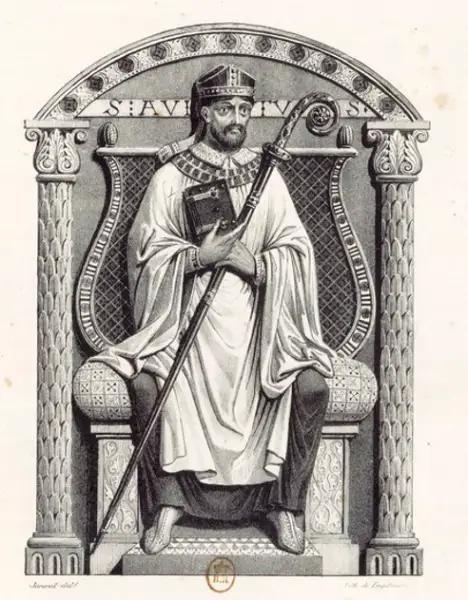
Overview
Avitus, known in French as Avit de Clermont, was a bishop of Clermont in sixth-century Auvergne, born probably in 525 and dying around 600. He came from the Roman Avitii family, a noble line connected with the emperor Avitus, and entered the episcopate in 571 when Bishop Cautinus died of the plague. His long reign coincided with the turbulent first generation of Frankish Catholic rule in Gaul, and the chronicle of Gregory of Tours, his contemporary, preserves the central episodes of his career. The most dramatic of these came in 576, when Avitus's preaching among the Jewish community of Clermont led to a celebrated conversion: a Jewish man accepted baptism at Easter and joined the city's procession, was publicly insulted by a coreligionist, and was defended by the bishop against a crowd ready to stone the offender. Weeks later, after further processions and an ultimatum from Avitus, some five hundred Jews of the city accepted baptism rather than exile. In 580 Avitus founded the Basilica of Notre-Dame du Port in Clermont, a church that still stands. Local tradition also credits him with a healing spring at Menat. A church council held at Clermont around 590 may have counted him among its participants, and he died near the close of the century, honored in both the Orthodox and Catholic calendars on 21 August.
The Complete Life
From the Avitii to the Chair of Clermont
Avitus was born about the year 525, a child of the late Roman aristocracy of Gaul. His family, the Avitii, claimed kinship with the emperor Avitus, the short-lived western ruler of the 450s, and belonged to that senatorial class from which the Gallic church of the sixth century drew so many of its bishops. His early life is unrecorded, but his elevation to the episcopate is fixed by the pestilence that swept Auvergne: in 571 Bishop Cautinus of Clermont died of the plague, and Avitus was chosen to succeed him. He would have been around forty-six years old at his consecration, and he governed the see for almost thirty years. The Auvergne into which he was consecrated had been Catholic for barely two generations under Frankish rule and retained a substantial Jewish community, an old pagan substratum in the countryside, and the wounds of the civil wars of the sons of Clovis. His contemporary and chief chronicler, Gregory of Tours, knew him personally and reports both his pastoral action and his family connections without ornament. That Avitus's name also entered the martyrologies of both the Orthodox East and the Latin West testifies to the reputation he carried beyond his own province. He rounded out his episcopate with practical achievements as well: in 580 he founded the Basilica of Notre-Dame du Port in Clermont, and around 590 he may have participated in a council of the church held in his cathedral city. He died about 600, some seventy-five years old.
§ Biography
Preaching, Conversion, and Coercion at Clermont
The event that most defines the memory of Avitus occurred in 576 and is known through Gregory of Tours. The bishop had long prayed and preached for the conversion of the Jews of Clermont. At Easter of that year one of their number accepted baptism and, newly chrismated, walked in the Easter procession through the city. As he passed, another Jew poured rancid oil over his head from a window above. The Christian crowd, outraged, sought to stone the offender on the spot; Avitus forbade the violence and spared the man. Tension continued to mount. On the feast of the Ascension, while the bishop led another procession, a Christian mob attacked the Jewish synagogue of Clermont and burned it to the ground. Avitus then sent the community a message whose terms Gregory preserves: he claimed no coercive power over their consciences — he preached the Son of God and offered the salt of wisdom — but likened himself to a shepherd charged with gathering into one flock sheep that belonged to the Lord, and concluded that those unwilling to believe should depart from the place. Three days later, according to the chronicle, some five hundred members of the Jewish community accepted baptism rather than leave the city. The episode presents the sixth-century mission in all its ambiguity: a bishop who restrained a lynching and disclaimed force, yet whose ultimatum left conversion or expulsion as the only alternatives. Later readers have found in it matter both for admiration of his zeal and for sober reflection on the conjunction of preaching and civic power in Merovingian Gaul.
§ Conversion of Jews
The Spring at Menat
Alongside the chronicle record of his public career, a gentler local tradition remembers Avitus as a healer. It is told that he once visited Menat, a village in the Auvergne, where sick children were brought to him. As he prayed among them, a spring of water broke from the ground — the fountain still known as Saint-Avit — and the children who bathed or drank from it were restored to health. The story belongs to the vast family of hagiographic spring legends that dot the landscape of France, in which a saint's presence or prayer calls forth water and the water carries blessing. What gives the Menat tradition its particular interest is its modesty: no elaborate miracle story attaches to it, only the memory of a bishop's compassion for suffering children and of a fountain that became a place of pilgrimage. Springs named for saints frequently mark pre-Christian sacred sites Christianized by association with a holy man, and the persistence of the name Saint-Avit into modern times shows how durably the bishop's presence was written onto the land. The healing ministry the tradition implies is consistent with the picture of Avitus that emerges from Gregory of Tours: a pastor close to his people, physically present in the towns and villages of his diocese, attentive to the sick and the young. The spring at Menat continues to draw pilgrims, and the pilgrimage was still being reported in the local press of the twentieth century, so that the spirituality of Avitus — prayer made tangible in water, blessing offered to the weakest — remains accessible to any visitor to the valley.
§ Miracle
Notre-Dame du Port and an Enduring Cult
The most concrete monument of Avitus's episcopate is the Basilica of Notre-Dame du Port in Clermont, which he founded in 580. Rebuilt in the Romanesque period after destructive fires, the church that stands today over his original foundation became one of the great pilgrimage churches of the Auvergne, home to a revered image of the Virgin, and was inscribed by UNESCO as part of the World Heritage listing of the roads to Santiago de Compostela. That a bishop of the sixth century should have set in motion an institution still living, still prayed in, and still honored by the world's cultural authorities more than fourteen centuries later is the clearest measure of his legacy. His cult is likewise durable. He is venerated as a saint both in the Eastern Orthodox Church and in the Roman Catholic Church, an unusual double commemoration that reflects the unity of the early medieval Church and the thoroughness with which the Latin martyrologies were received in the East. His feast falls on 21 August. Pilgrimage to the spring of Saint-Avit at Menat keeps his healing reputation alive, and the basilica he founded carries his name in its own history. Finally, his administration of the crisis of 576, whatever judgment later ages pass upon it, remains a fixed reference point for historians studying the position of Jewish communities in Merovingian Gaul, so that Avitus continues to be cited each time that difficult chapter of Christian history is honestly examined.
§ Biography
Timeline
- 525
May have been born this year into the Roman Avitii family connected with Emperor Avitus
§ Biography
- 571
Became Bishop of Clermont after Bishop Cautinus died of plague
§ Biography
- 576
A Jew of Clermont accepted baptism at Easter after the bishop's preaching, and was insulted with stinking oil during the Easter procession
§ Conversion of Jews
- 576
During an Ascension procession a Christian mob burned the Clermont synagogue, and three days after the bishop's message some 500 Jews accepted baptism
§ Conversion of Jews
- 580
Founded the Basilica of Notre-Dame du Port in Clermont
§ Biography
- 590
Possibly attended a church council held at Clermont in or near this year
§ Biography
- 600
Died around this year after nearly three decades as bishop of Clermont
§ Biography
In Their Own Words
I do not compel you by force to confess the Son of God... but nevertheless I preach him and I offer to your hearts the salt of wisdom.
The Record
- Major works
- Basilica of Notre-Dame du Port, Clermont (founded 580)
- Symbols
- Bishop's vestments·Spring of healing water (fontaine Saint-Avit)
- Canonization
- Pre-congregation; venerated in the Eastern Orthodox Church and the Roman Catholic Church
Prayer
Bibliography
Show 4 sources
- Latin Saints of the Orthodox Patriarchate of Rome. orthodoxengland.org.uk. Retrieved 15 August 2024.
- St. Avitus I of Clermont, Vela de Jerusalen (santosepulcro.co.il), retrieved 6 July 2023.
- Gregory of Tours, A History of the Franks, Pantianos Classics, 1916.
- Le pèlerinage de Saint Avit, La Montagne, 7 September 2015 (ISSN 0767-4007).
Profile text adapted from the Wikipedia article, licensed CC BY-SA 4.0.
Pray with this saint every day
Save St. Avitus I of Clermont to your favorites, read the full profile, and get feast-day reminders in the Saints app.
Get the Saints AppFree on the App Store for iPhone and iPad