
c. 450 – 517/519·Feast February 5
St. Avitus of Vienne
Latin poet, bishop of Vienne, and converter of a Burgundian king
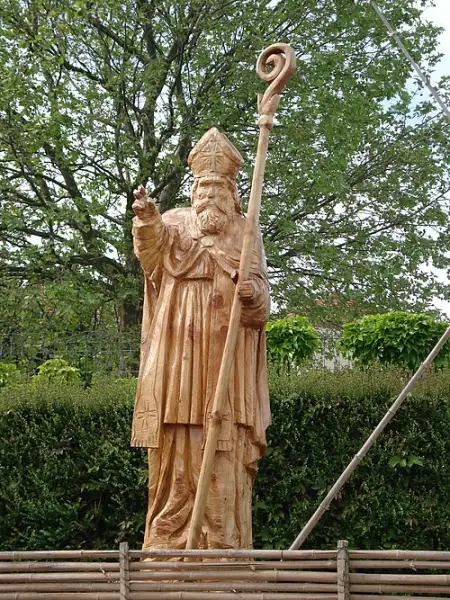
Overview
Alcimus Ecdicius Avitus, born around 450 and dying between 517 and 519, served as bishop of Vienne in Gaul and also wrote Latin poetry; memory keeps him for both gifts, and for his work as secretary and counselor to the Burgundian kings. He came from a distinguished Gallo-Roman family of senatorial rank that claimed kinship with the emperor Avitus; Hesychius, his father, had held the see of Vienne before him, where episcopal office ran informally in the family; his brother Apollinaris became bishop of Valence and his sister Fuscina a nun. Probably born at Vienne, he was baptized by Bishop Mamertus and ordained bishop of Vienne around 490. He won the confidence of the Arian king Gundobad, led a conference of Catholic and Arian bishops at Sardiniacum near Lyon, and converted the king's son Sigismund to Catholicism. Pope Hormisdas named him vicar apostolic in Gaul, in which capacity he presided at the Council of Epaon in 517 for the restoration of ecclesiastical discipline in Gallia Narbonensis, and he labored to heal the Acacian schism between Rome and Constantinople. His fame as a writer rests on ninety-six surviving letters, primary sources for the years 499 to 518, and on a five-book biblical poem in hexameters on original sin, the Flood, and the Red Sea — a paraphrase that Milton is said to have used in writing Paradise Lost.
The Complete Life
A Senatorial Family of Vienne
Avitus was born about the year 450 into one of the great Gallo-Roman families of southern Gaul. His father Hesychius was bishop of Vienne, and in that see episcopal honors passed informally from one generation to the next, so that the son was raised with the expectation of the office he would one day hold. The family claimed kinship with the emperor Avitus, and Avitus's paternal grandfather was himself a western Roman emperor whose precise identity the sources do not fix — a measure of how thoroughly the dynasty was woven into the fading fabric of imperial aristocracy. His younger brother Apollinaris became bishop of Valence and his sister Fuscina embraced the religious life as a nun, so that an entire generation of the family was given to the service of the Gallic church. Avitus was probably born at Vienne itself, since it was Bishop Mamertus — the liturgical innovator of the Rogation days — who baptized him. He grew up in the last decades of effective Roman administration in Gaul, educated in the schools of rhetoric that were then still functioning, and he mastered that late classical art so completely that later critics would rank him among its final exemplars. The formation of those years — scripture read through the discipline of classical verse, doctrine argued with the cadences of the schools — determined the whole shape of his career, in which the poet and the bishop would never be separated.
§ Life
Bishop of a Conquered City
Around 490 Avitus was ordained bishop of Vienne, taking up the chair his father had occupied. The city he inherited was under mounting Burgundian pressure: in 499 Vienne fell to Gundobad, the Arian ruler of the Burgundians, who was then warring against Clovis, king of the Franks. That conquest might have reduced the Catholic bishop to irrelevance; instead it created the mission of Avitus's life. As metropolitan of southern and eastern Gaul he took the lead in a conference convened between the Catholic and Arian bishops in the presence of Gundobad at Sardiniacum near Lyon — a theological encounter staged before the very ruler whose Arianism it addressed. Avitus won the confidence of the king, who retained him as secretary and counselor, and through that trusted position he reached the king's son Sigismund, whom he converted to the Catholic faith. The conversion of Sigismund, who would reign after his father, was among the most consequential pastoral achievements of the early sixth century, shifting the religious alignment of a Germanic kingdom. Avitus's own view of his office was exalted and Roman: a letter of Pope Hormisdas records that the pontiff made him vicar apostolic in Gaul, and in that capacity he presided at the Council of Epaon in 517, convened to restore ecclesiastical discipline in Gallia Narbonensis. He likewise exerted himself to end the long quarrel between the churches of Rome and Constantinople that had followed the excommunication of Acacius, and his later correspondence suggests the breach was mended before his death.
§ Life
Between Two Kings and Two Creeds
The mission of Avitus was conducted in the narrow space between an Arian court and a Catholic population, and his surviving letters let us watch him work. His correspondence documents the close relations between the Catholic bishop of Vienne and the Arian Gundobad on one side and the Catholic convert Sigismund on the other — a triangle in which preaching, diplomacy, and personal confidence all carried the faith forward. He wrote also to the Franks. His most famous letter is the one he addressed to Clovis on the occasion of the king's baptism, and its tone is revealing: Avitus greets Clovis not as a pagan convert but as a recent sympathizer with Arianism, possibly even still a catechumen, correcting gently and congratulating warmly. The letter belongs to the debate over the date and character of Clovis's conversion and is one of the principal primary sources for it. At the same time Avitus acted as a vigorous defender of Roman primacy. Like his contemporary Ennodius of Pavia, he insisted that the Apostolic See was the chief bulwark of religious unity in an emerging Christian civilization, and he argued in his letters that if the bishop of Rome were called in question the whole episcopate would seem to waver, not merely one bishop. That conviction drove his effort to close the Acacian schism, which had divided Rome and Constantinople for a generation, and it shaped his presidency at Epaon in 517. His death came shortly afterward, after Epaon and before the Council of Lyon of 519, and he was buried in the monastery of Saints Peter and Paul at Vienne.
§ Life
Poet of the Fall and the Flood
The inner life of Avitus shows itself above all in his major poem, the Poematum de Mosaicae historiae gestis, whose other title is De spiritualis historiae gestis: classical hexameters in five books treating original sin, the expulsion from Paradise, the great Flood, and Israel's crossing of the Red Sea. The opening three books possess a genuine dramatic unity, setting out the events that led up to the great disaster, the catastrophe proper, and its consequences; the fourth and fifth treat the Flood and the passage of the sea as figures of baptism, so that the poem moves from loss to regeneration. Avitus handled the scriptural narratives freely and familiarly, exhibiting what his admirers saw as their beauty, sequence, and significance, and he did so as one of the last masters of the rhetorical art taught in the schools of fourth- and fifth-century Gaul. His diction, though it abounds in archaisms and a certain rhythmic redundancy, remains pure and select, and he keeps the rules of meter with care. For the poem he also wrote a companion piece for his sister Fuscina, the nun, in praise of consecrated chastity. His spirituality was thus scriptural, sacramental, and literary at once: the history of salvation rendered in meter, baptism understood as the true crossing of the sea, virginity honored as a foretaste of heaven. A collection of his homilies and sermons once existed, but all perished except two and some fragments — a loss that leaves the poems and letters as the chief window into a mind in which classical culture and Catholic faith had become one substance.
§ Writings
Letters, Forgeries, and a Glimpse of Milton
Avitus left a double legacy: to historians, an archive; to poets, a precedent. His ninety-six surviving letters, as counted by his recent editors, constitute one of the important primary sources for the political, religious, and social history of the years 499 to 518, and set him beside Sidonius Apollinaris, Ruricius, and Ennodius among the four Gallo-Roman aristocrats of the era whose correspondence survives in quantity. Through them we know the court of Gundobad, the conversion of Sigismund, the baptismal congruences of Clovis, and the mind of a bishop who saw the Roman see as the guarantee of Christian unity. To the literary tradition he left the biblical poem, of which the Catholic Encyclopedia article by Thomas Joseph Shahan makes the striking claim that Milton drew on Avitus's paraphrase of Scripture in composing Paradise Lost. The Life's afterlife has not been without complications: a work known as the Dialogues with King Gundobad, once attributed to Avitus and purporting to record a colloquy of 449, was shown by Julien Havet in 1885 to be a forgery of the Oratorian Jérôme Vignier, who also fabricated a letter purporting to come from Pope Symmachus — a cautionary tale in the handling of Avitinian remains. Modern scholarship has restored the corpus with rigor: Danuta Shanzer and Ian Wood translated the selected letters and prose, and Michael Roberts edited and translated the biblical and pastoral poetry for the Dumbarton Oaks Medieval Library, so that the bishop-poet of Vienne is today more fully readable than at any time in centuries.
§ Writings
Timeline
- 450
Born into the senatorial aristocracy of Gaul around this year, reckoned kin of the emperor Avitus, most likely at Vienne.
§ Introduction
- 490
Ordained bishop of Vienne around this year, succeeding his father Hesychius in a see where episcopal office ran in the family.
§ Life
- 499
Vienne fell to the Burgundian king Gundobad, then at war with the Frankish king Clovis, and Avitus came to that ruler's attention.
§ Life
- 499
As metropolitan of southern and eastern Gaul, led a conference of Catholic and Arian bishops before Gundobad at Sardiniacum near Lyon.
§ Life
- 517
Presided as vicar apostolic of Gaul, an office granted by Pope Hormisdas, at the Council of Epaon restoring discipline in Gallia Narbonensis.
§ Life
- 5 Feb 518
Died between 517 and 519 and was buried in the Vienne monastery of St. Peter and St. Paul; his feast keeps February 5.
§ Introduction
In Their Own Words
If the pope... is rejected, it follows that not one bishop, the whole episcopate threatens to fall
The Record
- Major works
- Poematum de Mosaicae historiae gestis (De spiritualis historiae gestis), five books of biblical hexameters·De consolatoriâ castitatis laude, a poem for his sister Fuscina·Ninety-six surviving letters, including a famous letter to Clovis on the occasion of his baptism·Homilies and sermons, of which only two plus fragments survive
- Symbols
- Bishop's vestments·Scroll or book of poems
- Canonization
- Pre-congregation; venerated in the Catholic Church and the Eastern Orthodox Church
Prayer
Bibliography
Show 7 sources
- Avitus of Vienne, Selected Letters and Prose. Tr. by Danuta Shanzer and Ian Wood. Liverpool: Liverpool University Press, 2002 (Translated Texts for Historians).
- Michael Roberts, ed. and trans., Biblical and Pastoral Poetry, Dumbarton Oaks Medieval Library 74 (Cambridge, Mass.: Harvard University Press, 2022).
- Ulrich C. J. Gebhardt, ed. and trans., De spiritalis historiae gestis, Sammlung Tusculum (Berlin/Boston: De Gruyter, 2021).
- Nicole Hecquet-Noti, ed., Histoire spirituelle, Tome II (Chants IV-V), Sources Chrétiennes 492 (Paris: Les Editions du Cerf, 2005).
- George W. Shea, trans., The Poems of Alcimus Ecdicius Avitus (Tempe, Ariz.: Medieval & Renaissance Texts & Studies, 1997).
- Daniel J. Nodes, ed., The Fall of Man: De spiritalis historiae gestis libri I-III, Toronto Medieval Latin Texts 16 (Toronto: Pontifical Institute of Medieval Studies, 1985).
- Shahan, Thomas Joseph. 'St. Avitus.' In Charles Herbermann (ed.), The Catholic Encyclopedia, Vol. 2. New York: Robert Appleton Company, 1907.
Profile text adapted from the Wikipedia article, licensed CC BY-SA 4.0.
Pray with this saint every day
Save St. Avitus of Vienne to your favorites, read the full profile, and get feast-day reminders in the Saints app.
Get the Saints AppFree on the App Store for iPhone and iPad