
early 3rd century – c. 234·Feast May 6
St. Avoye
Sicilian virgin martyr of Boulogne-sur-Mer
Overview
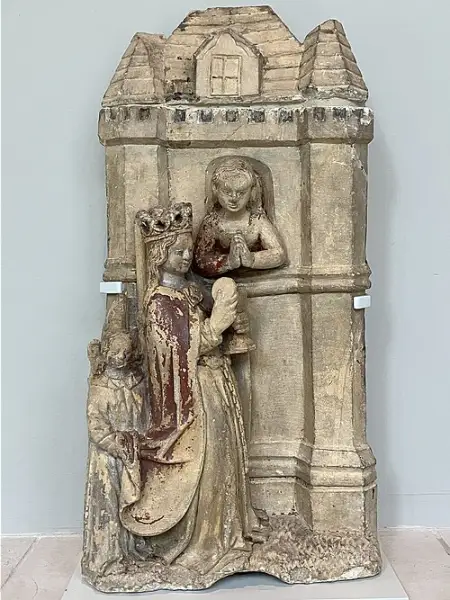
Saint Avoye of Sicily, whose memory survives under the names Saint Auré and Saint Ewe, was a third-century Christian martyr whose story binds southern Italy, Cornwall, and the coast of northern France. Tradition makes her the child of a pagan Sicilian father, Quintien, and of Gérasine, a Christian mother from the province of Brittany, one of nine children. Praying that her beauty be taken from her so that she might keep her virginity, she withdrew into the eremitical life. In the year of her death she crossed to Cornwall to attend the wedding of her aunt, Saint Ursula, only to find that Ursula too had consecrated herself to God. The two women fled to Cologne, where Ursula and her companions were slain by a barbarian band. Avoye herself was spared by one of the raiders who wished to marry her; on her refusal she was imprisoned and starved, strengthened, the legend says, by bread brought weekly by the Virgin Mary and kneaded by the angels. Freed at last, she made her way to Boulogne-sur-Mer, was retaken by the barbarians, tortured, and beheaded around 234.
The Complete Life
A Child of Two Shores
The tradition of Saint Avoye places her birth in Sicily in the early years of the third century, in a household divided in its faith. Her father, Quintien, was a Sicilian pagan; her mother, Gérasine, was a Christian who had come to the island from the province of Brittany, and it was from her that the daughter received the gospel. The couple raised a large family, for Avoye counted eight brothers and sisters around her. She grew up, the legend says, remarkably beautiful, and her comeliness became a source of anxiety rather than pride. Suitors gathered, and the virgin's heart was set elsewhere. In one of the most striking gestures of her story she prayed that God would take her beauty away, so that no man would desire her and her consecrated life might remain undisturbed. Having made that prayer, she withdrew from the world altogether and became a hermit, choosing solitude over the marriage her father's pagan house would have preferred. A second and quite different version of the tradition makes her an Englishwoman who fled to Pluneret in Brittany to escape a Saxon bridegroom her father had chosen, pursued across the sea by an angry parent.
§ Biography
Consecrated Virginity
Everything in the cult of Saint Avoye turns on her resolve to remain a virgin. In an age when a father's will and a suitor's demand could decide a woman's whole future, the decision to consecrate herself to God was an act of quiet defiance, and her prayer to be stripped of her beauty shows how literally she took the cost of it. The tradition links her vocation to that of her family: her aunt was Saint Ursula, herself the centerpiece of one of the most famous virgin-martyr legends of the middle ages, and when word came that Ursula was to be married, Avoye crossed the ocean from her hermitage to Cornwall to stand at the wedding. There she discovered that the report was false in the way that mattered: her aunt had no intention of marrying anyone, for she had given herself to God and meant to die a virgin as Avoye had. The meeting of the two women, each keeping the same secret from the other, is the moment at which the Sicilian hermit becomes a figure of the broader British and Breton world, joined to the company of consecrated women who preferred Christ to every contract their families had drawn.
§ Biography
Flight to Cologne and the Martyrdom of Ursula
When Avoye learned that Ursula shared her consecration, the two resolved to escape the marriages that threatened them, and together they fled to Cologne on the Rhine. The city proved to be not a refuge but the scene of the catastrophe that the legends of Ursula made famous. A band of barbarians fell upon the holy women, and Ursula with her companions was put to death. Avoye alone was spared, and the tradition gives a reason as cruel as it is consistent: one of the raiders, a pagan chief, desired her and meant to make her his wife. She refused him. The refusal cost her her liberty; she was thrown into prison and subjected to a slow torture of starvation. There, the legend relates, help came from heaven. Each week the Virgin Mary appeared to her bearing food kneaded by the angels themselves, so that the torment meant to break her became the setting of a continual miracle. In time she was released from her captivity by means the sources do not specify, and she made her way north and west toward the coast of Gaul, arriving at Boulogne-sur-Mer on the Channel.
§ Biography
Martyrdom at Boulogne
At Boulogne-sur-Mer the flight of the Sicilian virgin came to its end. The barbarians who had murdered Ursula's company found her there again, and this time there was no suitor to shield her and no prison wall to hide her. She was seized and tortured, and when she would not deny her Lord she was put to death by the sword, her head struck from her body around the year 234 according to the common account. The tradition adds a second strand to the story of her final days: in the version that makes her an English hermit of Pluneret, her fate is not execution but a lifetime of solitude, a reminder of how fluid the oldest saints' lives remain. What all the versions agree upon is the substance: a woman who would not marry, who would not yield, and who kept her consecration to the last. The Church of the first centuries counted such deaths as the truest confession of faith, and Avoye was honored among the martyrs from an early date, her memory kept on May 6 in the region of her passion, though some sources give May 2.
§ Biography
The Stone Boat of Plumeret
The cult of Saint Avoye took root on both sides of the Channel. In Brittany her chapel stands at Plumeret in the Morbihan, where to this day parents bring toddlers who are slow to speak and slow to walk and seat them in the stone boat of the saint to be blessed. That boat is itself the strangest of relics, for tradition tells that it carried Avoye across the ocean between France and Cornwall, and the heavy stone in the chapel has been read ever since as the vessel of her passage. In Cornwall her name survives in the village of St Ewe, which bears it, a testimony to the devotion she received among the Celtic Christians of the southwest. Her feast is celebrated on May 6, though some calendars and sources prefer May 2, a divergence that belongs to the age of her cult. She is honored in the Catholic Church and the Anglican Communion alike, and the legend assembled from Baring-Gould and Fisher, from Orme's study of the Cornish saints, and from the Breton tradition has kept alive the figure of a Sicilian girl whose prayer to lose her beauty made her beautiful in the memory of three countries.
§ Cult
Timeline
- 234
Travels to Cornwall for her aunt Ursula's wedding and flees with her to Cologne, where Ursula and her companions are martyred.
§ Biography
- 234
Refuses marriage to a barbarian chief, is imprisoned and starved, then freed and arrested at Boulogne-sur-Mer, where she is beheaded.
§ Biography
In Their Own Words
Kneaded by the angels themselves
The Record
- Patron of
- invoked for children with delayed speech and walking, at Plumeret in Morbihan
- Symbols
- stone boat
- Canonization
- Pre-congregation; honored as a martyr in the Catholic Church and the Anglican Communion
Prayer
Bibliography
Show 7 sources
- Broster, D.K. (2016). A Fire of Driftwood: A Collection of Short Stories. Jackson Keating. ISBN 9783741818837.
- Orme, Nicholas (2000). The Saints of Cornwall. OUP Oxford. pp. 120-121. ISBN 9780191542893.
- Baring-Gould, Sabine; Fisher, John (1908). The Lives of the British Saints: The Saints of Wales and Cornwall and Such Irish Saints as Have Dedications in Britain, Volume 2. pp. 475-476.
- Baring-Gould, Sabine (1870). Brittany. Library of Alexandria. p. 37. ISBN 9781465608383.
- "La légende de Sainte Avoye" (in French).
- Notes and Queries (August 14, 1869 ed.). Oxford University Press. 1869. p. 139.
- Romilly Allen, J. (1894). The Illustrated Archaeologist, Volume 2. England. pp. 106-107.
Profile text adapted from the Wikipedia article, licensed CC BY-SA 4.0.
Pray with this saint every day
Save St. Avoye to your favorites, read the full profile, and get feast-day reminders in the Saints app.
Get the Saints AppFree on the App Store for iPhone and iPad