
1620/1621 – 14 April 1682·Feast April 14
St. Avvakum Petrov
Old Believer Protopope and Martyr of the Nikonian Schism
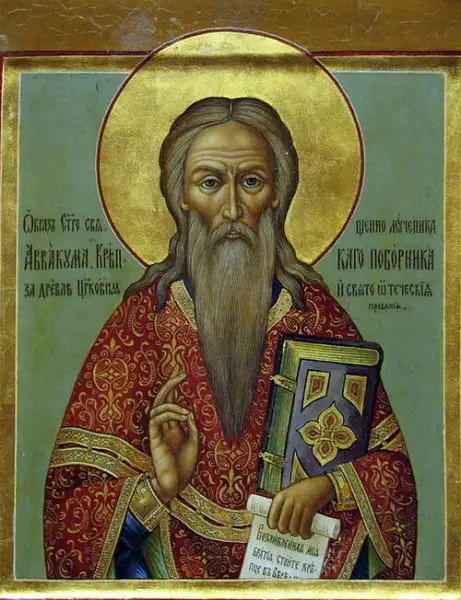
Overview
Avvakum Petrov, born in the village of Grigorovo near Nizhny Novgorod around 1620, became a priest of the Russian Orthodox Church and eventually protopope at Moscow's Kazan Cathedral, which stood on Red Square. When Patriarch Nikon began revising Russian liturgical books, vestments, and the manner of signing the cross in the 1650s, Avvakum judged the changes a corruption of a Church he believed had preserved the pure faith. He became the most prominent voice of the resistance that produced the Old Believers. His stand cost him dearly: he was exiled to Tobolsk in Siberia, dragged on a military expedition to Dauria near the Chinese border under the brutal commander Afanasy Pashkov, and later banished to Mezen and finally to Pustozyorsk above the Arctic Circle. There, with his companions Lazar, Fyodor, and Epifany, he was confined for more than a decade in a sunken log-framed hut before all four were burned alive on 14 April 1682. In prison he wrote his autobiography, The Life of the Archpriest Avvakum, a work whose mixture of Church Slavonic elevation and raw vernacular has made it a cornerstone of Russian literature, admired by Tolstoy and Dostoevsky alike. His letters to the tsar and to Old Believers such as Feodosia Morozova are likewise counted among the masterpieces of seventeenth-century Russian prose.
The Complete Life
A Priest's Son from Grigorovo
Avvakum was born around 1620 in the village of Grigorovo, in what is today Nizhny Novgorod Oblast. His father Pyotr was a priest who struggled with drink and died while the boy was still a child; his mother Maria later became a nun. The household gave him both a firsthand knowledge of clerical life and an early acquaintance with human weakness. At seventeen he married Nastasya Markovna, the daughter of a merchant, a union that would prove remarkably sturdy: she followed him through every exile, and her plain words of courage at a moment of doubt hardened his resolve to keep preaching. Ordained deacon at twenty-one and priest at twenty-three, he was raised to archpriest in Yurevyets at twenty-eight. By his own telling he was a man of ardent faith but also of severe and unyielding zeal: before the Nikonian reforms ever appeared, he came down hard on wandering minstrels, sexual immorality, and unbelief. That rigor brought him into repeated collisions with local boyars and officials, and eventually he fled to Moscow. There he moved in the circle of the Zealots of Piety, reformers who wished to purify the Church's moral life, and there he first knew Nikon as a friend. The friendship did not survive Nikon's elevation to the patriarchate in 1652 and the sweeping changes that followed.
§ Early life
The Zealot of Piety
Avvakum's vocation was formed inside a movement. In the late 1640s he belonged to the Zealots of Piety, known in Russian as the bogolyubtsy, lovers of God, a loose association of clergy and laymen who wanted to improve both religious and civic life and to purify the Russian Orthodox Church's witness. The group's outlook was shaped in part by the Ruthenian Orthodox revival then flourishing in Kiev under Petro Mohyla, where brotherhoods founded schools under Constantinople's patronage. Yet the Zealots were never of one mind. Some welcomed the scholarly, Greek-aligned currents flowing in from Ukraine and White Russia; others, Avvakum chief among them, held that the plain, homespun faith of the Russian people was sufficient and suspected that foreign learning would adulterate it. When Nikon took the patriarchal throne in 1652 he gave scholars trained by Jesuits in Ukraine and White Russia the task of critically reviewing Russian worship, precisely the sort of project Avvakum distrusted. Between 1653 and 1656 the reforms altered how Russians signed the cross, replacing the two-fingered with the three-fingered form, imposed Greek-style vestments, and issued corrected service books. For Avvakum this was not discipline but betrayal: the Russian Church, as he saw it, held the true faith entire, while Constantinople had fallen to the Turks precisely because of such innovations. His vocation now became witness, and he accepted the cost.
§ Historical background
Opponent of the Reforms
Avvakum's public mission was the refusal of Nikon's settlement. As the reforms advanced, dissenting clergy were subjected to shearings, markings, and banishment, and Avvakum himself was seized and shipped east with his family in 1653. Siberia did not silence him. He denounced the shamanism he encountered on the frontier, healed the sick and the mad as opportunity arose, and incurred the fury of the expedition commander Afanasy Pashkov, who had him beaten and dragged through years of marching. After Nikon fell from the tsar's favor, Avvakum was allowed back to Moscow in 1664, but his refusal to soften his condemnation of the corrected books led within months to a fresh exile at Mezen. Recalled for the Great Moscow Synod of 1666–67, he stood before the assembled patriarchs and denounced the reforms publicly, a defiance that sealed his fate. The council anathematized all who resisted the changes, and Avvakum, with the Old Believer leaders Lazar, Fyodor, and Epifany, was banished to Pustozyorsk on the Pechora River, a settlement above the Arctic Circle in what is now the Nenets Autonomous Okrug. Their guards mutilated the prisoners, cutting tongues, fingers, and hands; the Old Believer account holds that God healed them. The reforms they refused provoked rebellions across Russia for decades afterward.
§ Persecution of Avvakum and the Old Believers
Faith in the Pit
The spirituality that emerges from Avvakum's writing is earthy, apocalyptic, and utterly convinced of the nearness of the supernatural. He attributed his survival of beatings, starvation, and cold to prayer and grace: when Pashkov's men flogged him, he wrote, prayer dulled the pain. On the Tunguska River a storm spared his family after he prayed; in the winter wastes of Dauria, dying of thirst, he asked God for water and found the ice split open beside him, a mercy he likened to the rock struck for Israel in the desert. He healed madwomen who relapsed the moment they left his house, and he closed his memoir with a drawn-out contest of exorcism in Tobolsk, at the end of which the possessed woman revived and took the monastic name Agafya. Of the devil he wrote with a peasant's realism, remarking that the evil one fears not the club but the Cross of Christ, holy water, holy oil, and the Body of Christ. Yet the same pages that catalogue devils also revel in creation: cliffs like halls and turrets made by God, garlic sweeter than any at home, birds without number, fish so rich with oil they could not be pan-fried. Scholars have noted that he depicted Siberia as both hell and heaven, torment and treasure in a single land. His wife's question, whether the sufferings would last long, and his answer, until death, distill the whole: endurance embraced as vocation.
§ Holy and supernatural elements
Fourteen Years in a Dugout
Pustozyorsk was the end of the road in every geographical sense, a prison town near the Arctic Ocean where the state deposited those it could not silence. From 1670 Avvakum and his three companions were condemned to live on bread and water in a dugout, a sunken hut framed with logs, half cellar and half grave. It was in that hole, over the last fourteen years of his life, that he wrote the work on which his memory rests. He drafted the earliest version of The Life in the years 1669 to 1672, and he reworked the text in three further redactions down to 1675, refining a book that recounts the Siberian exiles, the friendship and estrangement with Tsar Alexei Mikhailovich, the exorcisms, and the landscapes he could not help admiring even as they starved him. He wrote as well to the tsar and to the Old Believer network, letters that circulated from hand to hand, including those to the noblewoman Feodosia Morozova. The regime never forgot him and never relented. On 14 April 1682 the four prisoners were locked inside a log house and burned alive. The place of the execution was later marked with an ornate wooden cross, and the manuscripts of the book he had written in the pit kept his voice alive in secret for nearly two hundred years.
§ Persecution of Avvakum and the Old Believers
A Saint Without a Synod
Avvakum was never canonized by the official Church whose reforms he rejected; there was no decree, no ceremony, no recognized cult within the Moscow patriarchate. His holiness was asserted instead from below, by the communities his witness had called into being. The Old Believers, who preserved the two-fingered cross and the unrevised books he died for, came to venerate him as a great martyr, and his feast is kept on the day of his repose, 14 April. The Russian Orthodox Old-Rite Church, the body that carries that tradition in institutional form, honors him among its chief confessors, and Pustozyorsk, the site of his burning, is remembered as his shrine. This is canonization of the ancient kind, the kind that precedes congregations and commissions: a suffering man, a death by fire, and a people who refuse to call the death a defeat. The wooden cross raised where the log house stood became a place of memory for the movement. His companions Lazar, Fyodor, and Epifany, burned with him, share in the same veneration. In this his cult mirrors his life, which was spent entirely outside official favor; the Church's structures condemned him, and the Church's persecuted remembrance crowned him.
§ Legacy
The Book from the Pit
The deepest of Avvakum's legacies is literary. His autobiography circulated in manuscript copies for almost two centuries before its first printing in 1861, and once published it took its place among the finest works Russia has produced; both Leo Tolstoy and Fyodor Dostoevsky are recorded as holding it in high esteem. The critic D. S. Mirsky observed that it is not a rounded autobiography but an apologia, written for edification and propaganda rather than disinterested record. Its style fused elevated Old Church Slavonic with colloquial Russian and even profanity, a combination the linguist Viktor Vinogradov analyzed as unprecedented, matching low and bodily imagery with high and exalted registers. Scholars such as Alan Wood have read it as the prototype of Siberian prison literature, the ancestor of Dostoevsky's Notes from the House of the Dead and Solzhenitsyn's Gulag Archipelago. Bruce T. Holl traced in it the genesis of Siberian literature itself. Beyond literature, Avvakum's stand fixed the identity of the Old Believers, the communities that rejected the Nikonian reforms and endured arrest, exile, and rebellion for decades in order to keep the rites they had received. English readers can know his voice through Kenneth Brostrom's translation of 1979, reprinted by Columbia University Press in 2021, and the earlier version by Jane Harrison and Hope Mirrlees.
§ Legacy
Timeline
- 20 Nov 1620
Born in Grigorovo, in present-day Nizhny Novgorod, to the priest Pyotr and the nun Maria.
§ Introduction
- 1637
Married Nastasya Markovna, a merchant's daughter, at the age of seventeen.
§ Early life
- 1648
Made archpriest in Yurevyets at twenty-eight, after serving as deacon at twenty-one and priest at twenty-three.
§ Early life
- 1649
In the late 1640s belonged with Nikon to the Zealots of Piety, a circle set on purifying Russian religious life.
§ Historical background
- 1652
Nikon became patriarch of Moscow and all Russia and began the liturgical reforms Avvakum would resist for life.
§ Historical background
- 1653
Exiled with his family to Tobolsk in Siberia for opposing the reforms.
§ Persecution of Avvakum and the Old Believers
- 1655
Moved to Yeniseysk, then departed with Afanasii Pashkov's expedition toward Dauria on the Chinese frontier, past Lake Baikal to Nerchinsk.
§ Persecution of Avvakum and the Old Believers
- 1664
Allowed back to Moscow after Nikon ceased to be patriarch, but within months was banished again, to Mezen.
§ Persecution of Avvakum and the Old Believers
- 1666
Recalled to Moscow for the Great Moscow Synod, which anathematized everyone refusing Nikon's changes, and denounced the reforms before the council.
§ Historical background
- 1667
Banished with fellow Old Believers Lazar, Fyodor, and Epifany to Pustozyorsk on the Pechora River, above the Arctic Circle.
§ Persecution of Avvakum and the Old Believers
- 1669
Drafted the first version of his autobiography in prison, producing three further redactions between 1672 and 1675.
§ Persecution of Avvakum and the Old Believers
- 1670
Condemned from this year onward to bread-and-water confinement in a sunken, log-framed dugout.
§ Persecution of Avvakum and the Old Believers
- 14 Apr 1682
Executed with his companions by burning in a log house at Pustozyorsk; that date is kept as his feast of repose.
§ Introduction
- 1861
His Life, which circulated in manuscript for nearly two centuries, was printed for the first time.
§ Life and writings
In Their Own Words
Ten years he tormented me, or I him — I don't know. It will be sorted out on Judgement Day.
Everything was smashed to bits! But what could be done if Christ and the most immaculate Mother of God deigned it so? I was laughing coming out of the water, but the people there were oh'ing and ah'ing as they hung my clothes around on bushes.
Try to unite with one another: for as close as one gets to one's neighbor, one is united with God for so much.
For the blessing of my father the starec Epifanij my life written with my sinful hand by me, the archpriest Avvakum, and if anything is said to you in the good, well, you who read or listen do not despise, for the love of the Lord, our vulgar, because I love my motherly Russian language, I do not use to adorn my speech with philosophical verses, since God does not listen to beautiful words, but it is our works that he wants.
The Record
- Major works
- The Life of the Archpriest Avvakum (autobiography, 1669–1675)·Letters to Tsar Alexei Mikhailovich·Letters to Old Believers, including Feodosia Morozova
- Patron of
- Patron of Russia
- Symbols
- Priest's robes·Two-fingered sign of the cross
- Canonization
- Venerated as a great martyr by the Old Believers (Russian Orthodox Old-Rite Church); never formally canonized by the Moscow patriarchate
Prayer
Bibliography
Show 7 sources
- Holl, Bruce T. (23 March 1993). "Avvakum and the Genesis of Siberian Literature". In Slezkine, Yuri; Diment, Galya (eds.). Between Heaven and Hell: the Myth of Siberia in Russian Culture. Palgrave Macmillan US. p. 34. ISBN 978-1-349-60553-8.
- Michels, Georg B. At War with the Church: Religious Dissent in Seventeenth-Century Russia. Stanford University Press, 2000.
- Hosking, Geoffrey. Russia and the Russians: A History. Cambridge, MA: Belknap Press of Harvard University Press, 2001.
- Kahn, Andrew; Lipovetsky, Mark; Reyfman, Irina; Sandler, Stephanie (2018). A History of Russian Literature. Oxford: Oxford University Press. ISBN 9780199663941.
- Kivelson, Valerie Ann. Cartographies of Tsardom: The Land and Its Meanings in Seventeenth-Century Russia. Cornell University Press, 2006.
- Petrovich, Avvakum (1963) [First published 1924]. The Life of the Archpriest Avvakum by Himself. Translated by Jane Harrison and Hope Mirrlees. Hamden, Connecticut: Archon Books.
- Brostrom, Kenneth N., trans. Archpriest Avvakum: The Life written by Himself. Michigan Slavic Publications, 1979. ISBN 0-930042-33-6.
Profile text adapted from the Wikipedia article, licensed CC BY-SA 4.0.
Pray with this saint every day
Save St. Avvakum Petrov to your favorites, read the full profile, and get feast-day reminders in the Saints app.
Get the Saints AppFree on the App Store for iPhone and iPad