
c. 250 – 327·Feast June 3
St. Awtel
Lycian Monk and Hermit, Patron of Kfarsghab
Overview
Awtel, honored as Mar Awtel or Mar Awtilios, was a monk and hermit of the early Christian East whose memory is kept in three traditions at once: the Maronite Church, the Eastern Orthodox Church, and the Syriac Orthodox Church. His birthplace and birth date vary with the source: the Maronite Sinksar has him born in the middle of the third century without naming a place, while Fr. Louis Cheikho, working from the Jacobite books of saints, makes him a native of Magdal or Magdaloun, a city of Lycia in Asia Minor, born in the sixth century to pagan parents. Converted and baptized in his youth, he dedicated himself to virginity, and when his family pressed a marriage upon him he fled rather than break his pledge. The voyage that carried him away nearly killed him: a violent storm threatened the boat, his prayer delivered everyone aboard, and the passengers were baptized as a result. He spent twenty years in Byzantium leading an ascetic life, returned home after his father's death, became a monk, and, after twelve years in community, withdrew to the desert as a hermit. There he built a monastery, worked cures that drew thousands of pagans to baptism, and died around the year 327. His cult survives above all in the Lebanese village of Kfarsghab, where the sole church in all Lebanon placed under his patronage stands on a rocky promontory above the Qadisha Valley, its feast kept on 3 June and 27 August.
The Complete Life
A Youth of Lycia
The opening chapter of Awtel's life is told differently by different churches, yet every version agrees on its shape. The Maronite Sinksar places his birth in the middle of the third century, while the sources gathered by the Jesuit scholar Father Louis Cheikho, working from a Jacobite book of saints in a manuscript that belonged to Patriarch Ignatius Ephrem II Rahmani, together with the Bibliotheca Orientalis of Assemani and the calendar of Çlîba the Jacobite, put him in the sixth century and name his birthplace Magdal or Magdaloun, a city of Lycia in Asia Minor. The Maronite tradition leaves the place unnamed. Both strands, however, give him pagan parents and a conversion while still young. Baptized, he made a solemn pledge of virginity, and immediately the pledge was tested: his father, wanting grandchildren and alliance, arranged a marriage that would have broken it. Rather than comply, the young man ran away from the paternal home. The choice set the pattern for everything that followed. Awtel's life would be a series of departures, from family, from city, and finally from human company altogether, each one made to protect a consecration made in youth. The hagiographers do not paint him as a rebel against his parents out of contempt; the traditions remember him waiting until his father's death before returning home, an obedience even in absence. What he would not surrender was the freedom given him at the font.
§ Life
The Storm at Sea
The escape from Lycia became the most famous episode of Awtel's life. Boarding a ship, in the Maronite account bound for Byzantium and in the older Syrian tradition for a city called Moumista, probably al-Maççîça, he sailed into a tempest so fierce that the vessel and everyone aboard stood in mortal danger. While the crew and passengers despaired, the young refugee prayed, and the storm's threat passed; the boat came through with all hands. The consequences went beyond survival, for the tradition records that everyone aboard came to faith in Christ and received baptism because of what they had seen. The Byzantine tradition, as reported by Father Peeters and noted by Cheikho, adds a darker reading of the same voyage: the fellow passengers, it says, had intended to capture Awtel and make him a slave, and it was from this captivity that he delivered them. Either way the sea crossing fixed his reputation as a man whose prayer avails for others. In Constantinople he found his vocation's first form, living ascetically in one of the city's monasteries through a stay of twenty years. It was a long apprenticeship in prayer and discipline, taken in the capital of the Christian world, before the death of his father opened the way home. He returned to his fatherland, and the wandering did not end: he spent time in the region of Antioch and, in some accounts, at Seleucia, its seaport, before turning back toward Lycia.
§ Additional information
Apostle of the Lycian Countryside
Back in his native Lycia, Awtel turned from pilgrim to missionary. The sources agree that the region around him was still largely pagan, and that his presence changed it. He joined the monastery of Mar Âba, according to the Jacobite book of saints, and there he lived as a monk and worked miracles. The Maronite Sinksar counts the effect in a single staggering figure: the cure of one pagan man became the reason ten thousand pagans turned to Christ and were baptized. Whatever the exact arithmetic, the claim points to a real and remembered mass movement, a countryside turning to the font because of what people believed God had done through one monk. Awtel baptized those he won; the texts say he christened them, marking the passage from old loyalties to the Church. His mission was not built on argument but on the visible holiness of a life and the cures attributed to it. The villages of Lycia in late antiquity stood between the dying temples of the old gods and the rising crosses of the new faith, and men like Awtel were the human bridge. Tradition also remembers that his preaching followed the pattern of his own flight: he asked nothing for himself, refused office when it was offered, and let the example of poverty and prayer do the persuading. The mission field he worked was the land of his birth, and he never left it again.
§ Version of Fr. Louis Cheikho
The Monk Who Refused Office
The spirituality that emerges from Awtel's traditions is one of deliberate obscurity. After twelve years as a monk, the Jacobite account says, he left the monastery of Mar Âba for a reason modern readers find striking: he wished not to be chosen as superior. Authority was within his reach and he walked away from it, choosing the margins where a hermit could keep watch over his own soul rather than govern the souls of others. His last retirement was in the desert, and there he was served by a single companion, a man whose serpent bite he had healed. The detail is characteristic: the hermit who refused to rule others was cared for by someone he had healed, an economy of gratitude rather than hierarchy. The core of his inner life, as the traditions preserve it, was the pledge of virginity made in youth and defended at real cost, the trust that God delivers those who call on him, learned in the storm at sea, and the discipline of the ascetic life, first in a Constantinopolitan monastery and then in the Lycian waste. Miracles cluster around him quietly rather than spectacularly: a healing here, a rescue there, a cure that opens a village to the gospel. He stands in the long line of desert fathers for whom sanctity is measured not in achievement but in fidelity to a calling received early and kept to the end.
§ Additional information
The Desert and the Monastery He Built
Awtel's last years were spent in the country he had evangelized. Having preached and baptized through the Lycian countryside, he closed his life in the desert, within a monastery of his own founding nearby, and dwelt there until the end. The Maronite Sinksar closes the account simply: after twelve years as a monk he became a hermit, and he remained a hermit until he died in the year 327. The two traditions, the Maronite and the Jacobite, disagree about the century but agree about the ending, an old man alone with God in a house of prayer of his own founding. The monastery he raised in the wilderness was at once his retreat and his legacy, a place where the solitude he had chosen could continue after him in the lives of others. It is the paradox of the hermit's vocation that the one who flees company often ends by gathering a community: the cell becomes a house, the house becomes a monastery, and the desert blooms with arrivals. Awtel died as he had lived, outside the centers of power and inside the tradition of the fathers. His passing left no recorded drama, only the memory of a long fidelity, and it fixed his feast in the calendars of the churches that had come to love him. Around his grave and his name a quiet cult formed, one that would eventually cross the sea to Lebanon.
§ Version of Fr. Louis Cheikho
One Saint, Three Churches
No bull of canonization exists for Awtel, and none is needed; he belongs to the vast company of saints recognized by tradition before the Church developed formal processes. What is remarkable in his case is the breadth of that recognition. He is venerated in the Maronite Church, the Eastern Orthodox Church, and the Syriac Orthodox Church, three bodies long separated by history and doctrine yet united in honoring this one hermit of Lycia. The calendars do not agree on the details. The Maronites celebrate him particularly on 3 November, and he is also kept on 9 October; in Kfarsghab the local feast falls on 3 June and 27 August. The Byzantines, according to Father Peeters, knew him under the name Agios Attaros and kept his feast between 2 and 7 June. The calendar compiled by al-Bîrûnî for the Antiochian Church records a martyr called Uwaytilyos on 23 September, though it has never been proven that this is the same man. Even his century is disputed, the Maronite Sinksar placing him in the third century and the Syriac sources in the sixth. That the traditions diverge so widely and still converge on the saint himself is the strongest evidence of how deeply his memory rooted. The churches kept the man even where they lost the chronology.
§ Life
The Church on the Promontory
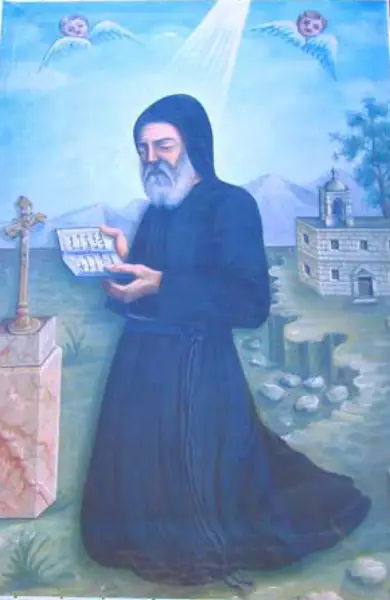
Awtel's most visible legacy stands in Kfarsghab, a village of North Lebanon: the sole church in all Lebanon placed under his patronage. It occupies a rocky promontory whose faces drop some thirty meters, commanding the approaches through the Qadisha Valley, a position so naturally defensible that it echoes the very etymology of the village's name, the fortified village. The building follows the layout of small Maronite churches of the twelfth and thirteenth centuries, a plain rectangle closed at the east by a semicircular half-domed apse, its interior arranged according to the standard plan of Patriarch Estephan El Douaihy. Its documented history begins with a renovation recorded in 1470, though historians suspect an earlier foundation. The church was extended in 1776 and 1778 to serve a growing population, a Garshuni stone inscription crediting the zeal of Sheikh Abou Youssef Elias. In 1795 a master woodworker from Damietta in Egypt completed the delicate screen dividing the men's from the women's section, and in 1882 a renovation was recorded on the oak door itself. A modern bell tower added in the 1950s was later dismantled to restore the original silhouette. In the 1960s the painter Saliba Douaihy, then a young Lebanese artist, produced the image of the saint still hanging above the altar, and in the 2000s the surrounding square was rebuilt in old stone. The village keeps him as its patron, and the promontory keeps the village.
§ Saint Awtel's Church, Kfarsghab
Timeline
- 250
Born at Magdal in Lycia, Asia Minor, per the dating given in the article's opening record
§ Introduction
- 327
Dies in Lycia, honoured across the Maronite, Eastern Orthodox and Syriac Orthodox churches
§ Introduction
- 1470
First documentary mention of Saint Awtel Church in Kfarsghab, a record of its renovation
§ The history
- 1776
The Kfarsghab church is extended to serve a growing population, commemorated by a Garshuni stone inscription
§ The history
- Feb 1795
An intricate wooden divider separating the men's and women's sections is completed by a master craftsman from Damietta
§ The history
- 1882
The church undergoes renovation recorded in an engraving on the main entrance door
§ The history
The Record
- Major works
- Monastery founded in the Lycian desert
- Patron of
- Patron of the village of Kfarsghab, Lebanon
- Symbols
- Monk's habit·Hermits' desert cell
- Canonization
- Pre-congregation; venerated by the Maronite Church, the Eastern Orthodox Church, and the Syriac Orthodox Church
Prayer
Bibliography
Show 7 sources
- Moubarac, Youakim, Pentalogie antiochienne / Domaine Maronite, Tome II, Volume I, pages 17-18, éditions du Cénacle Libanais, Beyrouth, 1984.
- Cheikho, Louis, Awliya' Allah fi Lubnan, edited in Beirut in 1914; translated to French and enriched by Youakim Moubarac in Pentalogie Antiochienne / Domaine Maronite, Tome II, Volume I, Cénacle Libanais, Beirut, 1984.
- Al Maxreq, year X, 1907, pages 672-672, Beirut, Lebanon.
- Abi Khattar, Sheikh Antonios, known as AïnTourini, Moukhtassar Tarikh Jabal Loubnan, in the version of Fr. Ignatius Tannous AlKhoury revised by Dr. Elias Kattar, editor Lahd Khater, Beirut 1983. OCLC 21044417, page 139.
- El Douaihy, Patriarch Estephan, Tarikh Al Azminah, in the version of the Abbot Boutros Fahd, editions Dar Lahd Khater, Beirut, 3rd Edition. OCLC 41272562, page 397.
- Atallah, Micheline, Saint Aquilina's Church And Sanctuary Part III, Journal of Maronite Studies, Vol. 3, Issue 4, October 1999.
- Abdallah, Charbel, L'architecture d'une église maronite selon le patriarche Douaïhy, Faculté Pontificale de Théologie de l'Université Saint-Esprit de Kaslik (Liban), 24 November 2010.
Profile text adapted from the Wikipedia article, licensed CC BY-SA 4.0.
Pray with this saint every day
Save St. Awtel to your favorites, read the full profile, and get feast-day reminders in the Saints app.
Get the Saints AppFree on the App Store for iPhone and iPad