
died c. 711·Feast April 18
St. Aye
Frankish countess and nun, patron of lawsuits
Overview
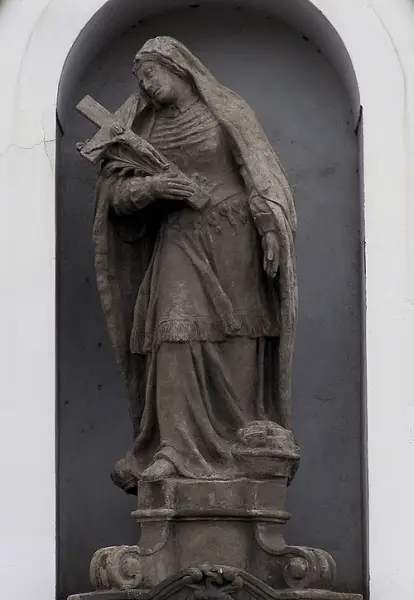
Saint Aye, who died around 711, was a saint of the Frankish aristocracy whose name comes down in the variant forms Aia, Aya, Agia, and Austregildis. She was a daughter of Brunulphe I, Count of the Ardennes, and a relative of Saint Waldetrudis, one of the great founding women of Belgian monasticism. In keeping with the customs of her class she was married, and her husband was himself numbered among the saints: Hidulf of Hainault. The marriage ended not in death but in a shared discernment, for husband and wife resolved together to enter religious life and parted ways to pursue it. Aye received the habit at the Abbey of Mons, where she lived as a nun, and she bestowed her property on the nuns of Saint Waldetrudis, turning the wealth of her county into the support of the communities that carried her kinswoman's name. She is revered by the Beguines of Belgium and honored on April 18. Her peculiar title to fame is patronage of lawsuits, a role tradition traces to a suit that decided her inheritance against the canonesses of Mons, and, in a variant legend, to an injustice she righted by speaking from beyond the grave.
The Complete Life
A Count's Daughter of the Ardennes
The records of the seventh-century Frankish church preserve little of Aye's childhood, and even her dates rest on shifting testimony, but her family stands firm in the tradition. She was a daughter of Brunulphe I, Count of the Ardennes, a magnate of the forest country that lies between the Meuse and the Moselle, and through her kin she was related to Saint Waldetrudis, the saint whose name stands at the center of the monastic world of Mons. That relationship placed Aye within a family network steeped in holiness, one of those noble houses of the Frankish lowlands from which the church of the region drew saint after saint. In such a house the faith was a matter of lineage as much as of sentiment. Aye was matched in marriage according to the same arithmetic of rank, and the husband chosen for her was Hidulf of Hainault, a nobleman of the neighboring country who, like her, would one day be raised to the altars. She is often confused with another Saint Agia, the mother of Saint Loup of Sens, so entangled do the genealogies of these Frankish saints remain.
§ References
A Marriage Dissolved by Mutual Consent
The story of Aye's vocation begins inside a marriage rather than against it. She and Hidulf lived as husband and wife in the country of Hainault, while both of them inclined more and more toward the religious life. What distinguishes their story is its mutuality. Sources record that husband and wife together decided to enter religious life, and that upon that decision they parted ways, dissolving by common consent the life they had built in order to pursue the one thing each now wanted. There was no repudiation and no flight; the countess went with her husband's blessing, and the count, it seems, with hers. Aye received the habit at the Abbey of Mons, the community gathered around the name and tradition of her kinswoman Waldetrudis, where she lived out her days in the humble stability of a nun. Whatever remained of her dower and inheritance she did not hoard: she made over her estate to the sisters of Waldetrudis, endowing the sisters among whom she had chosen to pray. Few conversions of the early middle ages are recorded with so little drama and so much consequence, for out of that one household's common resolve came two saints, and out of their parting came the cloistered peace in which Aye finished her life at Mons.
§ References
Prayer, Poverty, and the Cloister of Mons
As a nun of Mons, Aye belonged to a community that stood at the center of a family of saints, and her spirituality can be read from the choices the sources record. The first is poverty. A countess by birth and a landowner by marriage, she stripped herself of her estates while she yet lived, conferring her property on the nuns of Saint Waldetrudis so that her wealth would feed the prayers of the cloister rather than the ambitions of heirs. The second is stability. She did not wander among holy places or attach herself to her husband's new foundation; she settled at Mons, among women bound to her by blood and by the habit, and there remained until death. The third is humility of memory. So little was sought to be recorded of her that even the year of her passing is uncertain, some authorities putting it in 707 and others in 714, with the common date c. 711 standing between them. A sanctity that leaves behind buildings and books tells one story; a sanctity that leaves behind nothing but the devotion of the poor chaste women who came after her tells another, and the Beguines of Belgium, who revered her for centuries, understood which of the two hers was.
§ References
Patron of Lawsuits
Devotion to Aye took a form granted to few saints: she became the heavenly advocate of those entangled in legal contention. The origin of the patronage is traced to a lawsuit that decided her own inheritance against the Canonesses of Mons, a cause in which the countess-turned-nun found her goods and her name at issue before a tribunal. Out of that experience, and out of the conviction that a saint who had suffered litigation knew its miseries, grew the practice of invoking her in disputes over property, wills, and rights. A variant legend embroiders the title still further, telling how she set a wrong to rights by a word uttered from the tomb, her voice rising after death to vindicate a cause that had been defeated in her lifetime. Her feast is kept on April 18, and under the names Aia, Aya, Agia, and even Austregildis her cult spread through the Belgian lowlands, where the Beguines, the lay religious women of the region, honored her as one of their own across the centuries. Careful hagiographers note that she must not be confused with the other Saint Agia, mother of Saint Loup of Sens, whose story was often entangled with hers.
§ References
The Record
- Patron of
- patron saint of lawsuits
- Canonization
- Pre-congregation; venerated in the Roman Catholic Church from the early middle ages
Prayer
Bibliography
Show 6 sources
- Holweck, Frederick (1924). A Biographical Dictionary of the Saints. Detroit: Gale Research Co: Bloomsbury Academic. p. 126.
- Attwater, Donald (1958). A Dictionary of Saints. New York: P.J. Kennedy & Sons. pp. 7.
- Rev. Sabine Baring-Gould (M.A.). "S. Aya, Countess of Hainault. (7th Cent.)." In: The Lives of the Saints. Volume the Fourth: April. London: John C. Nimmo, 1897. p. 226.
- Englebert, Omer (1951). The Lives of the Saints. New York: David McKay Company Inc. pp. 151.
- Andre-Driussi, Michael (2008). Lexicon Urthus, Second Edition. Sirius Fiction. p. 8.
- "Saint Agia of Hainault". CatholicSaints.Info. 2012-04-18. Retrieved 2019-05-19.
Profile text adapted from the Wikipedia article, licensed CC BY-SA 4.0.
Pray with this saint every day
Save St. Aye to your favorites, read the full profile, and get feast-day reminders in the Saints app.
Get the Saints AppFree on the App Store for iPhone and iPad