
died c. 671·Feast June 26
St. Babolen
Columban Abbot of Saint-Maur-des-Fossés
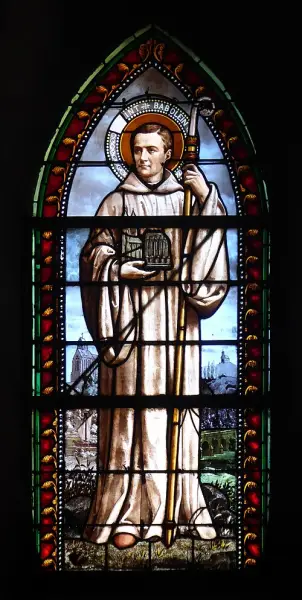
Overview
Babolen, also rendered Babolenus, Babolin or Babolein, was a seventh-century abbot whose nationality is uncertain, though several hagiographers suggest a Scottish or Irish origin. Trained in the monastic school founded by Columbanus at Luxeuil, he crossed into Gaul and served first as a monk there and then as abbot of Saint-Pierre. Around 638 Blidegisl, archdeacon of Paris, established a monastery on a peninsula formed by the Marne roughly two leagues from Paris; Babolen began governing this house, later called Saint-Maur-des-Fossés after the relics of Maurus were translated there from Anjou, about the year 640. He directed a numerous community, worked alongside Fursey at Lagny, and, supported by Bishop Audebert and his successor Landry, founded many churches and hospitals throughout the diocese of Paris. Having reached great old age he resigned the abbacy to a successor named Ambrose and withdrew to a hermitage, where he died on 26 June around 671. His body was laid in a stone sarcophagus beside the church he had raised in honour of the Blessed Virgin, and his remains were later translated to a church built by Abbot Benedict. His cult spread through the region, and in 1750 his relics were distributed among Parisian churches after the Chapel of Our Lady of Miracles at Saint-Maur was deconsecrated.
The Complete Life
A Monk of Uncertain Origin
Almost nothing certain survives about Babolen's birth and family. The writers who preserve his memory disagree about where he came from: the monks of St Augustine's Abbey, Ramsgate, call him a monk of unknown nationality; John O'Hanlon, the nineteenth-century historian of the Irish saints, admits that his country is doubtful while noting that many have judged him a Scot or an Irishman; the infobox tradition of the modern article likewise hedges with a probable Scottish origin. The confusion is compounded by names close to his own: O'Hanlon records that Babolenus of Fossey was sometimes muddled with a Papolenus who was bishop and abbot at Malmundarium and Stabuletum in Belgium, and with another abbot called Babolenus at Bobbio in Italy. What the traditions do agree upon is the school that formed him. He belonged to the Columban movement, that great wave of Irish monastic energy which Columbanus carried from Bangor through Burgundy. At Luxeuil, the mother house that Columbanus founded in the Vosges, Babolen learned the rigour, the penitential discipline and the missionary openness that marked that family of houses. Whatever shore gave him birth, his spiritual homeland was Luxeuil, and his working life was spent entirely in the Frankish church around Paris, where his name would be remembered chiefly as a builder and a governor of monks.
§ O'Hanlon's account
From Luxeuil to the Abbacy
Babolen's monastic career followed the ladder customary among the Columban houses of Gaul. He began as a simple monk at Luxeuil, submitting to a rule famous for its severity and its long offices. His gifts were soon recognised, and he was raised to the abbacy of Saint-Pierre, where he first exercised the government of a community. A greater charge awaited him on the Marne. In 638 Blidegisl, archdeacon of Paris, established a monastery on a peninsula enclosed by the river, some two leagues downstream from the city. About the year 640, according to O'Hanlon, Babolen took up the government of this house and laboured there with great diligence and zeal. Baring-Gould notes that he ruled over a large community, and Butler remembers the house as one in which a perfect spirit of charity, piety and every virtue held sway, and calls it a genuine image of paradise on earth and a seedbed of saints. The abbey later received the name Saint-Maur-des-Fossés when the relics of the Benedictine abbot Maurus were brought there from Anjou, a translation that fixed the house's identity for the rest of the Middle Ages. For Babolen the appointment was the summit of a life's work: the Columban formation of Luxeuil was now to be planted in the service of the church of Paris.
§ Butler's account
Churches and Hospitals for the Diocese of Paris
Babolen's abbatiate was anything but cloistered in spirit. Allied with Fursey, the Irish missionary abbot, he joined in the work at Lagny, the monastery Fursey governed east of Paris, and the two men lent their energies to the wider diocese. Working with the authority of Bishop Audebert of Paris and, after him, of Landry, Babolen founded many churches and hospitals throughout the territory, institutions that combined worship with care for the sick, the traveller and the poor. This partnership of monk and bishop is characteristic of the seventh-century Frankish church, in which abbots acted as a kind of missionary cavalry for their dioceses, opening houses and charitable foundations in districts the episcopal apparatus could not yet reach. At Fossés itself Babolen raised a church in honour of the Blessed Mother of God, and it was beside this church, on its northern side, that he would eventually be buried. Butler sums up the fruit of his governance by saying that he rendered the monastery a house of saints; O'Hanlon, quoting the older lives, credits him with great services to the diocese. The hospitals deserve particular notice, since they belong to the earliest stratum of organised medical charity in the Paris region, and they place Babolen among those abbots whose sanctity was measured as much in foundations as in miracles.
§ O'Hanlon's account
A True Image of Paradise on Earth
The portrait the old hagiographers give of Babolen is that of a superior who sanctified a house more by example than by command. Butler's judgment is the most quoted: under Babolen the abbey became a house of saints: a perfect spirit of charity, piety and every virtue that filled it made the place a very image of paradise on earth. The phrase, generous as it is, points to the Columban ideal that Babolen carried from Luxeuil: a community bound by strict observance, ceaseless prayer and mutual forbearance, in which the abbot is above all a father who embodies the rule before he enforces it. The Ramsgate Book of Saints describes him simply as a toiler for the welfare of souls around Paris, and that phrase of labour captures the spirituality of the man. His devotion to the Mother of God, shown in the church he dedicated to her at Fossés, belongs to the same seventh-century flowering of Marian cult in Gaul that produced so many abbatial dedications. In old age that spirituality took its final, most personal form: having governed others for decades, he resigned his charge to Ambrose and withdrew to a hermitage, returning to the solitude in which the Columban life begins. There, in holy retirement and in great old age, he prepared for death.
§ Butler's account
Resignation, Hermitage and Death
Babolen's last years followed a pattern revered in early monasticism: the abbot who, feeling age upon him, gives up his office and dies as a simple solitary. Butler records that in his old age he resigned the abbacy to Ambrose, his successor, and died in holy retirement; Baring-Gould and O'Hanlon tell the same story, adding the detail of the hermitage. O'Hanlon fixes his death about the year 671, on the sixth day of the July Kalends by the Roman reckoning, which is 26 June, the date his feast has kept ever since. His body was laid in a stone sarcophagus set against the church's northern flank — the church he had himself built and consecrated to the Blessed Virgin at Fossés. In that spot his remains rested for many years while, as the older lives attest, frequent miracles were reported at his tomb. At length his body was translated into another church, built by a religious abbot named Benedict, on the seventh day of the December Ides; the year of that translation was not recorded. The final disposition of his relics came much later: the body of the saint was preserved in a shrine above the high altar at Fossés, and miracles continued to be ascribed to his merits, with churches and altars raised in his honour in many places.
§ O'Hanlon's account
A Saint of the Martyrologies
No formal canonization process ever examined Babolen's cause, for he died centuries before such procedures existed. His sanctity was ratified instead by the ordinary channels of the early medieval church: inscription in the martyrologies and the celebration of his feast. Baring-Gould notes that he is commemorated in the Roman, Gallican and Benedictine martyrologies, and that the authority for his life is an account of his deeds and miracles preserved by Mabillon, the great Benedictine scholar of the seventeenth century. Local liturgical honour followed: the Paris Breviary, in its revised form, granted him a proper lesson on 26 June, a mark of diocesan cult, and Butler points readers to Molanus, Du Chesne and Mabillon for the older evidence. The cult also left its marks in stone and silver: many places raised churches and altars to his honour, and his shrine stood above the high altar at Fossés. This is canonization by consent: a monk whom his community, his diocese and successive generations of scholars judged to be what Butler's sources called him, a maker of saints, whose memory the church simply continued to keep once the calendar of Paris was formed.
§ Baring-Gould's account
The Relics Scattered and Preserved
Babolen's afterlife in relic form is unusually well documented for a seventh-century abbot, because the dispensation of 1750 left a paper trail. In that year the Chapel of Our Lady of Miracles, which stood beside the portico of the church of St Maur, was stripped of its consecration, and the relics of the two saints, Maur and Babolen, passed to the archdiocese of Paris for distribution. From these the canons of St Maur retained Babolen's principal reliquary together with other items. The parish church of St Maur received a vertebra and a small rib. A bone from one of the saint's arms was sent to the Chapel of St Bond in the parish of St Merry. Three further small bones were divided between the parishes of Jouy-le-Moutier and Bois-d'Arcy near Paris, and the archbishop of the day retained only the left tibia. This scattering, typical of eighteenth-century practice, carried the abbot's cult into a ring of parishes around the capital. His scholarly legacy is likewise secure: the lives by Butler, Baring-Gould, O'Hanlon and the Ramsgate monks all preserve his story, and each notes the doubt about his nationality that keeps him a somewhat mysterious figure, a Scot perhaps, an Irishman perhaps, but certainly a Columban monk of the church of Paris.
§ Relics
Timeline
- 638
Blidegisl, archdeacon of Paris, establishes the monastery on a peninsula of the Marne, two leagues from the city
§ Baring-Gould's account
- 640
Said to begin governing the abbey of Fosse, where he rules a numerous community with zeal
§ O'Hanlon's account
- 26 Jun 671
Dies in his hermitage at an advanced age and is laid in a stone sarcophagus beside the church he raised
§ O'Hanlon's account
- 1750
After the deconsecration of the Chapel of Our Lady of Miracles, his relics pass to the archdiocese of Paris for distribution
§ Relics
The Record
- Major works
- Founded many churches and hospitals in the diocese of Paris·Built a church at Saint-Maur-des-Fossés in honour of the Blessed Virgin Mary
- Symbols
- Abbot's crozier·Church or monastery in the background
- Canonization
- Pre-congregation; honoured in the Roman, Gallican and Benedictine martyrologies, with a proper lesson in the Paris Breviary
Prayer
Bibliography
Show 5 sources
- Baring-Gould, Sabine (1897), The Lives of the Saints, vol. 6, June, London: J. C. Nimmo
- Butler, Alban (1799), The Lives of the Primitive Fathers, Martyrs, and Other Principal Saints, vol. 6, J. Moir
- O'Hanlon, John (1875), Lives of the Irish Saints: with special festivals, and the commemorations of holy persons, Dublin: J. Duffy
- Magny; Hurtaut (1779), Dictionnaire historique de la ville de Paris et de ses environs, vol. 3, Montard
- St. Augustine's Abbey, Ramsgate (1921), The Book of Saints: a dictionary of servants of God canonized by the Catholic Church, London: A. & C. Black
Profile text adapted from the Wikipedia article, licensed CC BY-SA 4.0.
Pray with this saint every day
Save St. Babolen to your favorites, read the full profile, and get feast-day reminders in the Saints app.
Get the Saints AppFree on the App Store for iPhone and iPad