
died 253·Feast January 24 (Roman Rite); September 4 (Eastern Orthodox and Armenian)
St. Babylas of Antioch
Martyr Patriarch of Antioch
Overview
Babylas, a Syriac name rendered Babūla in that language and Babil in Arabic, governed the church of Antioch as its twelfth bishop from 237 until his death in 253, succeeding Zebinnus during the reign of the emperor Gordian III. When the persecution ordered by Decius broke upon the church in 250, Babylas made an unbending profession of his faith and was cast into prison, where the hardships of his confinement killed him, and he was honoured ever after as a martyr. A story preserved by John Chrysostom and by the Acts of the Martyrs records that he once barred a visiting pagan emperor from his church on account of that ruler's sins and directed him to stand with the penitents; the Acts name Numerian, but the incident more plausibly concerns Philip the Arab, whom Eusebius says a bishop kept from the Easter vigil. Babylas holds a singular place in the history of the cult of saints: in 351 the Caesar Constantius Gallus translated his remains to a new church at Daphne, the first recorded transfer of a saint's body for religious reasons. His presence there silenced, so it was said, the oracle of Apollo, and the emperor Julian had the sarcophagus carried back, after which the temple burned.
The Complete Life
The Twelfth Bishop of Antioch
Babylas's childhood and formation lie in obscurity; what survives begins with his election to the see of Antioch. He followed Zebinnus on that throne in 237, occupying the twelfth place in the succession from the apostles, during the reign of the emperor Gordian III, who ruled from 238 to 244. His name itself tells of the Syrian soil in which his church was planted: in Syriac it appears as Babūla, and in Arabic as Babil, while Greek writers rendered it Babylas. Antioch in his day was one of the great cities of the Roman world, a metropolis of many gods and many tongues, and its Christian community could already count Ignatius among its earlier bishops. To govern such a church demanded firmness as much as learning, and the events of Babylas's episcopate show that he possessed firmness to an uncommon degree. The anecdote best remembered of him belongs to this period: a visiting pagan emperor, whose sins were public, sought entry to the church, and Babylas not only refused him but stationed him among the ranks of the penitents, a humiliation no subject could safely inflict on a Roman ruler. Chrysostom's homily leaves the emperor unnamed; the Acts of the Martyrs call him Numerian; modern scholarship prefers Philip the Arab.
§ Life
A Throne in Days of Trial
Babylas received the pastoral staff of Antioch at a moment when the position of a bishop was becoming dangerous. The Roman state had not yet devised a systematic assault on the church's leadership, but the middle decades of the third century brought repeated local persecutions, and the bishop of so conspicuous a city stood first in the line of risk. He accepted the charge nonetheless and governed for some sixteen years, from 237 to 253, a span covering the reigns of Gordian III, Philip the Arab and the beginnings of Decius. In the succession of the patriarchs of Antioch he stands between Zebinnus, his predecessor, and Fabius, his successor, so the see survived the shock of his arrest and was not left without a shepherd. His vocation was thus exercised in the interval between ordinary government and open war on the church, and it is precisely in that interval that his most famous act falls: the refusal of communion, indeed of entrance, to a reigning emperor. Whatever modern scholars conclude about the ruler's identity, the story was told and retold because it answered the deepest question of the age, whether the church belonged to God or to Caesar, and Babylas answered it by making even an emperor stand as a penitent.
§ Life
Shepherd Under the Sword
The mission of Babylas was that of a confessor-bishop: to keep his flock intact and his own witness unbroken while the state demanded apostasy. In the year 250 the edict of Decius required all inhabitants of the empire to sacrifice to the gods and to obtain a certificate of having done so, an assault aimed less at killing Christians than at making them deny their Lord. Babylas responded with an unwavering confession of faith. For this he was thrown into prison, and there, in 253, he died of the sufferings his confinement inflicted. The church did not hesitate about the meaning of such a death: though no executioner's sword touched him, he was venerated as a martyr, a witness in the fullest sense, and the Greek tradition honours him as a hieromartyr, a priestly martyr. His death closed a sixteen-year episcopate and opened a cult. The community of Antioch buried its bishop and kept his grave, and within a century his remains had become the object of imperial attention, first pious and then hostile. In his own person Babylas thus joined the two great offices of the early church, the teaching authority of the bishop and the blood witness of the martyr, and the liturgies of both East and West have kept his feast ever since.
§ Life
The Discipline of the Penitents
The spirituality that shines from Babylas's story is one of penitential rigour joined to pastoral daring. The early church kept a formal order of penitents, sinners who stood apart from the faithful, often in sackcloth, seeking reconciliation through a long public discipline. To assign an emperor to that company was to declare that no crown exempts a man from the gospel's demands, and it was also to offer him, in the church's own terms, a path back to God. The legend that grew around the episode says that Babylas imposed on the ruler a penance for his part in the young Gordian III's murder before admitting him to the Easter celebration, joining thus the pursuit of justice to the offer of mercy. Chrysostom's homily on the saint, the principal ancient source, presents the conflict as one between the purity of the church and the pollution of pagan power. That a bishop of the third century could think in such terms, and act on them, testifies to a spiritual confidence that later ages would find astonishing. The same confidence appears again after his death, in the belief that the mere presence of his bones could silence an oracle and cleanse a suburb given over to Apollo, a conviction the faithful of Antioch held with complete seriousness.
§ Life
Prison, Death and Burial
The closing chapter of Babylas's life was written in a prison cell. Confronted under the persecution of Decius, which began in 250, he refused every demand that he deny his faith, and the authorities answered his constancy with imprisonment rather than immediate execution. He died from his sufferings, in the year 253, worn down by the conditions of his captivity. He was succeeded on the throne of Antioch by Fabius, who governed from 253 to 256. The church of Antioch buried its martyred bishop, and his grave became a place of Christian gathering and devotion. The hagiographic tradition that grew around his memory enlarged the number of his companions: the Menologion of Basil II preserves a miniature of the martyrdom of Babylas together with three youths, Urban, Prilidian and Epolonius, and a Greek liturgical source names children Ammonios, Donatos and Faustos as martyred with him. Such accretions belong to the piety of later generations rather than to the documentary record, but they show how strongly the figure of the imprisoned patriarch had seized the Christian imagination. What is certain is the tomb itself, which within a century would become the centre of a struggle between a Christian emperor's devotion and a pagan emperor's resentment, and the instrument, as the faithful believed, of a god's defeat.
§ Veneration
Honoured in East and West
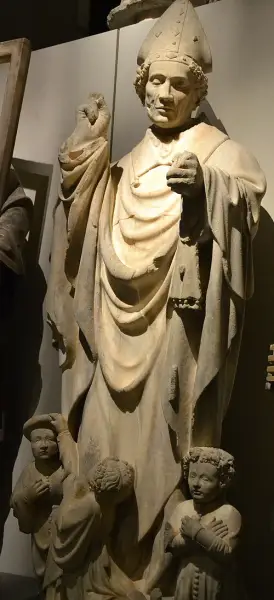
No process canonized Babylas, for none was needed; he entered the calendar of the saints by the unanimous consent of the ancient church. He is venerated in the Eastern Orthodox Church, the Eastern Catholic Churches of the Byzantine rite and the Armenian Apostolic Church, which keep his feast on 4 September, while the Roman Rite commemorates him on 24 January. He appears in the long lists of martyrs that the church has always kept, and is numbered among the martyrs who are saints of the Catholic Church. His cult rests on the oldest foundation possible, the memory of a bishop who died for the faith in prison, and it was reinforced in the fourth century by the dramatic events at Daphne, which gave his relics a fame far beyond Antioch. John Chrysostom devoted a homily to him, a mark of liturgical honour in itself, and that homily, together with the notice in Eusebius, secured his place in the historical record. Devotion to him spread with the translation of his supposed relics to Cremona in Italy, where his major shrine came to stand, and Western art preserved his image, notably in the marble group of Saint Babila with three child martyrs now in the museum of Milan Cathedral.
§ Veneration
The First Translation and the Burning of Apollo's Temple
Babylas's most lasting legacy lies in the history of relics. In 351 the Caesar Constantius Gallus raised a new church in his honour at Daphne, the pleasure suburb of Antioch famous for its temple and oracle of Apollo, and moved the bishop's remains into it. This was the first recorded translation of a saint's body for religious purposes, the opening instance of a practice that became routine in the Middle Ages. Gallus's intention, in Chrysostom's phrase, was to bring a physician to the sick: the martyr's presence was to heal a place given to paganism. The cure proved effective beyond expectation. In 362 the emperor Julian, the apostate who sought to restore the old gods, consulted the oracle at Daphne and was told that it could not speak while Babylas lay nearby. He had the sarcophagus carried back to its original grave, and a few days later, on 22 October, fire consumed the temple's roof and its statue of Apollo, a copy of Phidias's Zeus at Olympia. Julian, suspecting Christians, shut Antioch's cathedral and ordered an investigation; Ammianus Marcellinus records a rumour blaming candles left by a worshipper, while Chrysostom claimed lightning. The martyr's remains were then reinterred in a church across the Orontes, built under Bishop Meletius, who laboured on it with his own hands.
§ Veneration
Timeline
- 237
Succeeds Zebinnus as twelfth bishop of Antioch, in the reign of Gordian III
§ Life
- 250
Under the Decian persecution makes an unwavering confession of faith and is imprisoned
§ Life
- 253
Dies in prison from his sufferings and is venerated as a martyr
§ Life
- 351
Constantius Gallus builds a church at Daphne in the saint's honour and translates his remains to it, the first recorded translation of a saint
§ Veneration
- 362
Emperor Julian, told that the oracle of Apollo is mute because of Babylas nearby, has the sarcophagus returned to its original burial place
§ Veneration
- 22 Oct 362
A mysterious fire consumes the roof and statue of the temple of Apollo; Julian closes Antioch's cathedral and orders an inquiry
§ Veneration
- 362
The martyr's remains are reinterred in a church dedicated to him across the Orontes, a work promoted by Bishop Meletius
§ Veneration
In Their Own Words
bring a physician to the sick
The Record
- Symbols
- Bishop's vestments·Chains or prison fetters·Sarcophagus·Often shown with the three child martyrs Urban, Prilidian and Epolonius
- Canonization
- Pre-congregation; venerated as a martyr from antiquity in the Eastern Orthodox, Armenian Apostolic and Catholic Churches
Prayer
Bibliography
Show 5 sources
- Curtin, D. P. (October 2018), The Armenian Synaxarium - Volume I, Dalcassian Press
- Eduard Syndicus, Early Christian Art, p. 73, Burns & Oates, London, 1962
- Kirsch, Johann Peter, "St. Babylas", Catholic Encyclopedia, Vol. 2, New York, Robert Appleton Company, 1907
- Frendo, David (2007), "Dangerous Ideas: Julian's Persian Campaign, Its Historical Background, Motivation, and Objectives", Bulletin of the Asia Institute, 21
- "Άγιος Βαβύλας ο Ιερομάρτυρας επίσκοπος Αντιοχείας και τα Τρία Παιδιά που μαρτύρησαν μαζί μ' αυτόν Αμμώνιος, Δονάτος και Φαύστος", Διακόνημα (in Greek)
Profile text adapted from the Wikipedia article, licensed CC BY-SA 4.0.
Pray with this saint every day
Save St. Babylas of Antioch to your favorites, read the full profile, and get feast-day reminders in the Saints app.
Get the Saints AppFree on the App Store for iPhone and iPad