
died 10 April 376·Feast April 10 (Catholic); April 9 (Eastern Orthodox)
St. Bademus
Abbot and Martyr of Persia
Overview
Bademus, whose name also appears as Bademe and Vadim, was a wealthy and noble citizen of Bethlapeta in Persia who used his riches to found a monastery in the neighbourhood of his city and became its abbot. His life fell in the terrible persecution carried on by the Sasanian king Shapur II, which sought to break the Christian church of Persia and force its members into Zoroastrianism. In the thirty-sixth year of that persecution Bademus was arrested together with seven of his monks, and for months he lay loaded with chains in a dungeon. His fate became entangled with that of Nersan, a Christian lord, Prince of Aria, who had first held firm under the threat of torture but then agreed to conform to the state religion. To test the apostate's sincerity, Shapur moved Bademus into Nersan's chamber in the royal palace and promised to restore Nersan's rank if he would kill the abbot. Nersan agreed, but fear, shame, remorse and respect weakened his blows, and four strokes were needed to sever the martyr's head on 10 April 376. Christians carried the body away and buried it secretly, and Bademus's surviving disciples were freed in 379, after Shapur's death.
The Complete Life
A Noble of Bethlapeta
Bademus was born in the fourth century at Bethlapeta, a city of Persia, into a family at once wealthy and noble. Both qualities mattered in the Persian church of that era, for the Christian communities of the Sasanian empire contained men of standing whose position offered a measure of protection in ordinary times and a conspicuous target in times of persecution. Nothing is recorded of his parents, his education or the year of his birth; the story preserved of him begins when he was already a man of substance. What he did with his fortune is, however, on record: he founded a monastery in the countryside near his native city and set it under his own government as abbot. That act placed him among the founders of Persian monasticism, a movement that grew strong precisely in the decades when the church around it was being broken. At least seven monks were gathered under him, since seven were seized with him at his arrest, and the community evidently numbered more. He is remembered under several forms of his name, Bademe in one tradition and Vadim in another, the latter linking him to the saint known in the East as Vadim, whose memory the Syriac and Armenian calendars of the Persian church also keep.
§ Martyrology
Abbot Under a Persecuting King
Bademus's calling to the monastic life was exercised under the shadow of Shapur II, whose long reign made the fourth century a time of anguish for the church of Persia. The persecution that bears that king's name had entered its thirty-sixth year when the blow fell on Bethlapeta, which shows both how long the oppression lasted and how late in it this abbot was taken up. His vocation was therefore of the kind that expects cost. An abbot in Persia stood at the head of a visible community of converts from Zoroastrianism and of Christian families whose loyalty the crown had come to suspect, especially as Rome, the enemy of Persia, had become a Christian empire; to profess Christ was easily read as sympathy with the foe. Bademus chose nevertheless to gather monks, to teach them a common life, and to keep them faithful. The account of his arrest shows the community structure clearly: the soldiers took not the abbot alone but seven of his monks with him, and those men were kept in chains after his death, which argues that the Persian authorities understood monastic leadership as they understood any other, and struck at the head in order to scatter the body. His house near Bethlapeta thus became, in the event, a seedbed of confessors.
§ Martyrology
Chains in the Dungeon
The mission of Bademus closed where many a confessor's has closed, in a prison. Arrested with seven of his monks in the thirty-sixth year of the persecution, he lay for months loaded with chains in a dungeon, a confinement that the old accounts present as a deliberate cruelty rather than a mere holding measure. During the same period another Christian of high rank, Nersan, Prince of Aria, was imprisoned for refusing to accept Zoroastrianism. Nersan at first seemed resolved, but the sight of the tortures prepared for him broke his courage, and he promised to conform. Shapur then devised a test of the apostasy both exquisite and savage: Bademus was moved out of his dungeon into Nersan's chamber, which lay in the royal palace itself, and Nersan was told that killing the abbot would win back his princely rights and dignities. That bargain made Nersan's return to favour conditional on blood, and specifically on the blood of a man whose only crime was the faith Nersan had just betrayed. The abbot, chained and friendless in a palace chamber, thus became the instrument by which the king measured an apostate's sincerity, and the witness by which the church of Persia measured the difference between a confessor and a coward.
§ Martyrology
Invincible Patience
The spiritual quality for which the old martyrology honours Bademus is patience, and the word it uses is invincible. When the moment came, Nersan accepted the king's terms, took a sword and advanced to drive it into the abbot's chest; but a sudden terror seized him, he stopped short, and for a long while could not lift his arm to strike. Trying to harden himself, he went on trembling, aiming at the martyr's sides, while fear, shame, remorse and respect for the holy man made each stroke weak and unsteady. The wounds multiplied, and the bystanders, the account says, were struck with admiration at the sufferer's endurance. Bademus met the horror not with reproach alone but with a lament for the executioner's soul, crying out on the pitch of impiety to which Nersan's apostasy had carried him, declaring that he ran to meet death with joy, and asking only why it must be by that hand. The words reveal a spirituality entirely free of resentment: he grieves for the murderer more than for himself, even as he accepts the killing as his entrance into life. It took four strokes to complete the beheading. The contrast drawn by the story is deliberate and stern, the steadfast abbot against the wavering prince, and it was told in the church as a warning to those who might be tempted, under pressure, to buy ease at the price of faith.
§ Martyrology
Death, Burial and the Release of the Monks
Bademus was killed on 10 April in the year 376. The end was slow: Nersan's first attempt failed through terror, and the strokes that followed, weakened by the conflict in the apostate's mind, fell repeatedly on the martyr's sides before the fourth blow finally separated head from body. The Sassanid authorities then had the corpse thrown out of the city, the customary dishonour intended to deny the Christian dead a grave; but the Christians of the place came by night, carried the body away, and buried it in secret, so that the very attempt at disgrace became an occasion of devotion. Of Nersan the story records a terrible sequel: a short time after the murder he killed himself, and the church read his end as the fruit of apostasy. The seven monks arrested with the abbot remained in their chains. Their imprisonment outlived the king who had ordered it, and only in 379, after the death of Shapur II, were they released, three years after their father in religion had died in the palace chamber. The monastery's survival through those years of leaderless confinement completed the witness of its founder, for the community that had seen Bademus taken away in chains saw his confession vindicated by the fall of the persecutor.
§ Martyrology
Venerated in East and West
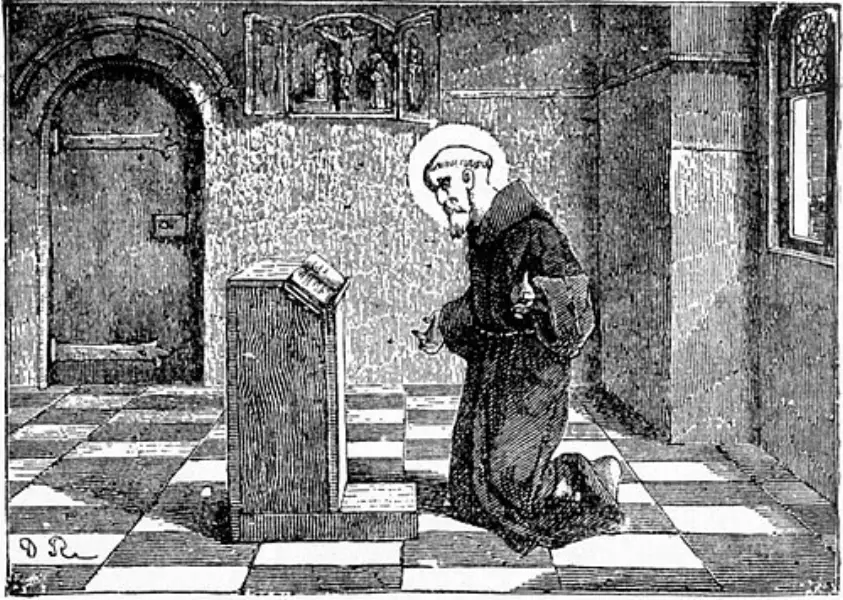
Bademus was recognised as a saint in the immediate aftermath of his martyrdom, in an age before formal canonical process, and his cult passed into both the Eastern and Western traditions. The Catholic Churches keep his feast on 10 April, the day of his death by the old reckoning, while the Eastern Orthodox Churches commemorate him a day earlier, on 9 April. He is listed among the martyrs who are saints of the Catholic Church, alongside the other victims of the Persian persecutions, and he belongs to the wider company of the Martyrs of Persia under Shapur II. His story was preserved by the hagiographers of the modern era no less than by the ancient church: Alban Butler gave him a full notice under 10 April in his Lives of the Saints, first published in the eighteenth century and reissued by Benziger Brothers in 1894, and the Little Pictorial Lives of the Saints of 1878 supplied the engraved portrait that long served as his image. Katherine Rabenstein's compilation of 1999, drawing on those sources, kept the narrative in circulation. His veneration today rests on that double foundation, the memory of the Persian church and the printed martyrology of the West.
§ Martyrology
Timeline
- 376
Arrested alongside seven monks amid Shapur II's persecution, then held for months in chains
§ Martyrology
- 10 Apr 376
Beheaded in prison by the apostate Nersan, prince of Aria, after four unsteady strokes
§ Martyrology
- Apr 376
Sassanids cast his body beyond the walls; Christians retrieve and bury it in secret
§ Martyrology
- 379
His jailed disciples are set free once King Shapur has died
§ Martyrology
In Their Own Words
Unhappy Nersan, to what a pitch of impiety do you carry your apostasy . With joy I run to meet death ; but could wish to fall by some other hand than yours: why must you be my executioner ?
The Record
- Major works
- Founded a monastery near Bethlapeta in Persia
- Symbols
- Abbot's habit·Chains·Sword, the instrument of his martyrdom
- Canonization
- Pre-congregation; recognised as a saint after his martyrdom, venerated in the Catholic and Eastern Orthodox Churches
Prayer
Bibliography
Show 2 sources
- Rabenstein, Katherine (April 1999), "Bademus of Persia, Abbot M (AC)", Saints O' the Day for July 16
- Butler, Alban (1894), "April 10.—St. Bademus, Martyr", Lives of the Saints, Benziger Brothers
Profile text adapted from the Wikipedia article, licensed CC BY-SA 4.0.
Pray with this saint every day
Save St. Bademus to your favorites, read the full profile, and get feast-day reminders in the Saints app.
Get the Saints AppFree on the App Store for iPhone and iPad