
died c. 130·Feast March 31
St. Balbina of Rome
Virgin Martyr Healed by the Chains of Peter
Overview
Balbina of Rome is venerated as a virgin martyr of the early Church, remembered together with her father Quirinus, a tribune of the Roman army. Her story survives in the Acts of Sts. Alexander and Balbina, a text of legend rather than history. Quirinus had been ordered to imprison Pope Alexander I and a Christian named Hermes because of their faith, holding the two men in distant jails and in chains. When Hermes asked to debate the pope about the afterlife, an angel freed Alexander and carried him to Hermes's cell, and the morning discovery of the prisoners together opened Quirinus's mind. He brought his daughter, who suffered from a large swelling of the throat, to the jailed pontiff; Alexander directed her instead to the chains that had once held St. Peter, and when she kissed them with devotion she was healed. Father and whole household were baptized, though Quirinus was later himself arrested and beheaded on 30 March 116. What became of Balbina afterward is imperfectly known; some accounts make her a virgin recluse until her death around 130, when she was condemned as a Christian under Hadrian and executed, by drowning or burial alive according to differing reports. She was laid beside her father in the catacomb of Prætextatus, and a basilica raised on the Aventine Hill in the fourth century still bears her name.
The Complete Life
Daughter of a Tribune
Balbina enters history as a child of Rome's governing class, the daughter of the army tribune Quirinus, in the reign of Trajan or Hadrian. Nothing certain is recorded of her birth or upbringing; what we have is legend, and the legend says the family was pagan and prosperous until the prisons of Rome changed it. Her father received orders to hold two Christians, Pope Alexander I and one Hermes, because of their faith, and he kept them in separate prisons a great distance apart, each man shackled and closely watched. Quirinus worked on Hermes, trying to win him back to the old gods, and Hermes answered that he would believe in eternal life if it could be proven; he insisted that the pope could argue the matter better than he and asked repeatedly to visit him. Permission was granted, then withdrawn when the tribune judged the visits frivolous, and the guard was tightened so the two could no longer speak. Hermes prayed that night, and an angel came to Pope Alexander and loosed his chains, and brought him across the city into Hermes's cell. When Quirinus arrived in the morning and found both men together, the impossible arrangement broke his certainty; he stayed and listened, and hearing how the pope had raised Hermes's son from the dead, he thought at once of his daughter and her affliction. The household's conversion began in a child's sickness.
§ Legend
The Healing at the Chains
Balbina's place in sacred story rests on a single act of obedience. Her father, his resistance worn down by what he had seen, told the imprisoned pope that his daughter carried a large goitre, and promised to believe and become a Christian if she could be healed. Alexander asked that she be brought to the prison where he had originally been confined. Quirinus objected reasonably enough: how could the pope be found there when he was standing here with Hermes? Alexander answered that the one who had brought him would also return him. Father and daughter hurried to the empty prison and found Alexander waiting, shackled exactly as before, and both knelt in reverence before him. What happened next fixed Balbina's iconography for all later centuries. Full of devotion, the girl began to kiss the links of the chain that bound the pope, and he corrected her, telling her not to kiss those fetters but to go out and find the chains of St. Peter, and to kiss those with devotion, and she would soon be well. Quirinus knew the place of Peter's imprisonment before his martyrdom and lost no time; he took Balbina there at once, the chains were found, she kissed them, and her throat was healed. In that redirection lies her vocation: not the veneration of the holy man before her eyes, but of the apostolic office and its sufferings. Quirinus had Alexander and Hermes pardoned and released, and with his wife and daughter was baptized by the pope.
§ Legend
A Death That Preached
Balbina left no writings and founded no community; the tradition gives her no recorded words beyond her implicit assent at the prison. Her mission, if it may be called one, was her death, the witness that the Acts and the martyrologies preserved. A second and darker account of the same period makes her father the officer ordered to execute Alexander and two other arrested Christians, Eventius and Theodolus; in that version Quirinus converted after witnessing miracles performed by the three, and was baptized with his wife and daughter Balbina. Both accounts then converge: Quirinus was arrested in his turn as a Christian and beheaded on 30 March 116, and was buried in the Prætextatus catacomb along the Via Appia, where pilgrims' itineraries of the Roman catacombs later noted his grave with great veneration. Whether his daughter witnessed the execution the texts do not say. What they do record is that Balbina did not recant what her healing had taught her. In an alternative tradition she was taken with her father in 116 and, like him, beheaded; in the more general account she lived on, some say as a virgin recluse, until the year 130. Either way the pattern holds: a household drawn to Christ through a miracle, and sealed in that faith by the sword, the water, or the earth that closed over it.
§ Death
The Devotion of the Chains
The spirituality associated with Balbina is a spirituality of reverence for the instruments of suffering. Her characteristic gesture, preserved in her attributes, is a maiden kissing the fetters of Christians held captive, an image drawn straight from the legend of her cure. It is a devotion the Church would come to know well in Rome: Pope Alexander, according to the Acts, decreed that the chain miracle deserved annual celebration ever after, and built a church of the Apostle Peter in which they have been held ever since, the church called ad Vincula, in chains, known today as St. Peter in Chains. The girl who obeyed the pope's correction rather than her own pious impulse became the type of the believer who honors not the visible holy man but the apostolic foundation and its cost. Her patronage extends this logic to the body: she is invoked against scrofula, struma, goitre, and diseases of the throat, the very affliction from which she was delivered. In her the physical cure and the act of faith are inseparable, and later generations of the sick have been invited to approach her as one who knows what it is to carry a swelling that shames and burdens, and to be freed of it by contact with what grace has touched. Her virginity, remembered in her traditional title, completes the picture of a life given wholly to the God who healed her.
§ Legend
Recluse and Martyr
The years after her father's death are the least documented of Balbina's life. Some accounts record her as spending the rest of her life as a recluse and nun, dying in 130, a life of withdrawal and prayer spent in the city where her father had died for the faith and where the chains of Peter were already an object of pilgrimage. The general consensus of the tradition is that in the year 130 she was convicted of the Christian name and condemned to death by the Emperor Hadrian. The manner of her execution is disputed between two grim alternatives, drowning or being buried alive; the Acts did not preserve the detail with certainty, or later copyists lost it. An alternative account compresses the story, having her taken with Quirinus in 116 and put to death by the sword as he was. In either version she died young, unrecorded by any civil historian, and known to posterity only because the Christians of Rome refused to forget her. After her death her body was laid beside her father's in the Prætextatus catacomb on the Appian Way, father and daughter lying together as they had converted together, and afterwards the bones and relics of both were carried to the church built in her honor in the fourth century. The grave that the old pilgrim guides noted with reverence became, in time, an altar.
§ Death
A Saint of the Martyrologies
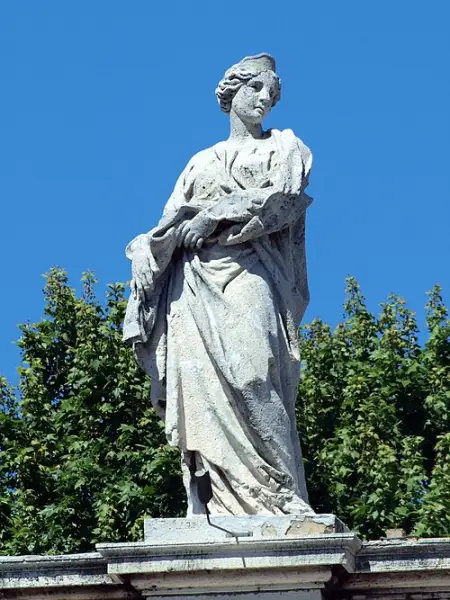
Balbina was canonized by no process, because none existed; she entered sanctity the way the early martyrs did, by the unanimous memory of the Church that buried her. Her name is carried by the martyrology of Usuardus, the ninth-century compilation whose account of her is built upon the story of Alexander I's martyrdom, and through him she belongs to the oldest stratum of Roman hagiology. Those legendary Acts of Alexander and Balbina, whatever their historical weight, were the document by which the Church kept her story alive, cited in the Bollandist collections at acta SS., Maii, I, 367 sqq. and studied by scholars such as Dufourcq. Her cult crosses confessional lines: she is venerated in the Catholic Church and in the Eastern Orthodox Church, and her feast falls on 31 March, the day after her father's commemoration on 30 March, keeping the pair together in the calendar as they were kept together in the catacomb. The churches of Rome gave her cult its architectural confirmation, with a basilica bearing her name raised on the Aventine in the fourth century and her relics honored beneath its altar. When the modern Church formalized its memory of the saints in stone, she was counted among the one hundred and forty figures atop the colonnade of St. Peter's Square, a virgin of the second century watching over the square built above the apostle whose chains had healed her.
§ Veneration
Santa Balbina on the Aventine
Balbina's most enduring monument is the basilica of Santa Balbina in Rome, built in the fourth century over the Aventine house of the consul Lucius Fabius Cilo, behind the Baths of Caracalla. It must not be mistaken for a catacomb bearing the saint's name, the coemeterium Balbinae, lying between the Appian Way and the Ardeatine Way, close by the small church known as Domine quo vadis; over that cemetery Pope Mark erected another basilica in the fourth century, now lost. The Aventine church carries a curious imperial memory of its own: tradition has it that there, Constantine took leave of the Pope there before departing for Constantinople, a farewell between the founding emperor of Christian Rome and the bishop who was leaving it for a new capital. The majority of Balbina's relics are said to remain in the altar of Santa Balbina, while some reached Cologne Cathedral in the Middle Ages, probably when Pope Leo IX gave Quirinus's body in 1050 to Gepa, abbess of Neuss, described as the pope's sister. In the late fifteenth or early sixteenth century her skull was taken from her body and enclosed in a reliquary bust of ornate workmanship, a South Netherlandish work preserved today in New York's Metropolitan Museum of Art, and her statue stands among the one hundred and forty saints of St. Peter's Square.
§ Basilica of Santa Balbina
Timeline
- 116
In the legend, her father Quirinus, her mother, and Balbina herself are baptized by Pope Alexander I after her goitre is healed through Peter's chains.
§ Legend
- 116
An alternative tradition arrests Balbina alongside her father and beheads her in the same manner that year.
§ Death
- 30 Mar 116
Quirinus, having in turn been seized as a Christian, is beheaded this day and laid to rest in the Prætextatus catacomb beside the Appian Way.
§ Legend
- 130
Per the general consensus, she is found guilty of Christianity and sentenced to death by Emperor Hadrian, by drowning or burial alive.
§ Death
- 130
In some tellings she lives on as a recluse virgin until dying this year; she is buried next to her father in the Prætextatus catacomb.
§ Death
- 390
A basilica is built in her honour during the fourth century, over the Aventine house of the consul Lucius Fabius Cilo.
§ Basilica of Santa Balbina
- 1050
Some of her relics reach Cologne Cathedral, most likely near Pope Leo IX's donation of Quirinus's body to the abbess Gepa of Neuss.
§ Veneration
- 1500
Around the turn of the sixteenth century her skull is removed and set in an ornate reliquary, today in New York's Metropolitan Museum of Art.
§ Veneration
In Their Own Words
You shall not kiss these chains, but go out and find St. Peter's chains. Once you've found them, kiss them with devotion and you will soon be well.
He who brought me here, will also bring me back.
The Record
- Patron of
- Against scrofula and struma·Against goitre·Against diseases of the throat
- Symbols
- Chains·Fetters·Young woman holding a chain·Young woman kissing the chains of captive Christians
- Canonization
- Pre-congregation; ancient Roman cult confirmed by her listing in the martyrology of Usuardus and her basilica on the Aventine
Prayer
Bibliography
Show 6 sources
- Acta Sanctorum, Maii, I, 367 sqq.
- Dufourcq, Étude sur les Gesta Martyrum Romains, loc. cit., 175.
- "Den katolske kirke – Den hellige Balbina av Roma (-~130)". Katolsk.no. Retrieved 1 December 2014.
- "Saints.SQPN.com". Saints.sqpn.com. Retrieved 1 December 2014.
- "San Quirino". Santiebeati.it. Retrieved 1 December 2014.
- "Reliquary Bust of Saint Balbina – South Netherlandish – The Metropolitan Museum of Art". Metmuseum.org. Retrieved 1 December 2014.
Profile text adapted from the Wikipedia article, licensed CC BY-SA 4.0.
Pray with this saint every day
Save St. Balbina of Rome to your favorites, read the full profile, and get feast-day reminders in the Saints app.
Get the Saints AppFree on the App Store for iPhone and iPad