
7th century·Feast October 16
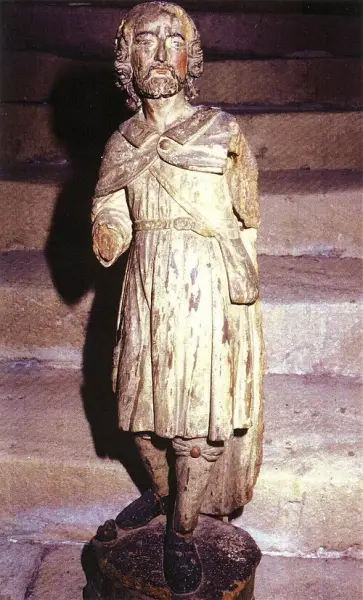
St. Balderic of Montfaucon
Founding Abbot of Montfaucon in Lorraine
Overview
Balderic, also spelled Baudry, was a seventh-century Frankish priest who founded Montfaucon, a monastery in Lorraine province. According to oral tradition written down three centuries later by Flodoard, canon of Reims, he and his sister Beuve were children of Sigebert I, king of Austrasia, and the family is further said to have been related to King Dagobert. Balderic was ordained to the priesthood and later established Montfaucon, which became the anchor of his religious life and the house where he guided others. Among those he formed was Saint Wandregisel, known also as Wandrille, who came to stay at Montfaucon in 628 after separating from his wife, and who counted Balderic as his tutor. In 639 Balderic founded a second house, a convent at Reims, St-Pierre-les-Dames, for Beuve his sister; she governed it as abbess and was succeeded in that office by Dode, the niece of the two founders. Balderic died at Reims while visiting his sister. His memory is kept in the Roman Martyrology tradition on 16 October.
The Complete Life
A Prince of the Merovingian Line
Balderic and his sister Beuve, who appears under the variant names Bove and Bova, lived in seventh-century France. The tradition concerning their origin is royal: they are reputed to have been children of Sigebert I, king of Austrasia, though this claim rests on tradition handed down by mouth until Flodoard, a canon of Reims, wrote it three centuries afterward. The same family memory connects them to King Dagobert, presumably the first Dagobert of Austrasia, one of the last significant Merovingian rulers. If the genealogy holds, Balderic was born into the turbulent and privileged world of the Frankish courts, where dynastic murder and monastic foundation sat close together and where the conversion of a prince's household into a house of monks was a familiar path out of worldly danger. What survives is the direction his life took: away from inheritance and toward the altar. The distance between the claims of Flodoard's informants and the recoverable facts is large, and honest reverence for the saint begins by admitting it, while recognizing that a cult remembered in Reims and Lorraine for fourteen centuries is itself a fact.
§ Balderic of Montfaucon
Priest and Founder at Montfaucon
Balderic's vocation unfolded in two foundations, one for monks and one for women religious. Ordained a priest of the Frankish Church, he went on to found Montfaucon, a monastery in Lorraine province, the house that gives him his distinguishing name and the center of his subsequent life. Montfaucon's importance in his story is visible in the people it drew: in 628 Saint Wandregisel, afterwards famed as Wandrille and founder of his own great abbey, came to stay at Montfaucon after separating from his wife, and Balderic served as his guide and tutor during the years that formed that saint's monastic vocation. The second foundation came in 639, when Balderic established a convent at Reims, St-Pierre-les-Dames, for Beuve his sister. It was a family enterprise in the deepest sense: Beuve, herself remembered as a saint, became the community's abbess, and on her death the office passed to Dode, also called Doda, the daughter of their brother and thus niece to both founders. A priest founding a convent for his sister, whose abbess-successor was their own niece, gives us a picture of Merovingian sanctity working through kinship networks, turning royal blood into monastic continuity, and securing for women of the family the same consecrated life the men had chosen.
§ Balderic of Montfaucon
Remembered at Reims
Balderic's death came at Reims, on a visit to his sister the abbess Beuve. The circumstance is small and telling: the founder of Montfaucon, the man whose counsel had set Wandregisel on the monastic path, died not in his own abbey but in the company of the sister for whom he had built St-Pierre-les-Dames, the house she governed. No miracles at his tomb, no vita of his own, and no further circumstances of his passing are recorded; his historical footprint is a foundation, a family, and a feast. That feast is kept on 16 October, and his veneration belongs to the Roman Catholic Church. The printed authorities behind the brief record are modest but respectable: the Monks of Ramsgate's Book of Saints of 1921, Katherine Rabenstein's compilation of saints of the day, and the older standard works of Alban Butler, whose Lives of the Saints carried such Merovingian abbots to modern readers, together with the Catholic Encyclopedia of 1913. Balderic's legacy is best measured through those he influenced: Wandregisel, whom he tutored at Montfaucon, carried the monastic ideal forward into one of the important foundations of northern Gaul, and the convent at Reims continued the work of prayer through Beuve and Dode after him.
§ Balderic of Montfaucon
Timeline
- 628
Guides and tutors Saint Wandregisel, who takes refuge at Montfaucon after parting from his wife.
§ Balderic of Montfaucon
- 639
Establishes the convent of St-Pierre-les-Dames at Reims for his sister Beuve, its first abbess.
§ Balderic of Montfaucon
The Record
- Major works
- Monastery of Montfaucon (foundation)·Convent of St-Pierre-les-Dames, Reims (foundation, 639)
- Symbols
- Abbot's crozier
- Canonization
- Pre-congregation; honored by ancient tradition in the Roman Catholic Church with feast on 16 October
Prayer
Bibliography
Show 5 sources
- Monks of Ramsgate. "Balderic". Book of Saints, 1921. CatholicSaints.Info, 18 August 2012.
- Rabenstein, Katherine (1998). "Reineldis VM (RM)". Saints of the Day for October 16. Retrieved 2008-01-03.
- Butler, Alban. "Wandregisel", Lives of the Saints, edited by Thurston and Attwater.
- Butler, Alban. Lives of the Fathers, Martyrs and Other Principal Saints. J. Duffy, 1866.
- Catholic Encyclopedia, 1913.
Profile text adapted from the Wikipedia article, licensed CC BY-SA 4.0.
Pray with this saint every day
Save St. Balderic of Montfaucon to your favorites, read the full profile, and get feast-day reminders in the Saints app.
Get the Saints AppFree on the App Store for iPhone and iPad