
died 6 March 757·Feast March 6
St. Baldred of Tyninghame
Hermit of the Bass Rock, Apostle of the Lothians
Overview
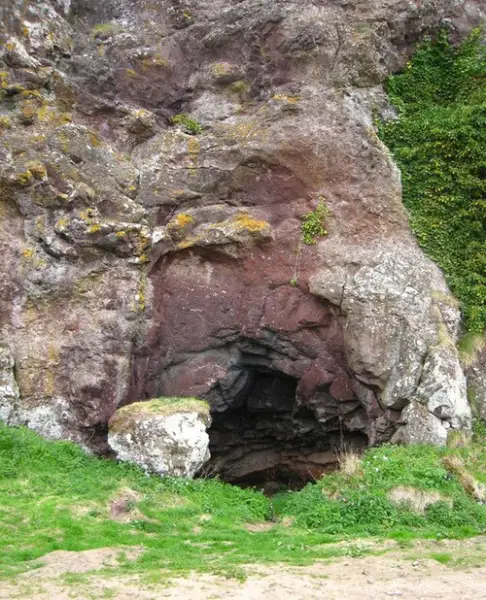
Baldred, called Balthere in the older records, was a Northumbrian hermit and abbot of the eighth century who worked in what is now East Lothian, Scotland. Known as the Apostle of the Lothians, he is credited with founding the monastery of Tyninghame, and the boundaries of his pastorate, in the words of Symeon of Durham, ran from Lammermuir to Inveresk at the mouth of the Esk. Most sources give him an Irish birth and connect him with the Northumbrian mission of the Lindisfarne tradition, though he lived in the diocese of Lindisfarne and is counted a Northumbrian, the Lothians then forming part of that kingdom. Periodically he set aside his spiritual rule over the Britons of Lothian and withdrew to the Bass Rock, the steep island in the Firth of Forth, where he built himself a small hermitage with a chapel, and he also at times dwelt in his cave above Seacliff Beach. His cult centered on four churches between East Linton and North Berwick, at Auldhame, Whitekirk, Tyninghame and Prestonkirk, which after his death disputed which of them should hold his body. He died on 6 March 757 at the site of his chapel on the Bass, and the calendar of the Scottish Episcopal Church keeps his feast on that day.
The Complete Life
An Irishman in Northumbria
The origin of Baldred, whom the earlier records call Balthere of Tyninghame, is stated with an unusual degree of candor about uncertainty. He is reported to have lived within the Lindisfarne diocese, and so to rank as a Northumbrian, an association that is not improbable, since in his day the Lothians formed part of the kingdom of Northumbria. Yet most sources assert an Irish connection, and an Irish birth is most likely, he having come to the Northumbrian mission from that island, one of the many monks of the Celtic church who crossed the sea to labor in Anglo-Saxon territory. Hector Boece, the Scottish historian whose Historia Gentis Scotorum appeared in 1527, adds a different frame altogether, saying that Baldred's ministry was exercised in territory that belonged in his day to Pictland. The claims are not irreconcilable for an eighth-century missionary working on a frontier where kingdoms met and overlapped. The confusion has a long history: because of a passage in the sixteenth-century Aberdeen Breviary, Baldred was often associated in the past with Kentigern, the great sixth-century saint of Glasgow, though the eighth-century date is now generally accepted. What emerges from the disagreement is the outline of a missionary whose labors sat on the seams of nations, and whom several peoples accordingly claimed.
§ Nationality
The Apostle of the Lothians
Baldred's vocation joined the two halves of the eremitical and pastoral life that would define him. He is customarily styled the Apostle of the Lothians, the evangelist of a broad tract of country between the Lammermuir hills and the sea, and he is credited with founding the monastery of Tyninghame, the house whose name he carries. Symeon of Durham, the medieval chronicler who is our principal witness, sets out the bounds of his charge with legal precision, describing the whole land belonging to the monastery of Saint Balther from Lammermuir to Inveresk, or Eskmouthe as the river mouth was then called. It was a wide responsibility for one man, covering the fertile coastal plain of what is now East Lothian, and its weight may explain his withdrawals. At times he preferred to lay down the spiritual rule of the Britons of Lothian, choosing the Bass Rock, the sheer volcanic plug that rises from the Firth of Forth, as the place where he would raise a little hermitage for himself, with a chapel attached. He did not always keep even that distance, for he also sometimes resided in St Baldred's Cave on Seacliff Beach, a shelter on the mainland shore facing his island. The rhythm of his life was thus an alternation: ministry among the people, then solitude with God, then ministry again, the classic pattern of the Northumbrian church that Aidan and Cuthbert had made famous before him.
§ Life
From Lammermuir to the Sea
The scope of Baldred's missionary work can be read from the map of the cult he left behind. Four churches certainly formed the center of his cult: Auldhame, Whitekirk, Tyninghame and Prestonkirk, all lying in East Lothian between East Linton and North Berwick, a tight cluster of foundations that marks the heartland of his activity. Within that country he preached, baptized, and governed a Christian people whose conversion from older loyalties the Northumbrian church had begun within living memory of his birth. The office he held placed him in succession to the Ionan and Lindisfarne tradition, carrying the gospel from the monastic centers out through villages and farmsteads. Tyninghame, the monastery he is credited with founding on the Tyne estuary, served as his base, and its church continued as the parish church of the village for nearly a thousand years after him. Whitekirk's parish church, famed since antiquity as a pilgrimage destination, likewise claims to the saint as the scene of his ministry, though A. E. Ritchie, the nineteenth-century historian of these churches, finds the claim doubtful. The dispute itself, spread across four parishes and several centuries, is the strongest evidence of the mission's breadth: a saint whose work could plausibly be claimed by so many places must have labored widely among them, and the people of the Lothians remembered their apostle in the very geography of their church life.
§ Veneration
The Cell on the Rock
The spiritual center of Baldred's memory is a rock in the sea. About halfway up the Bass Rock stand the ruins of an old chapel, properly the parish church of the Bass, which tradition identifies with the place where the saint kept his humble cell. That he chose such a place at all is the key to his inner life: the Bass is a steep-sided island, storm-lashed in winter and alive with seabirds in summer, and a man who built himself a hermitage there was not seeking picturesque retirement but the hard freedom of solitude before God. The associated chapel tells us that his solitude remained eucharistic, centered on prayer and the liturgy rather than on escape. Yet even this retreat he did not hold permanently, for he also sometimes resided in St Baldred's Cave on Seacliff Beach, returning to the mainland shore, close enough to the people to be reached. His pattern of withdrawal and return gives the lie to any picture of the hermit as a fugitive from responsibility: the man who governed the church of the Lothians from Lammermuir to the Esk was the same man who knelt alone on the rock. The well that bears his name near Prestonkirk, famed in tradition for its healing qualities, belongs to the same spirituality, the conviction that the place touched by a praying man becomes itself a channel of grace. In Baldred the Celtic love of wild places and the pastoral burden of an apostle were held in one life.
§ Life
Death on the Bass
Baldred died on the site of his chapel on the Bass Rock, and the dating of his death exercised the medieval chroniclers in a way that shows how carefully they kept his memory. According to Hovendeus the date is 756; Symeon of Durham assigns it to the twentieth regnal year of Eadberht of Northumbria, Turgot of Durham to Cynulf's seventeenth year as bishop, which is likewise 756. Since his feast is 6 March, the modern calendar yields 6 March 757, the date now accepted. The eighth-century chronology, however, was not always conceded. Because of a passage in the sixteenth-century Aberdeen Breviary, he was in the past often associated with Kentigern, the sixth-century apostle of Strathclyde, and only patient work on the Durham sources restored him to his own century. He died as he had often chosen to live, alone on his island with a chapel at hand, at the edge of the parish country he had served. The manner of his passing is not recorded beyond the fact of it, but the sequel is: his body became at once the object of rivalry among the parishes he had evangelized, a competition that shaped the legend of his burial and the translation of his relics in the centuries that followed. A hermit in life, in death he could not be left alone.
§ Dating
Three Bodies for Three Parishes
No formal act of canonization marks Baldred's entry into the calendar of saints; his sanctity was asserted by the people and parishes among whom he worked and by the religious houses that claimed his relics. The most colorful expression of that popular recognition is the legend that followed his death. The parishes of Auldhame, Tyninghame and Prestonkirk fell into dispute as to which should have his body, and on the counsel of a holy man they passed the night in prayer, and when morning came three bodies lay ready for burial, each wrapped in its winding sheet, indistinguishable one from another, and each parish took one home. The story was likely devised to account for the insistence of every parish that it held the shrine of Saint Baldred. Whatever its origin, it captures something true about his cult, which was always local, plural, and physical, centered on graves, shrines, statues, and wells rather than on documents. The Scottish Episcopal Church keeps his commemoration on 6 March in its own calendar of saints, and the Episcopal church at North Berwick is dedicated to him. He is venerated in the Catholic Church, in Anglicanism, and in the Orthodox Church, a triple recognition fitting for a saint who worked on the frontiers of three nations' later histories.
§ Veneration
Ruins, Wells, and a Church in the Gardens
The physical legacy of Baldred runs across the East Lothian landscape. On the Bass Rock the chapel ruins survive halfway up the island, their approximate date of erection or re-erection fixed by a papal bull of 6 May 1493 that describes the building as then novita erecta, newly built, with a further reconsecration in 1542 when the chapel was dedicated to him. In the grounds of Tyninghame House lies the twelfth-century St Baldred's Church, traditionally occupying the ground of his monastery, sacked, so the Melrose Chronicle records, by Danish raiders in 941. In the early eleventh century Alfred Westow carried the Tyninghame remains to Durham Cathedral. It remained the parish church until 1761, when the village of Tyninghame moved westward, after which its ruins dwindled into little more than an architectural folly among the gardens of the great house. At Prestonkirk Parish Church a statue of the saint, greatly revered by the local people, survived until 1770, when a builder damaged it; St Baldred's Well stands nearby, famed in tradition for its healing qualities. Whitekirk's church, once a celebrated place of pilgrimage, also claims him. The Episcopal church of North Berwick bears his dedication, and on Bass Rock itself the ornithologist Bryan Nelson much later camped within the ruined chapel walls while studying the island's seabird colonies.
§ Veneration
Timeline
- 6 Mar 757
Dies on 6 March at his hermitage on the Bass Rock, in King Eadberht of Northumbria's twentieth regnal year
§ Dating
- 941
The Tyninghame monastery is sacked by the Danes, according to the Melrose Chronicle
§ Veneration
- 1010
In the early eleventh century the Tyninghame body of Saint Baldred is translated to Durham Cathedral by Alfred Westow
§ Veneration
- 6 May 1493
A papal bull of 6 May describes the chapel on the Bass Rock as newly erected on the site of Baldred's cell
§ Veneration
- 1542
The Bass Rock chapel is reconsecrated and dedicated to Saint Baldred, marking further building work
§ Veneration
- 1761
The village of Tyninghame is relocated westward, ending St Baldred's Church's service as the parish church
§ Veneration
- 1770
A much-venerated statue of the saint at Prestonkirk Parish Church is damaged by a builder
§ Veneration
The Record
- Major works
- Monastery of Tyninghame (foundation)·Chapel and hermitage on the Bass Rock
- Symbols
- Hermit's cell on a sea rock·Bishop's or abbot's dress of the Northumbrian church
- Canonization
- Pre-congregation; early medieval cult in the kingdom of Northumbria, commemorated on 6 March
Prayer
Bibliography
Show 8 sources
- Stephenson, Joseph (trans.) (1988). Simeon of Durham's A History of the Church of Durham. Felinfach: Llanerch.
- Towill, Edwin Sprott (1983). Saints of Scotland. Edinburgh: St Andrew's Press.
- Jackson, Kenneth H (1958). "The Sources for the Life of St. Kentigern". Studies in the Early British Church.
- Ritchie, A. E. (1880). The Churches of Saint Baldred. Edinburgh.
- Ritchie, A.E., The Churches of St. Baldred: Auldhame, Whitekirk, Tyninghame, Prestonkirk, p. 26, J. Moodie Miller, Edinburgh, 1883.
- Yeoman, Peter (1999). Pilgrimage in Medieval Scotland. London & Edinburgh: B T Batsford & Historic Scotland.
- Farmer, David Hugh (2004). The Oxford Dictionary of Saints. Oxford: Oxford University Press. ISBN 978-0-19-860629-1.
- Boece, Hector (1527). Historia Gentis Scotorum.
Profile text adapted from the Wikipedia article, licensed CC BY-SA 4.0.
Pray with this saint every day
Save St. Baldred of Tyninghame to your favorites, read the full profile, and get feast-day reminders in the Saints app.
Get the Saints AppFree on the App Store for iPhone and iPad