
died 1140·Feast July 24
St. Baldwin of Rieti
Benedictine Abbot of San Pastore and Disciple of Clairvaux
Overview
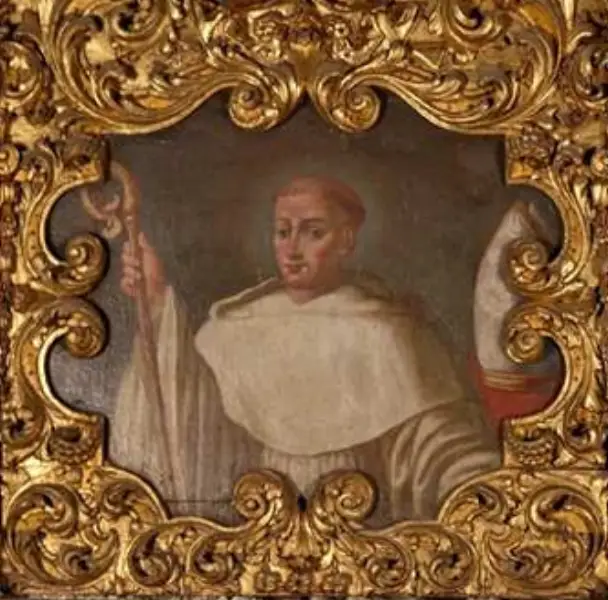
Baldwin of Rieti was a Benedictine abbot of the twelfth century and one of the Italian disciples of St. Bernard of Clairvaux. Born in Italy, he left his homeland as a young man to embrace monastic life at Clairvaux, Bernard's great house in France, then at the height of its influence as the beating heart of the Cistercian renewal. There he came under the sway of the reforming spirit that Bernard carried across Europe. In later years Baldwin was sent back across the Alps to serve the order in his native land, governing as abbot of San Pastore, a monastery in the countryside near Rieti in central Italy. He directed that community for the remainder of his days and died there in 1140. His memory is kept on 24 July, and the city of Rieti honors him as its heavenly patron. An eighteenth-century image of the saint survives in the carved choir stalls of the monastery of São João de Tarouca in Portugal, a quiet sign of how far his cult traveled along monastic lines.
The Complete Life
An Italian at Clairvaux
The surviving record of Baldwin's beginnings is brief but firm on the essentials: he was an Italian by birth who, as a young man, crossed the mountains to France and entered the monastery of Clairvaux. That single decision placed him inside the most consequential religious movement of his generation. Clairvaux, founded barely a generation earlier, had become under St. Bernard of Clairvaux the engine of Cistercian expansion and the intellectual and spiritual center of the Latin West. Italian recruits were not uncommon there; Bernard's fame drew men from every corner of Europe who wished to live the reformed Benedictine life in its strictest form. For an Italian pilgrim to monastic conversion, the journey to Burgundy or Champagne was both a literal exile from family and homeland and a symbolic entry into the universal church of the cloister. Baldwin's formation unfolded in that atmosphere of austerity, manual labor, and liturgical prayer, under the shadow of an abbot whose letters, sermons, and personality shaped a generation of monks. What Baldwin absorbed at Clairvaux he would later carry home.
§ Baldwin of Rieti
Abbot of San Pastore
Baldwin's mature vocation united the two worlds of his life: the Cistercian training of France and the pastoral soil of his native Umbrian borderlands. After his years at Clairvaux as a follower of St. Bernard, he was assigned to Italy and made abbot of San Pastore, a monastery situated near Rieti. The appointment reflects the ordinary machinery of twelfth-century monasticism, in which trained men from the mother houses were sent out to lead daughter foundations and to implant the observances of the reform in new regions. As abbot, Baldwin stood at the head of a community of monks living under the Benedictine tradition as the Cistercians had sharpened it, responsible for their souls, their discipline, and the lands that sustained them. The Sabine country around Rieti, already dense with ancient monasteries, received through such men the newer currents flowing from Burgundy. Baldwin's authority was not that of a writer or a diplomat but of a superior who held a house steady, and he would hold this office until death released him from it.
§ Baldwin of Rieti
A Death at Rieti and an Enduring Cult
Baldwin spent the whole of his final period at San Pastore, remaining near Rieti until his death in 1140. The year places him squarely within the second generation of the Cistercian story: Bernard of Clairvaux himself still had more than a decade to live, and the white monks were spreading across Italy at an accelerating pace. Baldwin died as he had lived, an abbot in office, and his memory settled quickly into local devotion. The city of Rieti came to regard him as its patron saint, and his feast is kept on 24 July. Evidence of his wider reputation survives in an unexpected place: an eighteenth-century depiction of the saint, carved among the choir stalls of the monastery of São João de Tarouca in Portugal, shows that his name was known and honored in Cistercian houses far beyond Italy. That a modest Italian abbot should appear in the woodworking of a Portuguese monastery testifies to the dense network of memory that bound the order's houses together, each praying the saints of the whole Cistercian family.
§ Baldwin of Rieti
The Record
- Patron of
- Rieti, Italy
- Canonization
- Pre-congregation; honored as a Benedictine saint and the patron of Rieti
Prayer
Bibliography
Show 1 sources
- St. Baldwin, Catholic Online
Profile text adapted from the Wikipedia article, licensed CC BY-SA 4.0.
Pray with this saint every day
Save St. Baldwin of Rieti to your favorites, read the full profile, and get feast-day reminders in the Saints app.
Get the Saints AppFree on the App Store for iPhone and iPad