
died 6 January 55 AD (traditional)·Feast January 6
St. Balthazar
Magus and King of Arabia, Bearer of Myrrh
Overview
Balthazar, whose name also appears as Balthasar, Balthassar, and Bithisarea, is the figure of Western Christian tradition who, with Caspar and Melchior, makes up the three Magi — the wise men or kings who came to the infant Jesus after his birth. Tradition styles him the King of Arabia and assigns him the gift of myrrh, the costly ointment that foreshadowed a king's death. The Gospel of Matthew names none of the Magi; the names enter history through a Greek manuscript of about 500 AD, rendered into Latin, in which this king appears as Bithisarea, a form that Western usage reshaped into Balthazar. The Ethiopian Orthodox Tewahedo Church preserves its own identification of him with Bazen of Axum. In art his image changed dramatically over time: early depictions show a white man, an eighth-century Pseudo-Bede text calls him a dark, fully bearded king, and from the fifteenth century Renaissance painters show him as a black African sovereign. Purported relics of the Magi, taken from Constantinople to Milan in 344 and translated to Cologne in 1164, rest in the Shrine of the Three Kings. His feast falls on 6 January.
The Complete Life
A Name Born of Tradition
Nothing in Scripture tells us who the Magi were. The Gospel of Matthew, the only evangelist to record their coming, gives neither their names nor even their number, and it is from a much later source that the familiar names descend: a Greek manuscript of about the year 500, translated into Latin, is generally accepted as the origin of the three names as Western Christianity received them. In that original text the king later called Balthazar appears under the older form Bithisarea, which Western usage gradually reshaped into Balthasar, Balthassar, and finally Balthazar. Tradition assigned each of the three a realm and a gift; Balthazar became the King of Arabia and the bearer of myrrh. Most scholars take the Magi to have been Zoroastrians — priests of Persia who read the heavens, and whose habit of scanning the sky for signs readied them to greet the star of Bethlehem. A striking variant survives in Ethiopia, where the ancient tradition of the Ethiopian Orthodox Tewahedo Church identifies Balthazar with Bazen, a ruler of Axum, enrolling the Magi into the historical memory of the Aksumite kingdom and giving African Christianity its own claim on the wise king.
§ Tradition
The Road to the Manger
The mission that defines Balthazar is the journey itself. Guided by the Star of Bethlehem, the Magi made their first stop at the palace of Herod the Great; he told them to bring him word when they had located the Child — a command that, as the Gospel makes plain, concealed a darker purpose. Warned and guided, they went on to the manger, where they worshipped the infant Jesus and offered their gifts. Balthazar's portion was myrrh, an aromatic resin of great price in the ancient world, and tradition read in it a prophecy of suffering: the ointment of burial, laid before a king whose kingdom would be won through death. Having paid homage, the Magi returned to their own country by another route, avoiding Herod and so defeating his design. Later legend carried the story further: it is purported that Balthazar kept Christmas with Caspar and Melchior in Armenia in the year 54, a last reunion of the three companions, and that he died on 6 January in the year 55, at the age of one hundred and twelve. The date of that traditional death became his feast day, so that the church honors him each year on Epiphany, the very season of his adoration.
§ Tradition
Relics from Constantinople to Cologne
The story told after Balthazar's death is in large part the story of his bones. By medieval account, the remains of the three Magi were taken from Constantinople in the year 344 by Eustorgius I, who carried them to Milan, where they rested for eight centuries as one of the city's treasures. In 1164 the Holy Roman Emperor Frederick Barbarossa, having asserted imperial power over Milan, had the relics translated to Cologne, and there they remain, enshrined in the Shrine of the Three Kings within Cologne Cathedral, one of the great pilgrimages of the Middle Ages and still the principal shrine associated with Balthazar. The presence of the relics fixed the Magi deep in the religious imagination of the German world, and it is fitting that among the patronages tradition assigns to Balthazar are Cologne itself, Germany, and Saxony, alongside causes that echo his own story: pilgrims, travellers, and travelling merchants, those who journey far as he did. He is commemorated on Epiphany together with the other Magi; in Catholic usage his feast falls on 6 January, kept as the traditional day of his death.
§ Commemoration
The Changing Face of a King
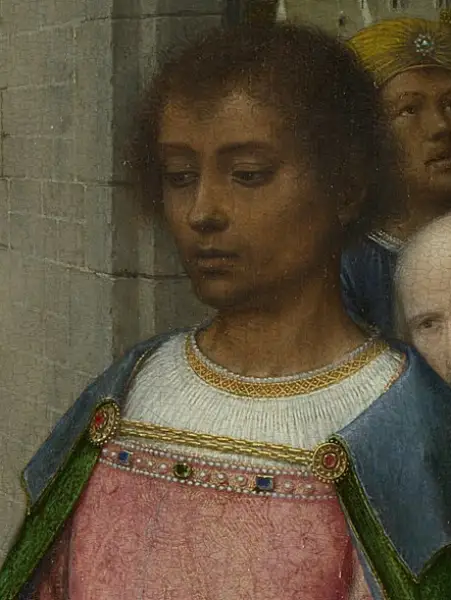
Few saints have been painted so differently across the centuries. Early Christian art shows Balthazar as a white man; in a Byzantine mosaic of about 565 at Sant'Apollinare Nuovo in Ravenna he appears among the Magi without any distinguishing darkness. A text of the eighth century ascribed to Pseudo-Bede describes him as a dark, fully bearded king, and from the thirteenth century onward he was occasionally shown attended by black African servants. Only in the fifteenth century did European Renaissance art first depict Balthazar himself as a black African, a change that gathered force precisely as the Portuguese Atlantic slave trade developed in the late 1400s. In devotional triptychs he increasingly appears as a man of color bearing the regalia of European royalty: Hans Memling painted him in 1470 wearing ermine and holding a covered beaker, by the 1490s the gift often took the shape of a horn, and Pieter Coecke van Aelst repeated the motif in 1530. His image lives on in popular devotion as well as art — Balthazar and Gaspar appear in Lew Wallace's 1880 novel Ben-Hur and its film adaptations — and even in natural history, where a red alga of New Zealand's Manawatāwhi Three Kings Islands bears his name. In Spain and other countries, the custom of portraying him in Epiphany cavalcades, long done with blackface makeup, has in recent decades given way to calls for performers of African descent to take the role, a living debate over the meaning of a king who came to stand for all the peoples of the world.
§ Blackface controversy and traditional iconic representation
Timeline
- 54
According to the traditional account, celebrates Christmas in Armenia together with the other Magi after returning home by another road.
§ Tradition
- 6 Jan 55
Dies on 6 January at the age of 112, the date now kept as his feast.
§ Tradition
- 344
Eustorgius I conveys the supposed remains of the Magi from Constantinople to Milan.
§ Commemoration
- 565
A Byzantine mosaic at Sant'Apollinare Nuovo in Ravenna shows Balthazar among the three Magi.
§ Tradition
- 700
In a text of this century attributed to Pseudo-Bede, Balthazar is described as a dark, fully bearded king.
§ Tradition
- 1164
Emperor Frederick Barbarossa translates the relics of the Magi to Cologne, where they rest in the cathedral.
§ Commemoration
- 1400
Over the course of this century, European Renaissance art first presents Balthazar as a black African himself.
§ Tradition
- 1470
Hans Memling paints Balthazar in ermine fur, holding his gift as a covered beaker.
§ Tradition
- 1530
Pieter Coecke van Aelst depicts Balthazar with a gift in the shape of a horn.
§ Tradition
In Their Own Words
a dark, fully bearded king
The Record
- Patron of
- against epilepsy·against thunder·motorists·pilgrims·playing card manufacturers·sawyers·travellers·travelling merchants·Cologne·Germany·Saxony
- Symbols
- king bearing gifts·king on a camel·three crowns·dark skin
- Canonization
- Pre-congregation; venerated in the Catholic Church, the Eastern Orthodox Church, and Lutheranism
Prayer
Bibliography
Show 6 sources
- Collins, Kristen; Keene, Bryan C., eds. (2023). Balthazar: A Black African King in Medieval and Renaissance Art. Getty Publications. ISBN 9781606067857.
- "Balthasar". Encyclopedia Britannica.
- Metzger, Bruce. New Testament Studies: Philological, Versional, and Patristic, Volume 10. BRILL, 1980. ISBN 9004061630.
- Tischler, Nancy (2010). All Things in the Bible: M-Z. Greenwood Publishing Group. p. 476. ISBN 978-0313330841.
- Freeman, Margaret (1978). The story of the Three Kings: Melchior, Balthasar and Jaspar. Metropolitan Museum of Art. p. 67. ISBN 9780870991806.
- "Magi". Catholic Encyclopedia. 1 October 1910.
Profile text adapted from the Wikipedia article, licensed CC BY-SA 4.0.
Pray with this saint every day
Save St. Balthazar to your favorites, read the full profile, and get feast-day reminders in the Saints app.
Get the Saints AppFree on the App Store for iPhone and iPad