
c. 626 – 30 January 680·Feast January 30
St. Balthild of Chelles
Anglo-Saxon Slave Who Became Queen and Regent of Francia
Overview
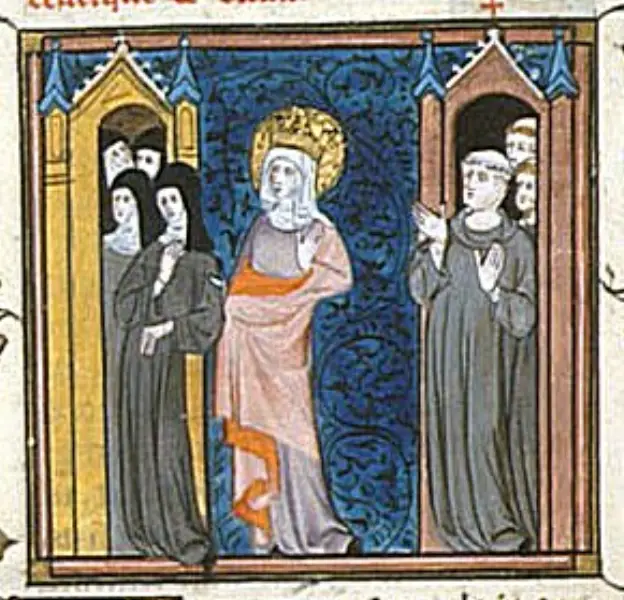
Balthild, also spelled Bathilda, Bauthieult or Baudour, was born an Anglo-Saxon around 626 and rose from servitude in a Frankish household to become queen consort of Neustria and Burgundy through her marriage to Clovis II, and then regent of the Frankish realm during the minority of her son Chlothar III. Tradition holds that she was sold into slavery as a girl and served in the house of Erchinoald, mayor of the palace of Neustria, who wished to wed her; she concealed herself until he had remarried, and Clovis himself later sought her hand. As queen she won praise for her charity and her open-handed gifts, which brought the abbeys of Corbie and Chelles into being, with Jumièges, Jouarre, and Luxeuil probably owing their rise to her as well; she also assisted Claudius of Besançon's Jura community. As regent she proved a capable stateswoman, abolishing the trade in Christian slaves and working with Eligius of Noyon to buy and free captives; she also placed her supporters in episcopal sees, and one hostile source, the Vita Sancti Wilfrithi, paints her as ruthless and possibly implicated in assassinations. After a power struggle with the mayor Ebroin had gone against her, she withdrew to Chelles, the place of her death and burial on 30 January 680. Formal recognition of her cult came in 833 under Louis the Pious, and around 860 Pope Nicholas I canonized her.
The Complete Life
From East Anglia to the Mayor's Household
Balthild's origins are a tangle of hagiography and history. Her Old English name, Bealdhild, means 'bold sword' or 'bold spear', and tradition represents her as an Anglo-Saxon of noble blood, perhaps a kinswoman of Ricberht, the last pagan king of East Anglia — a detail Pierre Fournet regards as doubtful. The Vita S. Bathildis describes her birth in about 626–627, a girl lovely, clever, unassuming, and mindful of other people's needs, and says that while still young she was sold as a slave and taken into the household of Erchinoald, Clovis's mayor of the palace in Neustria. Modern scholarship has pushed back against this picture: research suggests that her slavery was probably an invention of her hagiographers and that she in fact came from an upper-class Anglo-Saxon family. The Vita, after all, was written to further her successful candidature for sainthood, and a career rising from the slave market made a more compelling legend than an aristocratic marriage alliance. Whatever her true start, her path ran through the most powerful household in Neustria, where the widowed Erchinoald took a liking to her and proposed marriage. Unwilling, she hid herself away until he had taken another wife, and in time it was possibly through Erchinoald's doing that King Clovis himself noticed her and asked for her hand.
§ Hagiographic tradition
Queen, Mother of Kings, and Founder of Monasteries
Marriage to Clovis II, king of Neustria and Burgundy from 639 to 658, made Balthild queen consort of the western Frankish realms, and she bore the king three children — Clotaire, Childeric, and Theuderic — each of whom would in turn wear a crown. Even on the throne she kept, in the words of her hagiographers, a humble and modest bearing, and she became famous for charitable service and for donations on a royal scale. Out of those endowments rose the abbeys of Corbie and Chelles, and other houses — among them Jumièges, Jouarre, and Luxeuil — probably owed their foundation or funding to the queen as well. She extended her patronage southward as well, supporting Claudius of Besançon and his monastic community in the Jura Mountains. Historians detect politics in this generosity: the houses she built and controlled may have counterweighted, perhaps even neutralized, the aristocratic faction that opposed her, and filling various sees with her own partisans as bishops brought her still more power as a ruler. Erchinoald, her onetime owner, likewise stood behind her throughout the marriage, acting as something of a political guide. Vocation, for Balthild, was never only piety; it was the disciplined use of wealth, patronage, and appointment to reshape the church of the Franks.
§ Other sources
Regent of the Franks and Freeer of Slaves
At Clovis's death, sometime between 655 and 658, the succession fell to his eldest boy, Clotaire, and Balthild took the government of the realm as queen regent. She proved, by the record that survives, a capable stateswoman. Her son's minority forced her to face down an attempted seizure of power by Grimoald, the Austrasian major domus, and she brought the monarchy safely through the crisis. Her most remembered work was the abolition of the trade in Christian slaves, together with her strenuous efforts to redeem children who had been sold into bondage. In this she acted alongside the goldsmith-bishop Eligius of Noyon; Dado records that the two of them collaborated on the charity dearest to them, purchasing captives and setting them free. It is a striking mission for a queen whom one tradition held had herself begun life as a slave, and whether or not that tradition is historically sound, it fixed in Frankish memory the image of a ruler who used her office to unmake the market in human beings. Her regency was not gentle by every account: in the Vita Sancti Wilfrithi, Stephen of Ripon draws her as a harsh ruler at odds with the bishops and possibly behind a number of killings, while according to Bede, Aunemundus, bishop of Lyon, perished at her urging in 658 — though the bishop she is famously said to have murdered, Dalfinus, is not listed among the bishops of Lyon, and the tale may have been written to embellish Wilfrid's life.
§ Other sources
The Chemise and the Apron
Balthild's inner life is legible in two textiles that survive from her world. The first is a small scrap of an apron believed to be hers, read by scholars as a sign of her modesty and thrift: its embroidered cross is stitched in silk, not gold thread — a quiet renunciation for a woman who owned crowns. The second is her ornate chemise, a sleeveless tabard, probably made either by Balthild herself or by the nuns of Chelles Abbey, measuring some 84 centimeters wide by 117 tall and meant to hang loosely over the front and back of a dress. The garment is simple linen — the fabric of the lower classes — a gesture of humility toward the church, yet it carries a large bejeweled silk cross seventeen and a half centimeters tall, small portraits of humans and birds, and patterned rings around the collar imitating studded golden necklaces. Those embroidered necklaces reproduce the exact likeness of the jewelry Balthild had worn as queen; as a member of Chelles she traded her real ornaments for sewn replicas, an emblem of devotion worked in thread. Whether the chemise was a burial shirt that followed her into the tomb, as is commonly argued, or a garment she wore in daily service at Chelles, is disputed — the result of a body and a dress moved and hidden many times across the centuries.
§ Chemise of Balthild
Retreat to Chelles
Power did not release Balthild gently. After a struggle with Ebroin, the formidable mayor of the palace, she withdrew from court to the Abbey of Chelles near Paris — the house she loved best among all her foundations — and there she lived out her days as a religious among the community she had endowed. The date of her retreat belongs to the years of Ebroin's ascendancy, and the choice of Chelles was of a piece with her whole career: the monastery had been her refuge in intention long before it became one in fact. She died on 30 January 680, in her early fifties, and was buried at Chelles, east of Paris. A Vita followed hard upon her death, most likely from a member of her own Chelles community; the copy handed down in the Monumenta Germania Historica within the Scriptores Rerum Merovingicarum — like most vitae of royal Merovingian-era saints — still furnishes historians with useful detail beneath its pious varnish. The new Roman martyrology keeps her feast on 30 January, as it was celebrated in France; Eastern Orthodox calendars likewise honor her in mid-winter.
§ Hagiographic tradition
A Cult Confirmed
Balthild's official cult opened in 833, the year her remains were moved out of the old abbey church into a new one under Louis the Pious's auspices — a solemn translation amounting, in Frankish practice, to public recognition of sanctity. The impetus was as much dynastic as devotional: a Merovingian queen who had founded the very house that kept her bones was a treasure worth elevating in the eyes of her own descendants, and the translation may also have been arranged in the hope of drawing pilgrims to Chelles. The whole process reached its final conclusion around 860, when Pope Nicholas I canonized her, some two hundred years after her death at Chelles. Veneration spread through both the Catholic and the Eastern Orthodox churches, and the Abbey of Chelles outside Paris remained her major shrine through the Middle Ages. Her cult belongs to the great flowering of Merovingian royal sainthood, in which queens — Fredegund, Radegund, Nanthild, and Balthild alike — entered the calendar alongside bishops and martyrs, their political lives refashioned by the vitae into careers of humility and charity.
§ Hagiographic tradition
Seal, Shrine, and Scholarly Debate
Few early medieval queens left a material legacy as vivid. In 1999 a metal detectorist working a field at Postwick, four and a half miles east of Norwich in Norfolk, unearthed a gold seal matrix originally fitted to a seal-ring. On one face appear a woman's face and the name BALDAHILDIS written in Frankish lettering; on the other, a cross shelters a naked man and woman locked in an embrace. In Merovingian Gaul such seals were double-sided by design — one side for official documents, the other for private papers — and how the object traveled to East Anglia remains uncertain: a gift, an envoy's badge of identity, or a piece returned to Balthild's kin after her death. Paul Fouracre of the University of Manchester has even speculated that it may belong to a different Baldahildis altogether. The matrix is now held by the Norwich Castle Museum. Her chemise, embroidered with its silk cross and jeweled collar, survives as a landmark of early medieval textile art and of a queen's chosen humility, hidden for safekeeping in a sixteenth-century reliquary during the French Revolution. Modern scholarship continues to contest the hagiographic Balthild — the slave origin doubted, the assassination charges weighed, the monastic foundations read as political strategy — and a 2024 study by Isabel Moreira re-examines her as an Anglo-Saxon slave, Merovingian queen, and abolitionist saint.
§ Balthild seal matrix
Timeline
- 626
Born around 626–627, by tradition an Anglo-Saxon of noble family.
§ Hagiographic tradition
- 658
Clovis II dies between 655 and 658; her son Chlothar III succeeds and Balthild rules as regent, abolishing the trade in Christian slaves.
§ Hagiographic tradition
- 30 Jan 680
Dies on 30 January at the Abbey of Chelles near Paris and is buried there; her Vita is written soon afterward, probably by a member of the Chelles community.
§ Hagiographic tradition
- 833
Her remains are translated to a new church under the auspices of Louis the Pious, marking the beginning of her official cult.
§ Hagiographic tradition
- 860
Canonized by Pope Nicholas I, about two hundred years after her death.
§ Hagiographic tradition
- 1999
A gold seal matrix bearing her name BALDAHILDIS is discovered by a metal detectorist at Postwick near Norwich and enters the Norwich Castle Museum.
§ Balthild seal matrix
In Their Own Words
worked together on their favourite charity, the buying and freeing of slaves
was not the first Merovingian queen to begin her career in servitude
The Record
- Major works
- Foundations of the abbeys of Corbie and Chelles from her donations·Probable foundations or endowments at Jumièges, Jouarre, and Luxeuil·Support for Claudius of Besançon and his abbey in the Jura Mountains
- Canonization
- Canonized c. 860 by Pope Nicholas I, some two centuries after her death
Prayer
Bibliography
Show 6 sources
- Hartmann, Martina (2009). Die Königin im frühen Mittelalter. Stuttgart: Kohlhammer. pp. 82–85.
- McNamara, Jo Ann; Whateley, John E.; Halborg, E. Gordon (1996). Sainted Women of the Dark Ages. Duke University Press. ISBN 9780822312161.
- Madigan, Shawn (1998). Mystics, Visionaries, and Prophets: a Historical Anthology of Women's Spiritual Writings. Minneapolis: Augsburg Fortress. ISBN 9780800634209.
- Theuws, Frans; De Jong, Mayke; van Rhijn, Carine (2001). Topographies of Power in the Early Middle Ages. Leiden: Koninklijke Brill. ISBN 978-90-04-11734-1.
- Fournet, Pierre Auguste (1907). "St. Bathilde". In Herbermann, Charles (ed.). Catholic Encyclopedia. Vol. 2. New York: Robert Appleton Company.
- Moreira, Isabel (2024). Balthild of Francia: Anglo-Saxon Slave, Merovingian Queen, and Abolitionist Saint. Oxford University Press. ISBN 9780197792612.
Profile text adapted from the Wikipedia article, licensed CC BY-SA 4.0.
Pray with this saint every day
Save St. Balthild of Chelles to your favorites, read the full profile, and get feast-day reminders in the Saints app.
Get the Saints AppFree on the App Store for iPhone and iPad