
died c. 306·Feast December 4
St. Barbara
Virgin martyr of the three-windowed tower
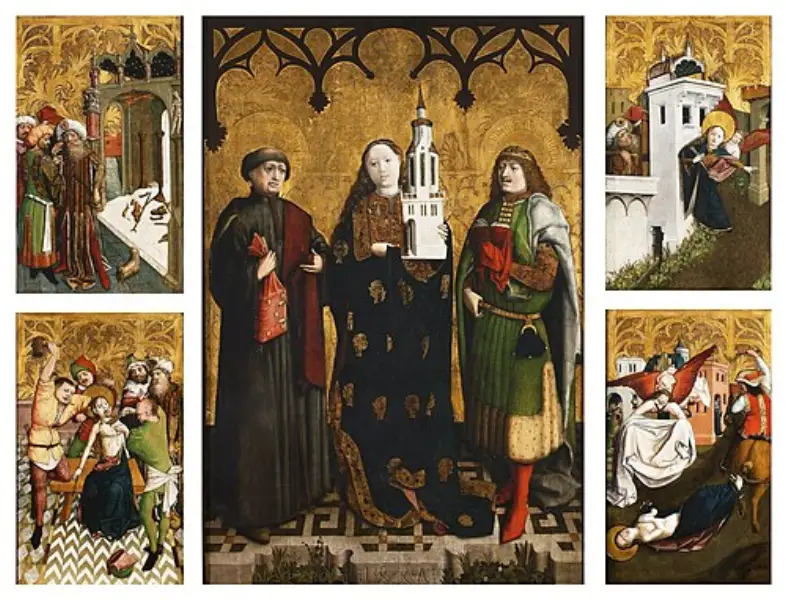
Overview
Barbara, honored in the East as the Great Martyr, was a virgin and martyr of the third century whom tradition places at Heliopolis in Roman Phoenicia, the city now called Baalbek in Lebanon, though other accounts set her story in Nicomedia of Bithynia. Hagiography describes her as the daughter of Dioscorus, a wealthy pagan who shut her in a tower to shield her from suitors and from the world beyond it. Into that enforced seclusion Barbara brought Christianity, and when her father arranged a marriage she refused it. A bathhouse she had built with three windows, a sign of her belief in the Trinity, exposed her faith, and Dioscorus delivered her to the provincial prefect Martinianus. Tortured and condemned, she was beheaded by her own father, who was struck dead by lightning on his way home. Her tomb became a place of miracles. Written legends of her passion appear only from the seventh century, and doubts about their history led to her removal from the Roman calendar in 1969, yet she remains on the Church's list of saints and stands among the Fourteen Holy Helpers.
The Complete Life
A Daughter Kept in a Tower
The sources agree on remarkably little about Barbara's origins, but the outline they draw is consistent. She was born in the middle of the third century, either at Heliopolis in Phoenicia or at Nicomedia in Bithynia, and her family was pagan and prosperous. Her father, Dioscorus, figures in the legend as a man of great wealth who devoted obsessive care to his only daughter's security. Fearful of the world and of the suitors who might one day claim her, he kept Barbara confined in a tower built for the purpose, where she lived under guard, cut off from visitors and from the city below. That tower became the stage on which her whole story turns. From her window Barbara is said to have watched the world she was forbidden to enter, and somewhere within those walls she encountered the Christian faith then spreading through the eastern provinces. Nothing in the tradition records who taught her or precisely when she was baptized; the hagiographers say only that she became a Christian in secret. For a daughter whose isolation was meant to preserve her for a marriage her father would arrange, the quiet adoption of a forbidden faith set an inevitable collision in motion.
§ Life
Three Windows
Barbara's break with her father's plans came through the question of marriage. An offer was made through Dioscorus for her hand, and she refused it, having already bound herself in secret to Christ. Before leaving on a journey, her father ordered a private bathhouse constructed beside her dwelling for her use; the builders planned two windows. Barbara directed that three be cut instead, and when Dioscorus returned and demanded the meaning of the change, she answered him plainly: the three windows signified the Father, the Son, and the Holy Spirit, the Trinity in whom she believed. She then acknowledged herself a Christian. The confession transformed her from a guarded daughter into a public offender. The faith was unlawful, and a wealthy pagan household now contained an unrepentant believer who had defied her father and, through him, the gods of the city. In the logic of the legend, the three windows Barbara chose for her bathhouse are the reason artists have always shown her with a tower bearing three lights: her vocation was expressed in architecture, a permanent testimony set into stone by her own command while her father was still absent and the decision was still hers to make.
§ Life
Before the Prefect
Dragged before Martinianus, prefect of the province, Barbara refused every pressure to sacrifice to the idols. The court's answer was torture, and the legend lingers over its failures. She was cruelly tormented, yet each morning her wounds were found healed. She was held overnight in a dark prison, and the cell was bathed in light. Torches were prepared to burn her, but the flames went out the moment they came near her. Every fresh cruelty resolved into a miracle, and every miracle hardened the court instead of breaking the accused. The account gives Barbara no speeches of defiance beyond her first confession; her constancy is shown entirely in what happens around her. Whatever the historicity of these details, the narrative shape is that of the classic virgin martyr passio: an official of the empire exhausts the machinery of punishment against a young woman and accomplishes nothing except the demonstration of her God's power. The prefect's final answer was a sentence of death, and in a singularly grim turn the legend assigns its execution not to the ordinary executioner but to Barbara's own father, who did not wait for another hand to carry it out.
§ Life
The Sword and the Lightning
The condemnation was carried out with terrible literalness. Dioscorus himself took the sword and beheaded his daughter, completing in person what the state had decreed. The legend then executes its own judgment: on his way home from the place of execution, lightning struck Dioscorus dead, and his body was consumed by flame. The symmetry, a father who imprisoned his daughter dying by fire from the sky, anchored every later association of Barbara with storms, explosions, and sudden death. A Christian named Valentinus buried her, and her tomb at once began to draw pilgrims on account of the miracles worked there. The Golden Legend fixes the martyrdom on 4 December, in the days of the emperor Maximianus, and that December date became her feast across East and West. A French retelling of the fifteenth century assigns her thirteen wonders, promising those devoted to her that death would not overtake them without confession and the last anointing. That promise of a provided death, both feared and desired in a violent age, carried her devotion far before anyone thought to ask whether she had ever lived.
§ Life
A Saint of Doubtful History
Barbara was never canonized in the modern sense; her cult predates the machinery of formal canonization by centuries. The evidence for that cult, however, is late and uneven. Her name was known in Rome by the seventh century, and organized veneration can be traced from the ninth, first in the Greek East, where she is honored as a Great Martyr. No earlier martyrology mentions her, and that silence underlies a long scholarly consensus that her passion story is pious fiction: one medievalist dismissed her outright as mythical, and the narratives of her life were judged fabulous even within the Church itself. The consequences were liturgical as well as academic. Her feast had entered Rome in the twelfth century and stood in the Tridentine calendar; in 1729 the date was partly reassigned to Peter Chrysologus, and in 1969 the reform of the Roman calendar removed her altogether, the stated reason being that the legends were entirely fabulous and could not even settle where she died. Removal from the calendar, however, is not deletion from the roll of saints: Barbara remains in the Roman Martyrology, which also lists ten other martyr-saints of her name, and her feast is still widely kept on 4 December.
§ Veneration
Patron of the Perilous Trades
Barbara's afterlife in Christian culture is far larger than her biography. As one of the Fourteen Holy Helpers she belonged to the late-medieval roster of emergency intercessors, and the lightning that killed her father made her the natural advocate against sudden death by storm, fire, or explosion. When gunpowder transformed warfare and mining, her patronage followed the blast: artillerymen, armourers, gunsmiths, and military engineers adopted her, and once explosives reached the mines in the seventeenth century, miners and tunnellers took her for their own. In Spanish, Italian, and old French, her very name became the word for a ship's or stronghold's powder store, where her image kept watch against accidental blast. The patronage remains alive in institutional form. Navies, artillery regiments on several continents, and fire services, especially in France, where her feast has been kept by firefighters since the Third Republic, still mark 4 December. Tunnelling crews set a shrine of Santa Barbara at a new portal before boring begins. Her reach extends beyond the Church as well: in Santeria she is identified with the storm deity Chango, and place names from the California coast across Latin America preserve the day on which Spanish explorers and missionaries first came ashore in her company.
§ Patronage
Timeline
- 4 Dec 306
Traditional date of her beheading at her father's own hand, placed by the Golden Legend within the reign of Maximianus.
§ Life
- 1576
Her relics were brought to Paterno in Sicily, an arrival the city still commemorates each 27 July.
§ Italy
- 1729
Her Roman feast of 4 December was reassigned to Saint Peter Chrysologus, leaving Barbara only a commemoration within that Mass.
§ Veneration
- 1780
Paterno began keeping the memory of the halted eruption of Mount Etna through her patronage, celebrated on 27 May.
§ Italy
- 4 Dec 1786
Mission Santa Barbara was founded on the California coast on her feast day by Franciscan missionaries.
§ Patronage
- 1969
The revision of the Roman calendar removed her feast, the accounts of her life having been judged entirely fabulous.
§ Veneration
- Nov 2012
Patriarch Filaret conveyed a small portion of her relics to St. Andrew Ukrainian Orthodox Cathedral in Bloomingdale, Illinois.
§ Veneration
- 24 Nov 2022
The Episcopal Church formally added her to its liturgical calendar, sharing 24 November with Catherine of Alexandria and Margaret of Antioch.
§ Veneration
In Their Own Words
This morning, Saint Barbara, Virgin, visited me and recommended that I offer Holy Communion for 9 days on behalf of my country and thus appease God's anger. This virgin was wearing a crown made of stars and was holding a sword in her hand.
The Record
- Patron of
- against lightning and fire·armourers·architects·artillerymen·chemical engineers·firefighters·firework makers·mathematicians·military engineers·miners and tunnellers·prisoners·Lebanon·Paterno and Rieti·the Italian Navy·Royal Air Force armourers
- Symbols
- three-windowed tower·palm of martyrdom·chalice·lightning·crown of martyrdom·miniature chains
- Canonization
- Pre-congregation; her cult is traceable to the ninth century in the East, though she was dropped from the General Roman Calendar in 1969 amid doubts about her legend.
Prayer
Bibliography
Show 6 sources
- Kirsch, Johann Peter. "St. Barbara." The Catholic Encyclopedia, Vol. 2. New York: Robert Appleton Company, 1907.
- Williams, Harry F. "Old French Lives of Saint Barbara." Proceedings of the American Philosophical Society 119, no. 2 (16 April 1975): 156-185.
- Cantor, Norman F. In the Wake of the Plague: The Black Death and the World It Made. 2002.
- Caprio, Betsy. The Woman Sealed in the Tower: Being a View of Feminine Spirituality As Revealed by the Legend of Saint Barbara. New York: Paulist Press, 1982.
- Kinard, Jeff. Artillery: An Illustrated History of Its Impact. Santa Barbara: ABC-CLIO, 2007.
- Martyrologium Romanum. Libreria Editrice Vaticana, 2001.
Profile text adapted from the Wikipedia article, licensed CC BY-SA 4.0.
Pray with this saint every day
Save St. Barbara to your favorites, read the full profile, and get feast-day reminders in the Saints app.
Get the Saints AppFree on the App Store for iPhone and iPad