
c. 1880 – 18 July 1918·Feast July 18
St. Barbara Yakovleva
Nun of the Martha and Mary Convent, New Martyr of Alapaevsk
Overview
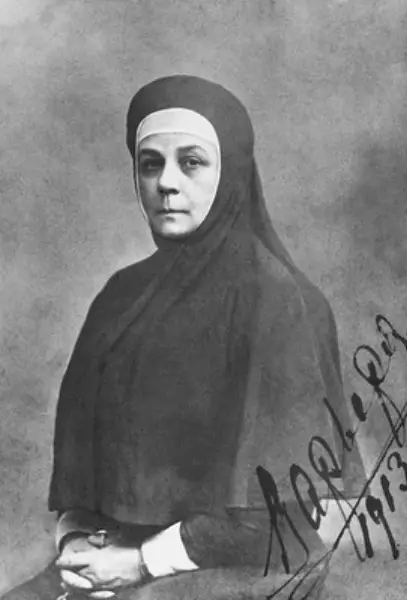
Varvara Alexeyevna Yakovleva, known to those around her as Varya and in religion as Nun Barbara, was a Russian Orthodox nun of the Martha and Mary Convent founded in Moscow by Grand Duchess Elizabeth Fyodorovna. Documentary evidence places her origin in Tver, and she came to the convent from Yalta, arriving on 20 August 1910, when she was about thirty years old; before taking the veil she had served as the Grand Duchess's maid. Small in stature and deeply pious, she joined a sisterhood whose works of mercy made it famous across Moscow: the sisters carried food to the homes of the poor, opened a home for women with tuberculosis, ran a hospital, and established houses for the disabled, for pregnant women, and for the elderly, as well as an orphanage, works that later spread to other Russian cities. When the Revolution of 1917 brought arrest and exile to the Grand Duchess, Yakovleva accompanied her voluntarily. Confined first at Yekaterinburg and then at Alapaevsk, the group of prisoners, which included several princes of the imperial house and Grand Duke Sergei Mikhailovich, was driven into the woods on the afternoon of 18 July 1918, clubbed, and thrown into a mineshaft, where they died. Barbara was glorified as a martyr by the Russian Church in exile in 1981 and by the Moscow patriarchate in 1992.
The Complete Life
A Woman of Tver
Reliable information about Barbara Yakovleva's early years is scarce. What documentary evidence exists shows that she came from Tver, the old city on the Volga northwest of Moscow, and that she was born around 1880, since she is recorded as thirty-one years old in 1911. Her path to religious life ran through the Crimea: she arrived at the Martha and Mary Convent in Moscow from Yalta on 20 August 1910, a mature woman of about thirty rather than a young postulant. Before taking the veil she served as maid to the convent's foundress, Grand Duchess Elizabeth Fyodorovna, the widowed sister of the Empress who had exchanged her court position for a life of prayer and service in the slums of Moscow. The relationship between the two women thus began in domestic service and ended in common martyrdom, one of the many quiet ironies of the Romanov tragedy. Those who knew her called her Varya, an affectionate diminutive, and she is remembered as small in stature and deeply pious, a physical smallness that contrasted with the immensity of what she would later face. She took the name Barbara in religion and the title nun, inokinya, living not as a full monastic of the great older houses but as a sister of Elizabeth's new foundation, which combined the vows of religion with the work of mercy.
§ Life
Sister of Martha and Mary
The convent Barbara entered was itself an innovation, founded by Grand Duchess Elizabeth Fyodorovna after the assassination of her husband to be a house of deaconess-like sisters devoted to the poor of Moscow. Named for the two sisters of Bethany, it set contemplation and active charity side by side, and the women who joined it took vows on the day of its consecration along with the Grand Duchess herself. Barbara's vocation was formed in that double discipline. She and the other women of the house took vows on that date, binding themselves to the religious life within a community whose work was as visible in the city as its chapel was hidden. For the sisters of Martha and Mary the veil did not mean withdrawal from Moscow's suffering but organized engagement with it. They went out from the convent in their white habits and crossed the boundaries of class that imperial Russia drew sharply, carrying food into the homes of the poor and sitting with the dying. Barbara came to this life from service in a great household, from Yalta and Tver, with no claim to distinction except piety, and the community gave her vocation its shape: prayer at the center, mercy at the edge, obedience to an abbess who was herself learning the way downward from palace to hospital ward. That formation would be tested within a decade, and it did not fail.
§ Life
Charity Known Throughout Moscow
The mission of Barbara's convent was the city's poor, and it made the sisters famous across Moscow for their works of mercy. The list reads like a survey of urban suffering before any welfare state existed. The women brought food to poor households, meeting hunger where it lived rather than waiting for it to come to them. They founded a house for tubercular women, tuberculosis being then an almost untreatable disease that condemned its victims to slow exclusion. They opened a hospital for the sick, homes for the physically disabled, for pregnant women, and for the elderly, and an orphanage for children who had lost their parents to the epidemics and disorders of the era. Their works of mercy afterwards reached other Russian cities, so that the Moscow house became the mother of a wider movement of practical Orthodox philanthropy. Barbara belonged to this work as a consecrated sister, not as a patron or an administrator, one of the women whose hands actually carried the bread and changed the bandages. The scale of the undertaking should not obscure its character: it was carried out under vows, in prayer, and in dependence on alms, by an aristocratic foundress and plebeian sisters together, in the years just before the war and revolution that would destroy the society their charity served.
§ Life
The Mineshaft at Alapaevsk
The Russian Revolution of 1917 swept away the world in which the convent had worked. Grand Duchess Elizabeth was arrested and sent into exile, and Barbara Yakovleva voluntarily accompanied her, a free choice made with full knowledge of the danger; the voluntariness is the heart of the story. The group of prisoners was confined first at Yekaterinburg, the city where the imperial family was being held, and later at Alapaevsk in the Urals. With them were Prince Ioann Konstantinovich, Prince Konstantin Konstantinovich, Prince Igor Konstantinovich, Grand Duke Sergei Mikhailovich, his secretary Fyodor Remez, and Prince Vladimir Pavlovich Paley, a cluster of Romanov princes and those attached to them. On the afternoon of 18 July 1918, one day after the execution of the tsar's family in Yekaterinburg, their captors drove them at gunpoint into the forest outside Alapaevsk, struck each on the head with clubs, and cast them one after another into a mineshaft. Grand Duke Sergei Mikhailovich alone, shot through the head, died instantly; the others survived the fall. From the bottom of the shaft the dying could be heard singing hymns, and one after another they fell unconscious and died. Barbara, the maid turned nun who had followed her abbess, was among the voices in that dark.
§ Exile and death
A New Martyr of Two Churches
Barbara's glorification came from both halves of a divided Russian Orthodoxy, and this double recognition is part of her significance. In 1981 the Russian Orthodox Church Outside Russia, the exiled church formed after the revolution, canonized her as a new martyr, a victim of Soviet oppression together with the other members of the Alapaevsk group; the category of new martyrdom was created precisely for those killed by the Soviet state for the faith and for their Christian standing. Eleven years later, in April 1992, after the fall of the Soviet Union had made such commemorations possible at home, the Moscow-based Russian Orthodox Church canonized her as a martyr as well, so that the church in the homeland confirmed what the church of the emigration had preserved. The two acts, in 1981 and 1992, bracket the collapse of the system that had killed her. Her feast is kept on 18 July, the day of the massacre, together with the other martyrs of Alapaevsk. She stands in the calendar as Nun Barbara, inokinya, a rank of religious profession that the church thought it right to record even in glory, honoring the humble form of consecrated life in which she had actually served rather than elevating her to an office she never held.
§ Veneration
The Tomb in Gethsemane
Barbara's principal legacy is her tomb in Jerusalem. The bodies of Grand Duchess Elizabeth Feodorovna and Barbara herself, after their recovery from Russia and long journey, rest at the Church of Mary Magdalene in Gethsemane, the Russian church on the Mount of Olives built in the tsar's time. For years they lay in the crypt, where only private veneration was possible, but in May 1982, the year after the ROCOR canonization, the two bodies were moved up into the main church of St Mary Magdalene, where the veneration of pilgrims could be public and unimpeded. The placing of a former maid and nun of Tver beside a granddaughter of Queen Victoria in a shared shrine is itself a sermon on the equality of martyrs before God. The martyrs of Alapaevsk as a group, with the princes and the secretary who died in the shaft with the two women, are commemorated together in the Orthodox calendar, and Barbara's memory is inseparable from theirs. Within the wider story of Romanov sainthood she represents its plebeian edge, the non-dynastic faithful who died for standing beside the Church's persecuted rather than for any claim of blood. The Martha and Mary Convent that formed her survived the Soviet decades in other uses and has been restored to religious life, and the charitable pattern she served there remains her most concrete monument.
§ Veneration
Timeline
- 1880
Born around this year; documentary evidence places her origins in Tver.
§ Life
- 20 Aug 1910
Arrives at the Martha and Mary Convent in Moscow from Yalta, having served Grand Duchess Elizabeth as her maid.
§ Life
- 1911
Recorded as thirty-one years old; the grand duchess and the other sisters take their vows, and the convent wins fame in Moscow for charity.
§ Life
- 1917
Voluntarily follows Grand Duchess Elizabeth into exile after her arrest in the wake of the Russian Revolution.
§ Exile and death
- 18 Jul 1918
Confined first at Yekaterinburg and then Alapaevsk, she is herded into the woods, clubbed, and thrown down a mineshaft with her companions.
§ Exile and death
- 1981
The Russian Orthodox Church Abroad glorifies her that year as a new martyr, joined with the others slain in the group.
§ Veneration
- May 1982
Her remains, with Elizabeth's, are carried from the crypt of the Church of Mary Magdalene in Gethsemane to its upper church.
§ Veneration
- Apr 1992
Canonized as a martyr by the Russian Orthodox Church within Russia.
§ Veneration
The Record
- Symbols
- Nun's habit·Mineshaft of Alapaevsk
- Canonization
- Canonized in 1981 as a new martyr by the Russian Orthodox Church Outside Russia, and in April 1992 by the Russian Orthodox Church
Prayer
Bibliography
Show 3 sources
- Mager, Hugo (1998). Elizabeth: Grand Duchess of Russia. Carroll and Graf Publishers. ISBN 0-7867-0678-3.
- Додонов Б. Ф., Копылова О. Н., Крячкова Л. В. «Новые свидетельства к биографиям крестовых сестер Марфо-Мариинской обители милосердия». Вестник церковной истории.
- "Saint Barbara, the Nun". Orthodox Church in America (OCA).
Profile text adapted from the Wikipedia article, licensed CC BY-SA 4.0.
Pray with this saint every day
Save St. Barbara Yakovleva to your favorites, read the full profile, and get feast-day reminders in the Saints app.
Get the Saints AppFree on the App Store for iPhone and iPad