
Legendary; story set in early Christian India·Feast August 26
St. Barlaam and St. Josaphat
Hermit Teacher and Convert Prince of India
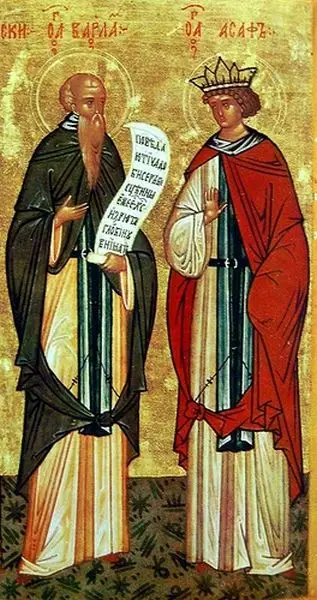
Overview
Barlaam and Josaphat are Christian saints of India whose story, one of the most widely travelled narratives of the Middle Ages, tells how a pagan prince found the true faith through a hermit's teaching. According to the legend, King Abenner of India harassed the church that the Apostle Thomas had planted in his land. When his astrologers foretold that his own heir would one day embrace Christianity, the king shut the boy Josaphat away from all contact with the world. The plan failed: the young prince encountered the recluse Barlaam, received instruction from him in secret, and was baptized. Josaphat held to his new faith against his father's fury and persuasion, and in time Abenner himself was converted, handed over the crown to his son, and withdrew to the desert as a hermit. Years later Josaphat in turn renounced the throne and went into solitude with Barlaam, his old master. Both are honored as saints in the Eastern Orthodox and Roman Catholic churches, with feasts on 26 August in the Greek tradition, 19 November in the Slavic tradition, and 27 November in the Roman Martyrology. Scholars established in the nineteenth century what medieval readers never suspected: the tale is a Christianized descendant of the life of Siddhartha Gautama, the Buddha, carried from a Sanskrit Buddhist original through Manichaean, Arabic, Georgian, and Greek versions before reaching Latin Christendom, so that the Buddha himself was unwittingly venerated as a Christian saint for roughly a thousand years.
The Complete Life
A Prince Hidden from the World
The legend opens in India, where King Abenner had set himself against the Christian community that tradition credited to the ministry of the Apostle Thomas. Famine, swords, and edicts failed to extinguish the faith, and then the astrologers brought the king a prophecy that cut closer: his own son would one day join the persecuted religion. Alarmed, Abenner resolved that the boy should never so much as see the realities that turn a heart toward God. The prince Josaphat was raised in splendid isolation, walled within palaces and pleasures, every sorrow, age, sickness, and death kept from his sight by his father's command. It is a story Christians came to know well in another form, for the same architecture of seclusion governs the youth of Siddhartha Gautama before his enlightenment beneath the bodhi tree, and the correspondence is not accidental: modern scholarship traced the Christian legend back through Georgian and Arabic intermediaries to a Sanskrit Mahayana Buddhist original of the second to fourth centuries. Within the tale's own logic, however, the plan of concealment contained its own defeat. A soul made for truth cannot be kept from asking questions, and the beauty of the sheltered world only sharpened Josaphat's hunger for what lay beyond it. The king had built a prison out of luxury, and prisons, the story means us to see, cannot hold a vocation. Contact came at last despite every precaution, and with it the encounter that would undo Abenner's design and, in the fullness of time, convert the persecutor himself.
§ Legend
The Hermit and the Prince
Into the sealed garden of Josaphat's upbringing came Barlaam, a hermit monk disguised as a merchant, carrying with him the pearl of the gospel. Meeting the young prince, he began to instruct him in the Christian faith, unfolding its mysteries under the cover of trade, and in due course he baptized him. The name Josaphat itself carries the memory of this transmission across languages: it descends from the Sanskrit word bodhisattva, which passed into Middle Persian as Bodisav around the sixth or seventh century, appeared in an eighth-century Arabic document as Būdhasaf or Yūdhasaf, took Georgian shape as Iodasaph in the tenth century, entered Greek as Ioasaph in the eleventh, and finally settled in Latin as Iosaphat or Josaphat. Barlaam's own name is the Arabic Bilawhar, carried through Georgian as Balahvar and into Byzantine Greek as Barlaám; its ultimate origin, whether from a Sanskrit epithet of the Buddha or from another source, remains debated. In the story the hermit serves as the prince's spiritual father: he teaches, he baptizes, and he withdraws, leaving Josaphat to stand alone. The pattern is that of every monastic vocation—the teacher points the way, but the disciple must walk it—and it sets the terms for the rest of the narrative, in which Josaphat keeps the faith under pressure and Barlaam waits in the wilderness for the fruit of his planting to come home.
§ Names
Faith under Fire and a Father Converted
The discovery of his son's baptism turned Abenner's fear into a campaign of persuasion and pressure. The king argued, threatened, and staged temptations; the story speaks of tribulation endured at length before the young prince's constancy. Josaphat would neither renounce his baptism nor be provoked into rebellion, and the standoff between father and son became the arena in which grace worked. In the end the persecutor yielded to the persecuted: Abenner himself embraced the Christian faith, handed his royal seat to Josaphat, and withdrew into the desert to live as a hermit, taking the very road he had tried to forbid his son. The inversion is the story's theological heart. The king who imprisoned to prevent a conversion was converted by the prisoner; the throne that was to secure a dynasty against the gospel became the instrument by which the gospel claimed the dynasty. Josaphat then reigned as a Christian prince, and the church his father had harassed flourished under his protection. The narrative gives the mission of the saint a double shape: first the holding of faith under persecution, then the exercise of power in its service. Readers of the Middle Ages found in this a mirror of their own hopes for rulers, and the tale's afterlife shows how deeply it answered them: retold in the Golden Legend, in Vincent of Beauvais's Speculum Historiale, in Anglo-Norman verse by Chardri, and in two Middle High German renderings, one of them the romance by Rudolf von Ems that Heinrich Heine ranked among the finest flowers of German religious poetry.
§ Legend
Parables, Monastic Ideals, and the Caskets
The spiritual texture of the legend is monastic and evangelical at once. Its long central portion is a catechesis in story: Barlaam instructs Josaphat through a string of parables, the best loved of which concerns the three caskets, one gold, one silver, one lead—a test of judgment that travelled far beyond its setting. Through Caxton's English version of a Latin text, the casket scene found its way into Shakespeare's The Merchant of Venice, where Portia's suitors must choose among metal caskets to win her hand. The choice of the humble outer covering over the glittering shell is the parable's point, and it is the point of the whole legend too: the prince discovers that the palace is a casket of gold enclosing nothing. The Greek text, though anonymous and ascribed in medieval manuscripts to 'John the monk', breathes the air of the iconoclastic controversy; Woodward and Mattingly argued from its doctrine, its enthusiasm for the monastic ideal, and its cool regard for bishops and secular clergy that it belongs to the eighth century, and it was long attributed to John of Damascus. Modern scholarship instead credits the Greek to Euthymius of Athos, a Georgian monk who died in 1028. In the sixteenth century the story was still being wielded to defend monastic living against the attacks of the Reformation, and to uphold human freedom of choice against Calvinist predestinarian teaching—an argument the imprisoned prince who chooses freely is almost designed to carry.
§ Greek manuscripts
Two Thrones Renounced
The legend's close completes the pattern begun at the baptism. Abenner, the first to renounce power, had already exchanged his crown for the silence of the desert; the story honours him as ending his life as a hermit. Josaphat, after reigning as a Christian king, followed: he abdicated the throne of India and went into seclusion with Barlaam, the old teacher who had first brought him the faith, closing the circle of their discipleship in shared solitude. Two renunciations thus frame the tale—father's and son's, persecutor's and convert's—and the pairing is deliberate, for the story wants both generations of readers to see that the gospel asks the same surrender of the old man and the young. No martyrology of India supplies dates for these deaths; the characters belong to narrative rather than archive, and their 'final years' are the ones the legend itself provides, a life of prayer in the wilderness after a life of rule. Devotion, not chronology, fixed their memory. The churches that received the story gave it liturgical space: the Greek Orthodox calendar entered the saints on 26 August by the Julian reckoning, the Slavic tradition of Orthodoxy on 19 November Julian, and the Roman Martyrology kept their joint feast on 27 November, though they never appeared in the Roman Missal. Since 1960 the Roman calendar's November commemoration of a Josaphat belongs to a different saint altogether, the bishop and martyr Josaphat Kuntsevych, honoured on 16 November.
§ Feast days
Saints Made by a Story
Barlaam and Josaphat stand among the few saints whose canonization was effectively performed by a book. No formal process ever examined their lives, because there were no lives to examine in the historical sense; there was only the legend, and the legend sufficed. The Greek Church received the narrative as the work of a holy hand and gave its heroes a place in the synaxarion, the Great Synaxaristes commemorating the venerable Joasaph, son of the king of India Abenir, on 26 August. The Slavic Orthodox tradition entered them on 19 November by the old calendar. In the West, the Roman Martyrology carried them with a joint feast on 27 November, the entry situating them among the Indians, neighbours of the Persians, and crediting the wonder of their deeds to the pen of St. John Damascene—an attribution the nineteenth century dismantled even as it uncovered something stranger. Eighteenth- and nineteenth-century scholars had taken the Greek text for an original Byzantine composition, until F. C. Conybeare and Paul Peeters demonstrated its Georgian, Arabic, and ultimately Sanskrit lineage. That discovery did not remove the saints from the calendars; it explained them. Theologians have since read the case as a striking instance of tradition's generosity: the church venerated in Josaphat a figure of holiness whose story had travelled to her from another faith, and the veneration, once established by centuries of liturgical use, did not depend on the philology that came later.
§ Sainthood
The Buddha in a Saint's Robe
The afterlife of Barlaam and Josaphat is one of the strangest and richest in Christian literature. In the Middle Ages the story was among the most widely read of all: it fills a large portion of book fifteen of Vincent of Beauvais's Speculum Historiale, appears in the Golden Legend, and was rendered into verse by Chardri in Anglo-Norman, by Rudolf von Ems and Bishop Otto II of Freising in German, into Old Norse as the Barlaams saga ok Jósafats attributed to the patronage of King Haakon III, into Hebrew by Abraham ibn Hasdai as Ben hammelekh vehannazir, and into Croatian, Hungarian, Portuguese, Italian, Catalan, Provençal, and Ethiopic. Its parable of the caskets reached Shakespeare through Caxton. One of the Marco Polo manuscripts even records the traveller's observation that the Mongols' name for the Buddha, Sergamoni Borcan, matched a figure remarkably like St. Josaphat—Polo apparently unaware why the resemblance was so exact. The answer came in 1859 and 1860, when Edouard de Laboulaye and Felix Liebrecht demonstrated the identity: a Sanskrit Buddhist narrative, travelling through Manichaean, Arabic, and Georgian channels, had been baptized into a Christian saint's life so thoroughly that the Buddha himself received a thousand years of unwitting Christian veneration. Modern editions, notably Robert Volk's critical text of 2006 and 2009 for the works of John of Damascus, mark the piece as spuria, and David Marshall Lang's 1966 translation of the Balavariani opened the Georgian tradition to English readers. The saints remain on Orthodox calendars, and the tale remains a classic study in how stories cross the borders of faith.
§ Texts
Timeline
- 200
The tale ultimately derives from a Sanskrit Mahayana Buddhist text of the second to fourth century, passing through a Manichaean version.
§ History
- 700
The Arabic Kitab Bilawhar wa-Budasaf, a stepping stone toward the Christian legend, is current in eighth-century Baghdad.
§ History
- 900
The first Christianized adaptation appears as the Georgian epic Balavariani of the tenth century.
§ History
- 1028
Euthymius of Athos, the Georgian monk who turned the story into Greek, dies in an accident while visiting Constantinople.
§ History
- 1048
The Greek adaptation is rendered into Latin and quickly becomes familiar across Western Europe.
§ History
- 1204
King Haakon III Sverresson of Norway, whom the saga of Guðmundur Arason credits with the Old Norse rendering, dies.
§ Editions
- 1500
During the sixteenth century the tale is retold in defence of monastic life and free will against Protestant teaching.
§ History
- 1859
The researches of Edouard de Laboulaye and Felix Liebrecht expose Josaphat as the Buddha, honoured for a millennium under a Christian name.
§ Texts
- 1960
From this year the Roman calendar's November commemoration of a Josaphat belongs to the bishop and martyr Josaphat Kuntsevych instead.
§ Feast days
In Their Own Words
But not till the mid-nineteenth century was it recognised that, in Josaphat, the Buddha had been venerated as a Christian saint for about a thousand years.
perhaps the flower of religious literary creativity in the German Middle Ages
The Record
- Major works
- The Greek legend of Barlaam and Ioasaph·The Georgian Balavariani·The Arabic Kitāb Bilawhar wa-Būdāsaf (Book of Bilawhar and Budhasaf)·La vie de seint Josaphaz, the Anglo-Norman verse life by Chardri
- Symbols
- Prince's crown, laid aside·Hermit's habit·Icon of Barlaam teaching the seated prince
- Canonization
- Pre-congregation; entered in earlier editions of the Roman Martyrology with a joint feast on 27 November and in Orthodox calendars on 26 August and 19 November.
Prayer
Bibliography
Show 8 sources
- Herbermann, Charles, ed. (1913). 'Barlaam and Josaphat'. Catholic Encyclopedia. New York: Robert Appleton Company.
- Conybeare, Frederick Cornwallis (1896). 'The Barlaam and Josaphat Legend in the Ancient Georgian and Armenian Literatures'. Folklore 7(2): 101–142.
- Peeters, Paul (1922). Traductions et traducteurs dans l'Hagiographie orientale à l'époque byzantine. Brussels: Brepols, pp. 241–364.
- Lang, David Marshall (1966). The Balavariani: A Tale from the Christian East. Los Angeles: California University Press.
- Lopez, Donald S. Jr. (2014). In Search of the Christian Buddha: How an Asian Sage Became a Medieval Saint. New York. ISBN 978-0-393-08915-8.
- Volk, Robert (2006/2009). Die Schriften des Johannes von Damaskos VI: Historia animae utilis de Barlaam et Ioasaph (spuria). Patristische Texte und Studien. Berlin: Walter de Gruyter.
- Macdonnel, Arthur Anthony (1900). 'Sanskrit Literature and the West'. A History of Sanskrit Literature. New York: D. Appleton and Co., p. 420.
- Hirsh, John C., ed. (1986). Barlam and Iosaphat: A Middle English Life of Buddha. Early English Text Society, Oxford University Press. ISBN 0-19-722292-7.
Profile text adapted from the Wikipedia article, licensed CC BY-SA 4.0.
Pray with this saint every day
Save St. Barlaam and St. Josaphat to your favorites, read the full profile, and get feast-day reminders in the Saints app.
Get the Saints AppFree on the App Store for iPhone and iPad