
c. 1112 – 1192·Feast November 6
St. Barlaam of Khutyn
Wealthy Novgorodian Who Became a Hermit
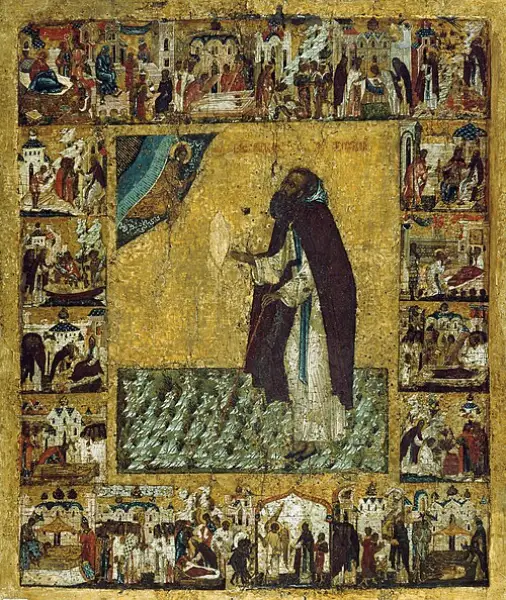
Overview
Barlaam of Khutyn, born Aleksa (or Aleksy) around 1112 into a wealthy family of Novgorod, gave up comfort for the solitary life after his parents died, distributing his whole inheritance to the poor. He withdrew to live alone on the Volkhov river and then settled at Khutyn, north of Novgorod, where he put up a small wooden chapel. His reputation for holiness spread, disciples gathered, and a monastery grew around him — the Khutyn Monastery, dedicated to the Transfiguration of Christ; it was then that he took the name Barlaam. Prince Yaroslav of Novgorod numbered among the monastery's benefactors. Before dying on 6 November 1192 (or 1193) he named the monk Antony to succeed him, and his grave became a goal of pilgrims. In 1452 his relics received formal enshrinement, and his life was written by Pachomius, a Serbian monk who became the great hagiographer of the Russian north. Russian liturgical practice still commemorates him when the bread and wine are prepared for the Eucharist.
The Complete Life
A Rich Man's Son of Novgorod
Barlaam was born around 1112, in the twelfth century when the city of Novgorod was rising to be one of the great commercial and political powers of the Russian lands. He entered the world with every advantage: his family was wealthy, part of the urban aristocracy that governed the republic-like city through its veche and traded from the Baltic to Byzantium. His secular name was Aleksa, also rendered Aleksy. Nothing in such a background pointed toward the desert except the gravity of a world in which wealth was increasingly suspected by Christian conscience. Medieval Novgorod produced a striking number of saints who abandoned riches for monastic life, and Barlaam belongs to the head of that line. The decisive break came with the death of his parents. Freed from filial obligation, the young heir did what the gospel had asked of the rich young ruler and what few have done: he walked away, and gave everything away, keeping nothing for the life of solitude he had chosen over the life of a merchant prince.
§ Life
Solitude at Khutyn and the Founding of a Monastery
After settling his inheritance on the poor, Barlaam went to live as a hermit on the Volkhov, the river on which Novgorod stands, and then moved to Khutyn, a place outside the city where he could be alone with God. There he raised a simple wooden chapel — the whole of his establishment at first. But solitude of that quality rarely goes unnoticed in the Christian East. His reputation for holiness spread through the Novgorod land, and men began to come to Khutyn to live under his guidance; their numbers, the tradition says, grew so great that a community became necessary. Out of the hermitage grew the Khutyn Monastery, dedicated to the Transfiguration of Christ, and out of the hermit grew a hegumen: it was in connection with this monastic profession that Aleksa received the name Barlaam. The foundation attracted the patronage of the mighty, including Prince Yaroslav of Novgorod, and became in time one of the most venerated monasteries of the Russian north, its churches rising above the same ground where one man had first built a chapel of wood.
§ Life
Death and Continuing Veneration
Knowing his end was near, Barlaam provided for his community by naming a monk named Antony as his successor, securing the continuity of the house he had founded. He died on 6 November 1192, or in 1193 by some reckonings — the old calendar date has remained his feast — at around eighty years of age. His grave immediately became a place of pilgrimage for the people of the Novgorod land, who came to Khutyn as to a wellspring. In 1452, more than two and a half centuries after his death, his relics were solemnly enshrined, the formal liturgical recognition of a veneration long established in practice. The Serbian monk Pachomius, who worked in Novgorod in the fifteenth century composing the lives of the Russian saints, wrote the account of Barlaam on which the tradition rests. His memory has entered the Church's liturgy at its most intimate point: Barlaam of Khutyn is commemorated in the Russian rite at the preparation of the bread and wine for the Eucharist, the proskomedia, so that each celebration of the divine liturgy in that tradition carries a trace of the hermit of Khutyn.
§ Life
Timeline
- 1112
Born around this year into a wealthy family of Novgorod, with the secular name Aleksa
§ Life
- 6 Nov 1192
Died at Khutyn on 6 November (some sources give 1193), having named the monk Antony to succeed him
§ Life
- 1452
His relics were enshrined, and the Serbian monk Pachomius wrote an account of his life
§ Life
The Record
- Major works
- Khutyn Monastery of the Transfiguration, near Novgorod (foundation)
- Canonization
- Pre-congregation; venerated in the Eastern Orthodox and Russian Greek Catholic churches
Prayer
Bibliography
Show 3 sources
- Butler, Alban; Burns, Paul (1995). Butler's Lives of the Saints. A&C Black. pp. 47–48. ISBN 978-0-86012-260-9.
- "Варлаам, преподобный хутынский". Brockhaus and Efron Encyclopedic Dictionary (in Russian). 1906.
- "ВАРЛААМ ХУТЫНСКИЙ - Древо". drevo-info.ru (in Russian). Retrieved 2023-06-18.
Profile text adapted from the Wikipedia article, licensed CC BY-SA 4.0.
Pray with this saint every day
Save St. Barlaam of Khutyn to your favorites, read the full profile, and get feast-day reminders in the Saints app.
Get the Saints AppFree on the App Store for iPhone and iPad