
died 1065·Feast November 19
St. Barlaam of Kiev
First Abbot of the Kiev Caves Lavra
Overview
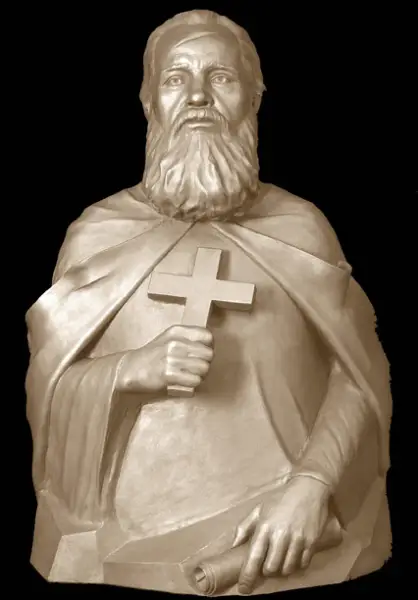
Barlaam of Kiev, who died in 1065, held the office of first abbot at the Kiev Pechersk Lavra, the mother house of Russian monasticism, serving alongside St. Anthony of Kiev. Born to a boyar family between the late tenth and early eleventh century, he was tonsured a monk by St. Nikon of the Kiev Caves over the opposition of his father, who had other plans for a son of his rank. In 1058, with Anthony's blessing, he built a wooden church in honor of the Dormition of the Theotokos at the lavra. He twice went on pilgrimage, first to the Holy Land in 1062 and afterwards to Constantinople. Returning from that second journey he fell ill and died in 1065 at the Zymne Monastery, ordering that he be buried in the Caves of St. Anthony. His principal feast falls on 19 November; further commemorations are kept on 28 September and again on the Second Sunday of Great Lent.
The Complete Life
A Boyar's Son in the Caves
Barlaam was born into the highest social stratum of Kievan Rus: his father was a boyar, one of the great nobles who served the prince and owned the land. The date of his birth can only be placed between the closing years of the tenth century and the opening of the eleventh, a time when Christianity was still young in the Rus lands, having been officially received only in 988. His renunciation was therefore doubly striking — a son of the aristocracy embracing the ascetic life within living memory of the baptism of Rus. The tonsure that made him a monk was performed by St. Nikon of the Kiev Caves, one of the first brethren of the Pechersk community and the priest who had earlier tonsured two Varangian nobles. His father opposed the step, and the tradition remembers the conflict: the father came to reclaim his son, only to be confronted by the monastic community in which the young man now stood. Barlaam held firm, and his profession became one of the early signs that the Kiev Caves was drawing to itself not only the poor and the penitent but the flower of the ruling class.
§ Biography
First Abbot of the Lavra
Barlaam's chief work was the governance of the community that grew around St. Anthony of Kiev. Anthony, who had lived as a hermit in the caves above the Dnieper, gathered disciples; when their numbers required order and a church, Barlaam became the first to hold the office of abbot over them, the organizer of what would become the Kiev Petchersk Lavra — the Caves Lavra — mother-house of Russian and Ukrainian monasticism. In 1058, blessed by Anthony, he put up at the monastery a church of timber consecrated to the Dormition of the Theotokos — the Mother of God's falling asleep — and the Dormition title bound the young Kievan brotherhood to Byzantium's great Marian tradition. Under Anthony's counsel and Barlaam's administration the Caves monastery passed from a cluster of hermit dwellings to an ordered cenobitic house, the model that monasticism throughout the Rus lands would imitate for centuries. His service as abbot spanned the years in which the lavra's fame began to spread beyond Kiev itself, laying the foundation of its later place as the spiritual center of the whole church.
§ Biography
Pilgrimages and Death
Barlaam's life closed with the two journeys that medieval Christians counted among the greatest works of devotion. In 1062 he set out for the Holy Land, walking the roads by which Russian pilgrims reached Jerusalem through Constantinople and the Byzantine east; the journey was an arduous pilgrimage to the places of the Lord's life, death and resurrection. Returning, he did not settle again into the routine of the cloister: he undertook a second pilgrimage, to Constantinople, the imperial capital and the greatest Christian city of the age, with its relics and its Hagia Sophia. The second journey proved too much for his health. Soon after leaving Constantinople he fell ill and died in 1065 at the Zymne Monastery, a house on the Western Bug associated with the same monastic movement. Mindful of where his heart lay, he gave orders that his body be carried back and laid in the Caves of St. Anthony, among the brethren and the founder he had served; he was buried there as he had asked, and the Caves became his shrine. The Eastern Orthodox Church honors him principally on 19 November, and keeps further commemorations on 28 September and at the Second Sunday of Great Lent.
§ Veneration
Timeline
- 1058
Erected a timber church honouring the Dormition of the Theotokos, blessed by St. Anthony
§ Biography
- 1062
Set out on the first of his two pilgrimages, travelling to the Holy Land
§ Biography
- 1065
Died at Zymne Monastery not long after returning from Constantinople, having ordered burial in the Caves of St. Anthony
§ Biography
The Record
- Major works
- Wooden church of the Dormition of the Theotokos at the Kiev Pechersk Lavra (1058)
- Canonization
- Pre-congregation; venerated as a saint of the Russian Orthodox Church
Prayer
Bibliography
Show 4 sources
- "Venerable Barlaam, Abbot of the Kiev Near Caves". www.oca.org. Retrieved 2024-08-04.
- "Venerable Barlaam, abbot of the Kiev Caves (1065)". www.crkvenikalendar.com. Retrieved 2024-08-04.
- C. R. Beazley (1900). "The Oldest Monument of Russian Travel". Transactions of the Royal Historical Society, 14, p. 175.
- Диба Ю. Батьківщина Малковичів – «страна своя» преподобного Варлаама Печерського. Волинський благовісник. Богословсько-історичний науковий журнал. Луцьк, 2013, №1, С.99–112.
Profile text adapted from the Wikipedia article, licensed CC BY-SA 4.0.
Pray with this saint every day
Save St. Barlaam of Kiev to your favorites, read the full profile, and get feast-day reminders in the Saints app.
Get the Saints AppFree on the App Store for iPhone and iPad