
1st century AD; died c. 61 at Salamis·Feast June 11
St. Barnabas
Apostle, Son of Encouragement, and Martyr of Cyprus
Overview
Barnabas, born Joseph or Joses to a Hellenic Jewish family of Levite descent, was a native of Salamis in Roman Cyprus and one of the most trusted figures of the first Christian generation. The Acts of the Apostles introduces him as a member of the Jerusalem community who sold a field he owned and laid the whole price at the apostles' feet, an act of open-handedness that earned him the surname Barnabas, 'son of encouragement'. When the converted Paul returned to Jerusalem under a cloud of suspicion, it was Barnabas who brought him to the apostles and vouched for him. Sent later to shepherd the young Gentile mission at Antioch, he judged the work too large for one man and fetched Paul from Tarsus; together they taught there for a year. They carried famine relief to Judea around 44 AD, then preached through Cyprus, Pamphylia, Pisidia, and Lycaonia, winning the Roman governor Sergius Paulus. Acts names Barnabas an apostle, and he stood with Paul at the Council of Jerusalem around 49, when the church agreed that Gentile converts need not take up Jewish observances. A sharp disagreement over John Mark later split the partnership: Paul went north with Silas, Barnabas sailed for Cyprus with his kinsman. Paul's letters show him still alive and working, self-supporting, in 56 or 57. Tradition holds that he was martyred at Salamis, stoned in the synagogue by enraged opponents; John Mark buried him. In 478, so the island's church history relates, he appeared in a dream to Archbishop Anthemios, whose finding of the tomb with Matthew's Gospel laid upon the saint's breast won Cyprus its historic ecclesiastical privileges from the Emperor Zeno.
The Complete Life
A Levite of Cyprus Named Joseph
The man the church would come to call Barnabas began life as Joseph—Joses in the Byzantine text of Acts—a Hellenic Jewish boy of Levite family born at Salamis on the island of Cyprus. His parents belonged to the diaspora that kept the Law while speaking Greek, and a Levite lineage carried the duty of service at the altar and the study of Scripture. Matthew George Easton's Bible Dictionary hazarded that he and the young Paul of Tarsus sat together as students under Gamaliel, a pleasing conjecture and no more than that. What is certain is that he surfaces in the Acts of the Apostles already a man of property and of standing in the Jerusalem community. The first thing told about him is a sale: he had land, he sold it, and he brought the whole sum to the apostles for distribution to the needy. The community answered the gesture with a new name. Barnabas, they said, son of encouragement—Acts glosses the Greek as son of comfort—and whether the word reaches back to an Aramaic phrase meaning son of consolation or son of the prophet, Luke the narrator seized on the sense of it. When he later sends Barnabas to Antioch, he has him encourage the believers there to hold fast to the Lord, a deliberate wordplay on the name itself. Encouragement, in other words, was not a nickname but a verdict on a character: this was the man who builds others up.
§ Name and etymologies
The Man Who Trusted Saul of Tarsus
Barnabas's vocation announced itself in his capacity for trust. When the persecutor-turned-disciple Paul came up to Jerusalem attempting to join the followers of the Way, the community wanted nothing to do with him; they remembered the arrests and could not believe the change. It was Barnabas who took him by the hand, brought him to the apostles, and told them the story of the Damascus road and of Paul's bold preaching in that city. Without that sponsorship the history of the mission to the nations might have run very differently. The same quality showed at Antioch. News reached Jerusalem that pagans in that city were turning to the Lord, and the church sent Barnabas, a good man full of the Holy Spirit and of faith, to see to it. Arriving, he saw the grace of God at work and was glad—and then did the characteristic thing: he recognized that the harvest was too great for him alone, traveled to Tarsus to look for Paul, an admirable colleague, and brought him back. For a year the two taught together in the Antiochene church, and it was there, Scripture notes, that the disciples were first called Christians. Barnabas's vocation was thus always a mediating one: between the suspect convert and the wary church, between the Hebrew congregation and the Greek, between the mission and its men. He held doors open that others would have shut, and the church walked through them.
§ Biblical narrative
Cyprus, Asia Minor, and the Council of Jerusalem
The missionary career of Barnabas divides into three great movements. First, the relief journey: around 44 AD he and Paul carried to Jerusalem the collection the Antiochene church had raised for the poor of Judea, returning with John Mark, Barnabas's kinsman. Second, the first missionary journey itself: from Antioch the party sailed to Cyprus, Barnabas's own island, where the proconsul Sergius Paulus heard the word and believed; then on to the chief towns of Pamphylia, Pisidia, and Lycaonia, preaching in synagogues to Jews and to the God-fearing Gentiles gathered around them. It was during this circuit, Acts 13:9, that Saul begins to be called Paul, his Roman name, and from that point the book ordinarily pairs the two as Paul and Barnabas rather than the reverse—though at Lystra the local crowd, taking Paul for the spokesman Hermes, cast Barnabas for the greater god Zeus, and Acts 14:14 names the two of them apostles, the only verse to give Barnabas that title outright. Third, the Council of Jerusalem in about 49: the question of whether Gentile converts must be circumcised was argued, and the council, with Barnabas and Paul reporting the signs God had worked among the nations, agreed that the Gentiles might be received without the yoke of the Mosaic law. The mission of Barnabas thus stood at the hinge on which the whole church turned outward.
§ Biblical narrative
Rebuke, Reconciliation, and the Second Chance
The spirituality of Barnabas is best read in the two moments when he fell short and when he insisted on mercy. At Antioch, after the council, Peter arrived and ate freely with the Gentile believers until men from James criticized the practice; Peter drew back, and the other Jewish Christians followed him, Barnabas among them. Paul confronted Peter publicly, telling him he was not walking straight in line with the gospel's truth, and in the Galatian letter he recorded his sorrow that even Barnabas had been carried away by the dissimulation. The episode is preserved without excuse, and its honesty is itself part of the tradition: the son of encouragement could bend to fear, and the church did not hide it. The second moment repairs the first. Planning a further journey, Paul proposed revisiting the churches they had planted; Barnabas wanted John Mark with them, but Paul refused, since the young man had turned back from the earlier trip. The contention grew so sharp that the two separated, Paul departing with Silas through Syria and Cilicia while Barnabas took Mark and sailed to Cyprus. What looked like a failure of the partnership doubled the mission and gave Mark his second chance—the very thing Barnabas had once done for Paul himself. His way with people, generous, patient, unwilling to let a man be written off, is the practical core of his sanctity, and the New Testament lets us see it working through both his loyalty and his errors.
§ Biblical narrative
The Last Journeys and a Stoning at Salamis
Scripture grows quiet about Barnabas after the parting of the ways, but it does not fall silent at once. When Paul wrote 1 Corinthians, in 56 or 57, he mentioned Barnabas as still at work as an apostle and, like Paul, supporting himself by his own labour rather than living off the churches; the reference also lets us see that no lasting breach had opened between the two men. A few years on, during Paul's Roman imprisonment of 61 to 63, John Mark appears attached to Paul as a helper—Colossians 4:10—which has generally been read as a sign that Barnabas was by then dead. Beyond this point the tradition takes over. Cypriot memory, forming no earlier than the third century, brought him home to Salamis to preach the gospel, and there, says the legend of his martyrdom, certain Jews who had come to Syria and Salamis, exasperated beyond endurance by his extraordinary success, fell upon him in the midst of a disputation in the synagogue, hauled him out, and stoned him to death. John Mark, his kinsman, secretly buried the body. The apocryphal Acts of Barnabas varies the manner of death, describing him as roped by the neck and dragged to the place where he was to be burned. Other sources carry him instead to Rome, where the Clementine Recognitions picture him preaching even in Christ's own lifetime, and to Alexandria; the biblical record itself certifies only the man, not the manner of his going.
§ Martyrdom
Patron of Cyprus with an Emperor's Gifts
Barnabas belongs to that first rank of saints whose holiness the church acknowledged by simply continuing to speak his name; his canonization belongs to the earliest, pre-congregational era, and his festival on 11 June is kept by the Catholic Church, the Eastern Orthodox, the Oriental Orthodox, the Anglican Communion, and the Lutheran Church alike—the Church of England formally remembering him with a festival on that day. The most remarkable chapter of his cult belongs to Cyprus. The island's own church history relates that in 478 Barnabas came to Archbishop Anthemios in a dream and disclosed the spot where his body lay, beneath a carob tree. The next day the tomb was opened and found to hold the saint's remains with a manuscript of Matthew's Gospel resting on his breast. Anthemios brought the Gospel to the Emperor Zeno in Constantinople and came home bearing the church of Cyprus's privileges of self-government: the festival purple cloak of the Greek archbishop of the island, the imperial sceptre, and the crimson ink for his signature—regalia still in use and still traced to that donation. The archbishop then enshrined the relics in a church he built beside the tomb, and excavations near the present monastery have uncovered an early church with two empty tombs held to be those of Barnabas and Anthemios. The Monastery of St Barnabas at Famagusta remains his great shrine, and he is honored as the patron and traditional founder of the Cypriot Orthodox Church, as well as first bishop of Milan in Italian tradition.
§ Martyrdom
The Encourager's Long Afterlife
Barnabas left a legacy at once biblical, national, and literary. To the churches he is the apostle of the second chance and the patron of Cyprus and Antioch, invoked against hailstorms and as a peacemaker; on Tenerife he was historically called upon with St Benedict to protect the island's fields from drought. Two whole books gathered around his name. Tertullian and other Western writers credited him with the Letter to the Hebrews, a judgment modern scholarship now sets aside as unknowable; Clement of Alexandria, Origen, Jerome, and many early voices attached his name to the Epistle of Barnabas, which survives entire under that name in Codex Sinaiticus, the oldest complete New Testament manuscript—yet while a minority of scholars still defend the old view, most now locate the letter's writing in Alexandria during the 130s. The fifth-century Decretum Gelasianum condemned a Gospel of Barnabas of which no text survives, and a later book of the same title—extant only in Italian and Spanish manuscripts of the sixteenth and seventeenth centuries—presents an Islamic-inflected life of Jesus that names Judas crucified in our Lord's place and announces Muhammad by name, a work of no apostolic connection. Pseudo-Hippolytus lists him among the Seventy and makes two Barnabases bishops, of Milan and of Heraclea. In 1538 the Clerics Regular of St. Paul settled at the monastery of Saint Barnabas outside Milan and have been called Barnabites ever since, so that the son of encouragement still lends his name to men who go about building up the church.
§ The Barnabites
Timeline
- 44
Travels with Saul to Jerusalem carrying relief money from Antioch for the poor of Judea
§ Biblical narrative
- 49
Takes part in the Council of Jerusalem, which admits Gentiles without requiring the Jewish law
§ Introduction
- 50
Recorded in episcopal successions as bishop of Milan, a see he holds until about 55
§ Other sources
- 55
Credited as first bishop of Cyprus in the ancient succession lists
§ Other sources
- 57
Still living and self-supporting when Paul writes 1 Corinthians, which dates to 56 or 57
§ Biblical narrative
- 61
John Mark, his kinsman, is by now attached to the imprisoned Paul in Rome, taken to mean Barnabas has died; tradition says he was stoned at Salamis and buried by Mark
§ Martyrdom
- 478
Reveals his sepulchre beneath a carob tree in a dream to Archbishop Anthemios; the recovered body, with Matthew's Gospel on its breast, wins Cyprus privileges from Emperor Zeno
§ Martyrdom
- 1538
The Clerics Regular of St. Paul make the Milan monastery of Saint Barnabas their chief house and take the name Barnabites
§ The Barnabites
In Their Own Words
We keep the eighth day with joyfulness, the day also on which Jesus rose again from the dead.
The Record
- Major works
- Epistle of Barnabas, traditionally ascribed to him, preserved complete in Codex Sinaiticus·Epistle to the Hebrews, attributed to him by Tertullian (authorship now considered unknown)
- Patron of
- Cyprus·Antioch·Milan·Against hailstorms·Invoked as peacemaker and for peacekeeping missions·Protector of the fields of Tenerife against drought
- Symbols
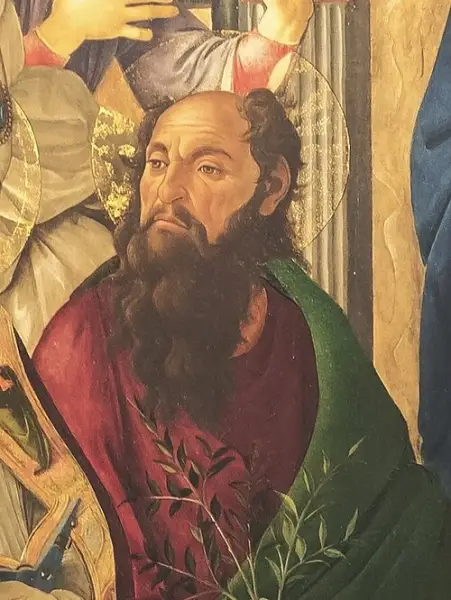
- Red martyr's cloak·Pilgrim's staff·Olive branch·Gospel of Matthew held in his hands
- Canonization
- Pre-congregation apostle, honored from the earliest centuries in the Catholic, Eastern Orthodox, Oriental Orthodox, Anglican, and Lutheran churches.
Prayer
Bibliography
Show 8 sources
- Fenlon, John Francis (1907). 'St. Barnabas'. In Herbermann, Charles (ed.). Catholic Encyclopedia, Vol. 2. New York: Robert Appleton Company.
- Cross, Frank Leslie; Livingstone, Elizabeth A. (2005). The Oxford Dictionary of the Christian Church. Oxford University Press. ISBN 978-0-19-280290-3.
- Attwater, Donald and John, Catherine Rachel (1993). The Penguin Dictionary of Saints, 3rd ed. New York: Penguin Books. ISBN 0-14-051312-4.
- Harnack, A. (1908). 'Barnabas'. In Jackson, Samuel Macauley (ed.). New Schaff–Herzog Encyclopedia of Religious Knowledge, Vol. 1, 3rd ed. London and New York: Funk and Wagnalls.
- Singer, Isidore, et al., eds. (1901–1906). 'Barnabas, Joses'. The Jewish Encyclopedia. New York: Funk & Wagnalls.
- Huffman, Joseph P. (December 2015). 'The Donation of Zeno: St. Barnabas and the Modern History of the Cypriot Archbishop's Regalia Privileges'. Church History 84(4).
- Fleetwood, John (1874). The Life of Our Blessed Lord and Savior Jesus Christ: And the Lives and Sufferings of His Holy Apostles and Evangelists. Garretson.
- Ragg, Lonsdale; Ragg, Laura (1907). The Gospel of Barnabas. Oxford: Clarendon Press.
Profile text adapted from the Wikipedia article, licensed CC BY-SA 4.0.
Pray with this saint every day
Save St. Barnabas to your favorites, read the full profile, and get feast-day reminders in the Saints app.
Get the Saints AppFree on the App Store for iPhone and iPad