
died c. 545·Feast April 11
St. Barsanuphius the Great
The Great Old Man of Gaza
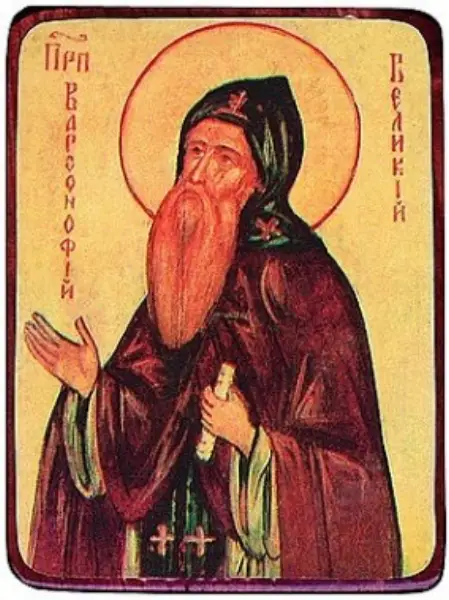
Overview
Barsanuphius, honored in the East as Barsanuphius the Great, was a sixth-century hermit and spiritual writer who began his ascetic life in Egypt and later withdrew to a cell near the village of Thavata in the hilly country outside Gaza. Already seasoned in the Desert Fathers' way, he became a magnet for other ascetics in the region, and the abbot of a neighboring monastery, Seridus of Gaza, served as the one go-between carrying questions to the recluse and his answers back, which Seridus recorded in Greek since he knew no Coptic. Around 525 a second hermit, John, called the Prophet, joined the community and was given Barsanuphius's own cell. The two elders then answered, jointly and by letter, inquiries from hermits, bishops, priests, monks, and laypeople of every occupation; more than 850 of these letters survive, some 400 from Barsanuphius's hand, and they stand among the classic monuments of Orthodox spiritual direction. When Seridus and John died within a fortnight of each other around 543, Barsanuphius shut himself away completely until his own death, placed about the year 545. Both East and West honor him, and his relics, carried to the southern Italian city of Oria in 850, made him its protector; Oria still entrusts him with the keys of the city each 30 August.
The Complete Life
From Egypt to Gaza
Barsanuphius was born in Egypt, the homeland of the monastic movement, and received his formation there in the tradition of the Desert Fathers, arriving in Palestine already an experienced ascetic. Why he left Egypt is not certain; one plausible suggestion is that the firmly Chalcedonian allegiance of the Gaza region drew him from an Egypt whose hierarchy had turned against the Council of Chalcedon. If so, the move was doctrinal rather than wanderlust. He settled at Thavata, a village in the hills near Gaza, at some point early in the sixth century, and made his home in a cell there as a recluse. It cannot be established whether he had been ordained a priest; the sources are silent, and the silence is itself telling, since what mattered to his admirers was not office but the discernment of a man long practiced in the combat of the desert. He stood on the Chalcedonian side of the great divide of his day, though his letters show none of the militancy that marked some of his contemporaries. Egypt gave him his training; Gaza gave him his work.
§ Hermit
The Recluse of Thavata
The vocation of Barsanuphius was silence placed at the service of others. From his cell at Thavata he began to offer counsel and spiritual direction to the ascetics living around him, and the monks of a nearby monastery gradually took on the burden of supporting the solitaries who gathered near the hermit. The abbot of that house, Seridus of Gaza, ended up as the single channel of communication: anyone who wanted the Old Man's advice brought the question to Seridus, who carried it in and brought the answer out, writing the replies down in Greek because he had no Coptic. The arrangement held for decades and produced one of antiquity's great letter collections. It was not without strain. At one point members of the monastery began to doubt that the hermit existed at all; on learning of it, Barsanuphius settled the matter by coming out and washing their feet, an act of humility as well as proof. Here the pattern of his authority appears whole: hiddenness, service, and words that traveled farther than the man ever did.
§ Hermit
The Letter Apostolate
Between 525 and 527 another hermit, John, entered the same monastic community as Barsanuphius's disciple, and the older man gave up his own cell to him, moving to another nearby. From then on the two worked as a pair: Barsanuphius was called the Old Man, or the Great Old Man, and John the Other Old Man, or the Prophet. John placed himself under his senior's authority, though after John was established as an anchorite Barsanuphius never pressed that authority. John in turn became the teacher of Dorotheus of Gaza, who stood to John much as Seridus stood to Barsanuphius. Together the two elders answered an astonishing range of correspondents: hermits, priests, bishops, monks, and lay people of various trades, from small practical worries to the deepest theological questions. Contemporary readers thought the two could communicate without speech or writing, so unified was their counsel; they rebuked anyone who tried putting the same question to each of them in hopes of a different answer. Their mission, conducted entirely through letters carried by Seridus and Dorotheus, was the spiritual fatherhood of a whole region exercised from two cells.
§ Spiritual direction through letters
Counsel and Doctrine
What emerges from the correspondence is a personality at once forceful, encouraging and warm; Barsanuphius writes with clarity and prayerfulness, never put off by difficulties. Scripture runs through the correspondence, handled allegorically and spiritually to meet each correspondent's need. Having watched the Origenist controversy and the damage done by speculative exegesis, the two Old Men treated the understanding of the Bible as a lifelong labor to be pursued with discernment, and often read it anagogically. They quoted the Sayings of the Desert Fathers freely and knew Basil the Great and Origen. Barsanuphius would not join in condemning Origenism outright, but he rejected firmly the notion that spiritual knowledge, gnosis, could be earned as the wages of ascetic practice, and he judged it perilous for monks to conduct themselves as though the thing were possible. In directing souls he and John gave few precise prescriptions: they did not assign set numbers of penitential acts, preferring to urge the practice of the virtue opposed to whatever vice or temptation afflicted the disciple. It is direction by discernment rather than by rule, patient with weakness and suspicious of shortcuts, and it is the reason their letters are still read as a manual of the spiritual life.
§ Spiritual direction through letters
Seclusion and Death
The close of Barsanuphius's life was an act of closure as deliberate as any of his earlier withdrawings. In the space of two weeks, between 543 and 544, both Seridus the abbot and John the Prophet died. The two channels of his apostolate were gone at a stroke: the mediator who had carried his letters, and the partner who had shared them. Barsanuphius's answer was to withdraw into total seclusion. The brethren chose Aelianos to be their new abbot, and Dorotheus of Gaza departed from the community. The Old Man himself died some time afterward, a date reckoned around 545. Yet his death did not quite close the story, for a strange tradition grew that he was still alive. When Evagrius Scholasticus wrote of him in 593, dedicating a chapter of his Historia Ecclesiastica to the hermit, he recorded that the belief in Barsanuphius's continued life persisted; Evagrius relates that when the patriarch of Jerusalem, presumably Peter of Jerusalem, commanded that the cell be unsealed, fire leapt out of it and drove everyone present to flight. The story belongs to hagiography rather than chronicle, but it witnesses to the awe the recluse's memory commanded.
§ Death
Honors in East and West
No formal process of canonization stands behind Barsanuphius's cult; his holiness was recognized by the churches that read his letters, and both the Eastern Orthodox Church and the Roman Catholic Church venerate him as a saint. His feast falls on 6 February in the Orthodox East and on 11 April in the Roman calendar, while the Italian city of Oria keeps him additionally on 20 February and on 29 and 30 August. The Coptic Synaxarion, notably, does not mention him. His authority reached deep into Orthodox monasticism: Theodore the Studite counted him among the influences on his reform of the Stoudios Monastery in Constantinople, and Theodore recorded that the hermit was depicted on the altar cloth of Hagia Sophia alongside Anthony the Great and Ephrem the Syrian, an extraordinary honor for a recluse who almost never left his cell. From the tenth century onward his name appears in many Orthodox synaxaria, and the Russian monastery of St. Panteleimon on Mount Athos kept a liturgical office for Barsanuphius and John together.
§ Sainthood
Oria and the Letters
Barsanuphius's living legacy is twofold: a letter collection and an Italian city. The letters were gathered by an anonymous editor who seems to have been a monk of the community while the two Old Men lived, and who may even have seen Barsanuphius; many suspect Dorotheus of Gaza. He grouped the letters by type of petitioner and prefaced each with the question that prompted it, leaving a record whose internal details, from Justinian's laws to the Justinian plague, confirm a sixth-century composition and illuminate the ecclesiastical and social history of the Gaza region. The earliest manuscripts are two Georgian translations from Saint Catherine's Monastery at Sinai, and Athos preserved the collection through the Middle Ages until the complete edition of 1816; the first complete English version is by John Chryssavgis. In Italy, a Palestinian monk brought the relics to Oria in 850, and after their loss and recovery they rest in the basilica. Oria credits him with saving the city from wartime destruction, a legend even giving him a sword against a Spanish invader; each 30 August the mayor hands the city's keys to his effigy.
§ Patron saint of Oria
Timeline
- 500
Leaves Egypt and settles as a recluse near Thavata, outside Gaza, early in the century
§ Hermit
- 526
John the Prophet joins the community; Barsanuphius hands over his cell and is known thereafter as the Great Old Man
§ Collaboration with John the Prophet
- 543
Seridus and John die within two weeks of one another; Barsanuphius withdraws into total seclusion and Aelianos becomes abbot
§ Death
- 545
Dies at the monastery of Seridus near Gaza
§ Death
- 593
Evagrius Scholasticus devotes a chapter to him, reporting that fire flashed from the sealed cell when the patriarch of Jerusalem ordered it opened
§ Death
- 850
His relics are brought to Oria in southern Italy by a Palestinian monk
§ Patron saint of Oria
- 885
In the 880s Bishop Theodosius of Oria places the relics in a chapel near the porta Hebraea, where they rest from about 890 to 1170
§ Patron saint of Oria
- 1170
The relics are lost during a Moorish capture of Oria, later rediscovered, and enshrined in the city's basilica
§ Patron saint of Oria
- 1190
In the late twelfth century an Orian priest composes a Latin vita of the saint, including the tale of the relic translation
§ Patron saint of Oria
- 1569
Johann Grynaeus prints the first edition of the letters at Basel, alongside writings of Dorotheus
§ Composition and history of letters
- 1816
Nikodemos, a monk of Athos, publishes the first complete edition from Athonite manuscripts
§ Composition and history of letters
The Record
- Major works
- Around 850 surviving letters of spiritual counsel, written with John the Prophet (roughly 400 from Barsanuphius himself)
- Patron of
- Oria, Italy
- Symbols
- Monastic vestments·Scroll
- Canonization
- Pre-congregation; venerated in both the Eastern Orthodox Church and the Roman Catholic Church
Prayer
Bibliography
Show 6 sources
- Chryssavgis, John (2006). Barsanuphius and John: Letters, Volume 1. CUA Press. ISBN 9780813201139.
- Chryssavgis, John (2022). The Letters of Barsanuphius and John: Desert Wisdom for Everyday Life. Bloomsbury Publishing.
- Hevelone-Harper, Jennifer L. (2005). Disciples of the Desert: Monks, Laity, and Spiritual Authority in Sixth-Century Gaza. JHU Press.
- Hevelone-Harper, Jennifer L. (2019). "The Letter Collection of Barsanuphius and John", in Late Antique Letter Collections: A Critical Introduction and Reference Guide. University of California Press.
- Torrance, Alexis (2013). Repentance in Late Antiquity: Eastern Asceticism and the Framing of the Christian Life c. 400-650 CE. Oxford University Press.
- Hombergen, Daniël, O.C.S.O. (2004). "Barsanuphius and John of Gaza and the Origenist Controversy", in Christian Gaza in Late Antiquity. Brill.
Profile text adapted from the Wikipedia article, licensed CC BY-SA 4.0.
Pray with this saint every day
Save St. Barsanuphius the Great to your favorites, read the full profile, and get feast-day reminders in the Saints app.
Get the Saints AppFree on the App Store for iPhone and iPad