
died 456·Feast February 3
St. Barsauma
Father of the Syrian Monks, Foe of Chalcedon
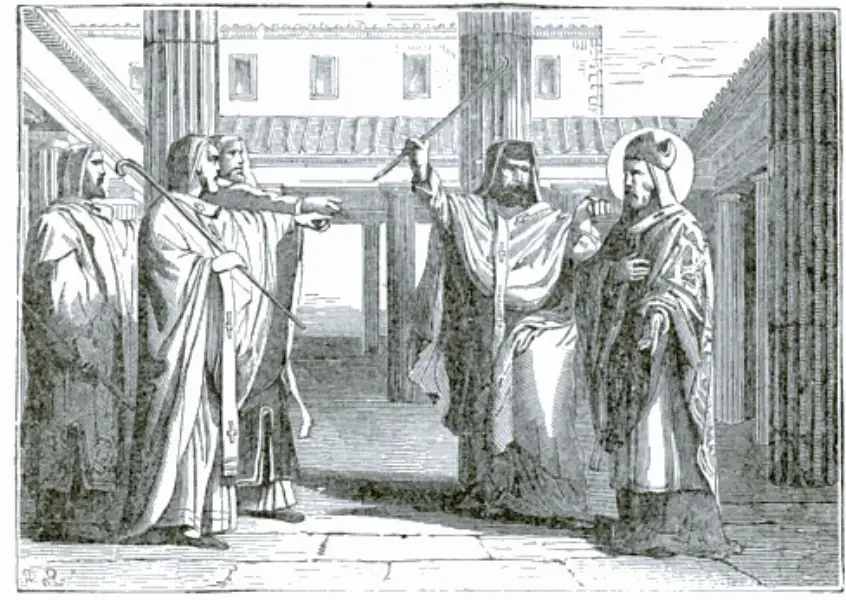
Overview
Barsauma, in classical Syriac Barṣawmo and in Greek Barsoumas, was a Syriac-speaking monk and ascetic of the fifth century who became one of the most formidable opponents of the Council of Chalcedon of 451. Honored in the Oriental Orthodox churches as the Father of the Syrian Monks, he is remembered equally for his austerity and for the violence that gathered around his campaigns against non-Christian worship. Trained under St. Abraham of the High Mountain, he led bands of monks through the provinces of the East between roughly 418 and 423, destroying pagan temples along with Jewish and Samaritan synagogues; ancient sources recount that when he reached the synagogue of Rabba, or Areopolis, its doors opened of themselves and the building was burned to the ground, with looting forbidden on his orders. In 438 he and forty followers attacked Jews praying among the ruins of the Jerusalem Temple, killing many; tried for the deed, he protested that the stones had fallen from heaven and was acquitted. At the Second Council of Ephesus in 449, Bishop Diogenes of Cyzicus later testified, Barsauma's monks assaulted Patriarch Flavian of Constantinople while Barsauma himself stood by crying out for his death; the bishops at Chalcedon, hearing this, anathematized him as a murderer. He died in 456. A Syriac Life composed about a century after his death preserves his memory, Andrew Palmer's recent translation has carried it to English readers, and Jacob of Serugh preached a homily in his praise.
The Complete Life
A Disciple of Abraham of the High Mountain
The sources tell us almost nothing of Barsauma's beginnings: no birthplace, no family, no boyhood tale survives. What they do fix is his spiritual lineage. St. Abraham of the High Mountain, an anchorite whose memory the Syriac churches also cultivated, formed him as a disciple, and from that school he seems to have drawn both the ferocity of his asceticism and the conviction, common among Syrian monks of the fifth century, that the coming of Christ entailed a duty to overthrow the old cults. He lived as a Syriac speaker in the eastern provinces of the Roman world in the decades when theology and empire had begun to pull against each other: the councils of Ephesus in 431 and 449 and of Chalcedon in 451 tore the church into communions that still endure, and Barsauma stood throughout on the side that would become the Oriental Orthodox inheritance, holding the one nature of the incarnate Word against the definition of Chalcedon. His later titles, the Father of the Syrian Monks above all, speak of a man who gathered and led communities of monks rather than a solitary hiding in a cell. Everything else about the young Barsauma—the date of his birth, his region, his first vocation—is simply not recorded, and the biography composed perhaps a century after his death opens onto a man already made: severe, mobilized, and certain that God's cause and his cause had met.
§ Hagiography
The Ascetic as Holy Man of the People
In the late antique East the monk who lived beyond the cities was not a recluse in the modern sense but a public figure, and this is the office Barsauma filled. The Syriac Life that preserves his memory presents him as a holy man whose words carried authority with crowds and whose movements could empty a district of its old worship. His vocation joined two elements that modern readers find hard to hold together: the pursuit of personal sanctity through fasting, prayer, and the discipline of the desert, and the exercise of a militant patronage over the Christian community against its rivals. He moved with followers, sometimes dozens strong, and his authority over them was evidently absolute, since at the burning of the synagogue of Rabba a single order of his sufficed to forbid looting among men who had just watched a building burn. The tradition calls him the Father of the Syrian Monks, a title that claims for him a kind of patriarchate over the ascetic movement of the Syriac countryside, and it is in that capacity—as leader and exemplar rather than as bishop or theologian—that his name traveled. He composed, so far as the record shows, no treatises and held no see; his vocation was enacted rather than written, in journeys, confrontations, and the founding discipline of monastic bands whose zeal the church would spend the next centuries both honoring and regretting.
§ Hagiography
Temples and Synagogues Overthrown
The mission for which Barsauma is remembered was the physical destruction of non-Christian places of worship. Between about 418 and 423—some sources prefer 419 to 422—he and his monks put an end to numerous pagan temples and to synagogues of both Jewish and Samaritan communities. The Syriac account of the synagogue of Rabba, the Areopolis of antiquity, gives the campaign its signature scene: when Barsauma arrived, the doors of the building are said to have opened of themselves, the synagogue was set alight, and, on his explicit prohibition, nothing was carried off, so that it burned to the ground untouched. The story is told as miracle and vindication together, heaven opening the doors and discipline keeping the hands of the mob clean; whether any of the local Jews went over to Christianity, the sources do not say. In 438 the movement reached Jerusalem, where Barsauma and forty followers attacked Jews at prayer among the Temple's ruins, killing many of them. Brought to trial, he answered that he was innocent of the deaths because the stones had come down from heaven; the court, whether persuaded or overawed, acquitted him. Historians must hold both facts at once: a community that revered him as a saint, and a record of killing that the same sources preserve without disguise.
§ Hagiography
Ephesus, Chalcedon, and a Cry of Murder
The last chapter of Barsauma's public life belongs to the church's greatest crisis. At the Second Council of Ephesus in 449—the gathering its enemies called the Robber Synod—Patriarch Flavian of Constantinople was violently deposed and died of injuries received there three days afterwards. Barsauma was present, and in 451, at the Council of Chalcedon, Bishop Diogenes of Cyzicus rose to testify that he had himself seen Barsauma's part in it: a group of his monks, Diogenes said, had seized and beaten Flavian while Barsauma stood by and shouted for them to strike him dead. The Acts of Chalcedon preserve the roar that answered: the bishops cried out that Barsauma was a murderer, that he must be cast out, sent to the arena, held anathema. It is testimony, not verdict—the accusation of a partisan assembly against the ally of its enemies—but it is testimony the church's own record keeps. Thereafter Barsauma passes from the councils; he lived some five more years, dying in 456, still revered in the Syriac world as the ascetic champion of the anti-Chalcedonian cause. An iconographic tradition of the other side remembered him differently, depicting him together with Pope Dioscorus I of Alexandria in the act of killing Flavian, so that his final years left two images of the same man: a father of monks and a murderer, each drawn by the communion that needed it.
§ Martyrdom of Flavian
Saint of the Oriental Orthodox Communion
No process ever examined Barsauma's life; he is a saint by the older and simpler road of liturgical memory: the Oriental Orthodox churches regard him as a saint, and they kept the anti-Chalcedonian faith he had defended with such terrible energy. The Syriac Orthodox Church commemorates him each year on the third of February, and the Coptic Orthodox Church keeps his departure on the ninth day of the month of Amshir in its own calendar, both dates bearing witness to a cult spread across the two great Syriac and Egyptian branches of the communion. The title under which the liturgies remember him is not controversial but tender: the Father of the Syrian Monks, as though the churches wished to dwell on the ascetic rather than the activist. His canonization in effect happened in the decades after his death, when the communities that revered the monastic resistance to Chalcedon fixed his feast and told his story; a Syriac biography composed about a century after he died gave the memory its lasting shape, and Jacob of Serugh, among the finest poets of the Syriac tradition, added a homily in his praise. That a man anathematized by name at Chalcedon should be entered permanently in the calendars of the churches that rejected Chalcedon is the whole of his cause: sainthood here is the recognition of one side of a divided Christendom, and it has lasted fifteen hundred years.
§ Veneration
A Difficult Saint and His Modern Readers
Barsauma's afterlife has been long, contested, and recently renewed. Within the Syriac churches his cult endured through the annual feasts and through the literature: the Syriac Life composed roughly a century after his death, a work of partisan and sometimes miraculous storytelling that remained largely inaccessible to Western scholarship, was finally carried into English by Andrew N. Palmer, whose University of California Press volume of 2020, an English eulogy of a hero who resisted the council of Chalcedon, brought the Barsauma legend to Anglophone readers, with a review by Sebastian P. Brock following in the Journal of Theological Studies in 2021. Roger Akhrass's 2015 list of the homilies of Jacob of Serugh confirmed the poet's contribution to the dossier. Lucas Van Rompay's entry in the Gorgias Encyclopedic Dictionary of the Syriac Heritage and Jean Maurice Fiey's Saints syriaques keep the scholarly record. Historians of late antique Judaism, among them François Nau in 1927 and Hagith Sivan in 2008, have used the episodes of 423 and 438 as evidence for the condition of Jewish communities under Theodosius II, so that the destruction attributed to Barsauma became a primary source for the very people it harmed. He remains what he was: a saint of one communion whose life is a warning, to all communions, of what zeal becomes when it takes up stones.
§ Sources
Timeline
- 418
Launches a campaign destroying temples and Jewish and Samaritan synagogues, continuing to about 423 (another dating gives 419-422)
§ Hagiography
- 438
With forty followers attacks Jews praying at the ruins of the Jerusalem Temple, killing many; tried, he claims the stones fell from heaven and is acquitted
§ Hagiography
- 449
At the Second Council of Ephesus his monks, by later testimony, assault Patriarch Flavian of Constantinople, who dies of his injuries three days later
§ Martyrdom of Flavian
- 451
Bishop Diogenes of Cyzicus testifies against him at the Council of Chalcedon, and the assembled bishops cry for his anathema as a murderer
§ Martyrdom of Flavian
- 456
Dies, honored afterwards by the Oriental Orthodox as a saint and Father of the Syrian Monks
§ Hagiography
- 2020
Andrew N. Palmer's English translation of the Life of Barsauma is published by the University of California Press
§ Sources
In Their Own Words
Barsauma is a murderer, cast him out, out with him to the arena, let him be anathema.
Strike him dead!
The Record
- Major works
- Subject of the Syriac Life of Barsauma, composed c. 556·Homily on Barsauma by Jacob of Serugh
- Symbols
- Monk's habit·Staff of the archimandrite
- Canonization
- Pre-congregation; regarded as a saint by the Oriental Orthodox, commemorated in the Syriac Orthodox and Coptic Orthodox churches.
Prayer
Bibliography
Show 7 sources
- Palmer, Andrew N., ed. (2020). The Life of the Syrian Saint Barsauma: Eulogy of a Hero of the Resistance to the Council of Chalcedon. Transformation of the Classical Heritage 61. University of California Press. ISBN 978-0-520-97298-8.
- Brock, Sebastian P. (2021). 'Review of Palmer 2020'. The Journal of Theological Studies 72(2): 1007–1009.
- Van Rompay, Lucas (2018). 'Barṣawmo'. In Brock, Butts, Kiraz and Van Rompay (eds.). Gorgias Encyclopedic Dictionary of the Syriac Heritage: Electronic Edition. Beth Mardutho.
- Fiey, Jean Maurice (2004). Saints syriaques. Princeton: Darwin Press.
- Nau, François (1927). 'Deux épisodes de l'histoire juive sous Théodose II (423 et 438) d'après la vie de Barsauma le Syrien'. Revue des Études Juives 83: 184–206.
- Sivan, Hagith (2008). Palestine in Late Antiquity. Oxford University Press.
- Akhrass, Roger (2015). 'A List of Homilies of Mor Jacob of Serugh'. Syriac Patriarchal Orthodox Journal 53: 87–161.
Profile text adapted from the Wikipedia article, licensed CC BY-SA 4.0.
Pray with this saint every day
Save St. Barsauma to your favorites, read the full profile, and get feast-day reminders in the Saints app.
Get the Saints AppFree on the App Store for iPhone and iPad