
died 114 (traditional); probably mid-3rd century·Feast January 30
St. Barsimaeus
Bishop-Confessor of Edessa, Friend of Sharbel
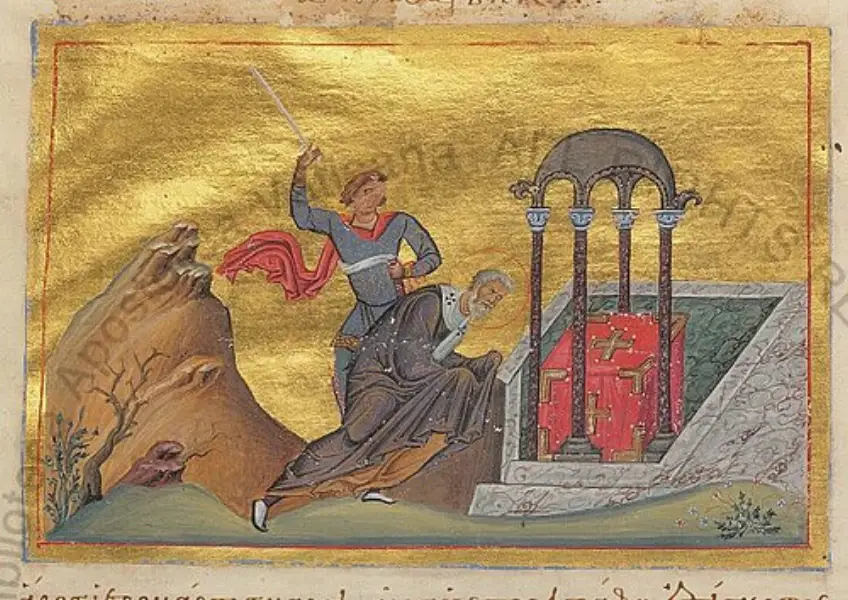
Overview
Barsimaeus, also spelled Barsimeus, Barses, or Barsamya—a Syriac name that may mean 'son of the blind man' or 'son of the divine standard'—was a bishop of Edessa in Syria, revered as a martyr. The standard account makes him a missionary bishop who was put to death in 114 AD during the persecutions that followed the Emperor Trajan's conquest of Mesopotamia, condemned by the president Lysias for his zeal in winning great numbers to the faith. Butler's Lives of the Saints counts him the third bishop of Edessa in succession from St. Thaddaeus, one of the seventy-two disciples, and the entry of the Roman Martyrology under 30 January records that he was martyred under Trajan in 106 or 112 for converting too many of his fellow citizens, above all Sarbil, a pagan priest, and the priest's sister Bebaia. A variant tradition enlarges the story: Barsimaeus had baptized Sharbel, and after Sharbel's martyrdom the bishop was arrested and tried; popular protests made the judge hesitate, and a fresh decree from the emperor ordered his release, the crowd welcoming him back as a persecuted confessor and the friend of Sharbel. Modern scholarship finds this chronology suspect. The narrative, it is now argued, was backdated by about a century and a half to bind the church of Edessa to the apostolic age, and it more likely reflects the sufferings of a later bishop under the persecution of Decius around 250, one who was beaten with rods for Christ, imprisoned, and then gave the remainder of his life to governing his church, succeeding Palut on the episcopal throne.
The Complete Life
Third Bishop of the First Christian City
Edessa, the capital of a small kingdom beyond the Euphrates, was among the earliest seats of Christianity in the world, and its tradition claimed an apostolic founder: Thaddaeus, numbered by the Gospels' interpreters among the seventy-two disciples sent out by the Lord. Into that succession Barsimaeus was set as, in Butler's reckoning, the third to occupy the throne—after Thaddaeus himself and his immediate successor—and the Syriac name he bore, Barsamya, has been read either as 'son of the blind man' or as 'son of the divine standard', the second of which may conceal a pagan religious title absorbed into a Christian family, as Amir Harrak's study of Syriac onomastics suggests. Of the man before his consecration nothing is recorded: neither birthplace, nor parents, nor age. What the traditions assume is a Christian formed in the Syriac-speaking church of Osrhoene at a moment when that church was still young enough to remember its founders and still exposed enough to imperial power to fear it. The office he inherited was missionary by nature—Edessa sat among pagan, Jewish, and later Manichaean communities—and the accounts of his episcopate make evangelization, not administration, the center of his work. That emphasis, converting the pagan priest Sarbil and his sister Bebaia, baptizing Sharbel, winning great multitudes, is what the martyrologies cite as the very cause of his condemnation.
§ Life
Missionary Bishop of a Border Kingdom
The standard account names Barsimaeus a missionary bishop, and the word is chosen deliberately: the church of Edessa understood itself as sent. He governed a see that had come to faith, so its own story ran, through the healing of King Abgar and the preaching of Thaddaeus, and each bishop after the founder inherited the duty of carrying the gospel outward into the Syrian countryside and its mixed population of pagans, Jews, and Samaritans. The Roman Martyrology's entry under 30 January captures the vocation in a single phrase: he died for over-zealous success in making fellow citizens Christians. Among those fellow citizens the sources single out Sarbil, a pagan priest, together with his sister Bebaia—conversions that would have struck at a temple's whole establishment—and, in the variant narrative, Sharbel, whom Barsimaeus himself baptized and who was afterwards martyred. A bishop who converts a priest wins a controversy, not merely a soul, and the traditions agree that it was this success, this excess of harvest, that brought the Roman authority down upon him. His vocation was thus inseparable from its cost: the shepherd who draws the flock enlarges it, and enlarging it in a hostile empire meant standing where the blow would land. Later scholarship would soften the blow's consequences, but no reading of the evidence denies that Barsimaeus was made to suffer for the conversions he wrought.
§ Life
Two Endings: Sword or Release
The traditions give Barsimaeus two endings, and honesty requires both. In the earlier and more famous one, Trajan, having crossed the Euphrates and overrun Mesopotamia in 114, presided over a persecution in which the president Lysias condemned the bishop to die for his zeal; so Butler, so the Monks of Ramsgate in their Book of Saints of 1921, and so the Roman Martyrology, which alternatively dates the martyrdom to 106 or 112. In the second and perhaps truer ending, the bishop is not killed at all. Under the emperor Decius, around 250, a bishop of Edessa named Barsimeo underwent a beating with rods on account of his faith in Christ and went to prison; freed at last, he spent what remained of his life in the governance of the church entrusted to him. A variant of this version supplies the drama: Barsimaeus had baptized Sharbel, and after Sharbel's martyrdom the bishop was arrested and tried; his arrest stirred popular protest, the judge held back from torture or execution despite his refusal to comply with the imperial decree, and then a new decree reached Edessa repealing the old and ordering his freedom. The crowd, the story says, received him back with enthusiasm, hailing him as a persecuted confessor and the friend of Sharbel. A confessor's crown instead of a martyr's, deliverance by the arm of the state rather than victory over it—this quieter close is the one modern scholars judge the more probable.
§ Life
A Name in the Martyrologies
Barsimaeus is a saint of the books: his cult rests on the martyrologies rather than on any process, and those books have kept him steadily for centuries. The Roman Martyrology carries him under 30 January as Barsimeo, called Barsamya, bishop of Edessa, martyred under Trajan in 106 or 112 for the excess of his converting zeal, with the pagan priest Sarbil and the priest's sister Bebaia named among his harvest. Butler reports that the same date holds him in the Greek Menology as well, and the Eastern calendar more generally keeps his memory on 29 January, the one-day displacement familiar from the Orthodox reckoning. The Church of the East knew his story in Syriac under the title the Martyrdom of Barsamya, a narrative that modern editors, including the scholars of syriaca.org, have edited and studied. What this amounts to is canonization by commemoration: no congregation sat, no miracles were attested, but year upon year the Latin and Greek churches pronounced his name at the altar, and the pronunciation sufficed. The two calendars' disagreement over the date, and the martyrologies' own disagreement over the year, have never troubled the cult, for the point of the entry was never the chronology—it was the memory of a bishop of the first Christian city who was made to suffer because too many of his neighbors believed him.
§ Life
The Backdated Bishop
The most enduring contribution of Barsimaeus to history may be the lesson his story teaches about how traditions grow. Modern scholarship, as summarized by Joseph-Marie Sauget in the Enciclopedia dei santi, holds that the dramatic Trajanic martyrdom was probably antedated by something like a hundred and fifty years so as to tie the church of Edessa directly to the apostles, and that the narrative's true subject is a bishop of the mid-third century who endured the persecution of Decius, survived it, and succeeded Palut on the episcopal throne. The motive was not fraud but lineage: a young church, claiming Thaddaeus as founder, wanted bishops to bridge the gap between the apostle and its own day, and a confessor of 250 became a martyr of 114. The disguise worked for eighteen hundred years—Butler, the Ramsgate monks, and the compilers of the martyrologies all pass on the Trajanic dating in good faith—and it took the patient comparison of Syriac, Greek, and Latin witnesses to undo it. The saint survives his own demotion. Whether he died by Lysias' sentence or lived to govern the flock he had been given back, the church's memory of him holds: a convert-maker of Edessa, friend and baptizer of Sharbel, beaten and imprisoned for refusing an emperor's decree, and honored on 30 January by the West and 29 January by the East, in the calendars of both, still.
§ Life
Timeline
- 106
The Roman Martyrology instead places his martyrdom under Trajan in 106 or 112, crediting his zeal in converting the pagan priest Sarbil and his sister Bebaia
§ Life
- 114
Traditional date of death: as third bishop of Edessa he is condemned by the president Lysias in the year Trajan conquers Mesopotamia
§ Butler's account
- 250
Scholars judge the story backdated: the underlying bishop was persecuted under Decius, beaten with rods, released from prison, and governed his church thereafter
§ Life
- 250
Probably lives and works in the middle of the third century, succeeding Palut as bishop of Edessa
§ Life
- 1866
Alban Butler's Lives of the Saints, volume I for January, prints the traditional account under 30 January
§ Butler's account
- 1921
The Monks of Ramsgate's Book of Saints records him as the third Bishop of Edessa, martyred under Trajan
§ Monks of Ramsgate account
In Their Own Words
BARSIMAEUS (St.) Bp. M. (January 30) (2nd century) The third Bishop of Edessa in Syria, put to death as a Christian by the President Lysias, under the Emperor Trajan, A.D. 114.
Saint Barsaumas was crowned with martyrdom, being condemned to die for his zeal in converting great multitudes to the faith, by the president Lysias, in the reign of Trajan, when that prince having passed the Euphrates, made the conquest of Mesopotamia in 114.
The Record
- Symbols
- Bishop's vestments·Palm of martyrdom
- Canonization
- Pre-congregation; commemorated in the Roman Martyrology and the Greek Menology on 30 January (29 January in the Eastern calendar).
Prayer
Bibliography
Show 7 sources
- Butler, Alban (1866). The Lives of the Saints, vol. I: January.
- St. Augustine's Abbey, Ramsgate (1921). The Book of Saints: A Dictionary of Servants of God Canonized by the Catholic Church. London: A. & C. Black. OCLC 671676136.
- Sauget, Joseph-Marie (2013). 'San Barsimeo (Barsamya) Vescovo di Edessa'. Enciclopedia dei Santi. ISBN 9788831193474.
- 'Barsamya'. syriaca.org.
- Harrak, Amir. 'Pagan Traces in Syriac Christian Onomastica'. University of Toronto.
- 'Den hellige Barsimaeus av Edessa (200-t)'. Den katolske kirke (Norwegian).
- 'Saint Barsimaeus of Edessa'. CatholicSaints.info.
Profile text adapted from the Wikipedia article, licensed CC BY-SA 4.0.
Pray with this saint every day
Save St. Barsimaeus to your favorites, read the full profile, and get feast-day reminders in the Saints app.
Get the Saints AppFree on the App Store for iPhone and iPad