
c. 17 BC – c. 69/71 AD·Feast August 24
St. Bartholomew the Apostle
Apostle of Christ and Martyr of Armenia
Overview
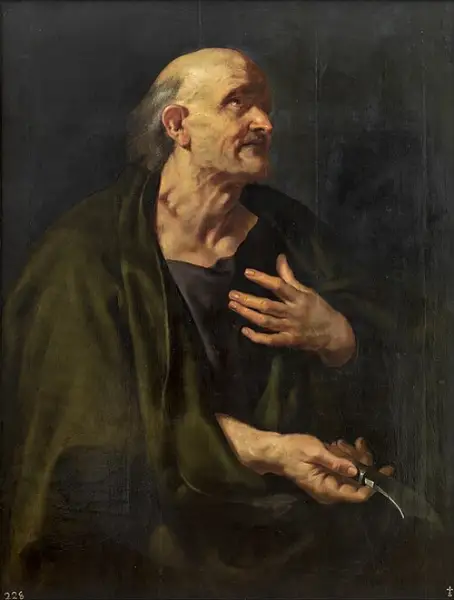
Bartholomew belongs to the twelve apostles of Jesus as the New Testament presents them: Matthew, Mark, and Luke each name him among the Twelve, as does the Acts of the Apostles. His Aramaic name, bar-Tolmay, means son of Tolmai, and a broad body of modern scholarship identifies him with Nathanael, the earnest Israelite whom Jesus sees beneath the fig tree in the Gospel of John. Ancient tradition, recorded by Eusebius of Caesarea, sends him after the Ascension on a missionary journey to India, where he is said to have deposited a copy of Matthew's Gospel; other accounts add Mesopotamia, Parthia, Lycaonia, and Ethiopia to his field of labour. Together with the apostle Jude Thaddeus he is credited with planting Christianity in Armenia, a mission Armenians honour as the seed of their church, and both are counted patrons of the Armenian Apostolic Church. The Hellenic account of his end places his martyrdom at Albanopolis in Armenia: after converting the local king Polymius, he was seized by order of the king's brother Astyages and put to death, the medieval imagination settling on flaying as the instrument of his red martyrdom. His relics travelled widely — to Daras in Mesopotamia by imperial gift in 507, then by legend-driven tide to Lipari, to Benevento in 838, and in part to Rome in 983 — and his image, holding knife and skin, became one of the most arresting figures in Christian art, from Michelangelo's Last Judgement to Ribera's doubting executioner.
The Complete Life
A Son of Tolmai from Cana
The man the Gospels call Bartholomew bore an Aramaic patronymic, bar-Tolmay, marking him as the son of a father named Tolmai — a name some render as son of the furrows. The place of his birth is given by tradition as Cana in Galilee, within the Roman Empire of the first century. The Synoptic Gospels — Matthew, Mark, and Luke — each include him in their rosters of the Twelve, and the Acts of the Apostles repeats the list, yet none of these texts attaches a single word of narrative to him: no saying, no deed, no scene. He is a name among names, one of the inner circle chosen by Christ whose individual features the canonical record leaves blank. Into that blank the Gospel of John offers a compelling candidate. Nathanael, the sceptic from Cana who asks whether anything good can come out of Nazareth, is summoned by Philip, and when Jesus sees him approaching he declares him a true Israelite in whom there is no deceit. Nathanael appears again, after the resurrection, among the disciples at the Sea of Galilee. Because Bartholomew's name is a patronymic rather than a personal one, and because John never lists a Bartholomew while the Synoptics never mention Nathanael, a long line of interpreters has concluded the two are one man, and most scholars today accept the identification. Thus the apostle's early portrait is drawn: a Galilean, probably of Cana, a man of blunt honesty whom the Lord's glance beneath the fig tree was enough to convert, and whose question and confession — Rabbi, you are the Son of God — stand in place of the biography the other evangelists did not think to give.
§ New Testament references
Named Among the Twelve
Bartholomew's vocation is bound up with the founding act of the apostolic college. Jesus, in the commissioning of the Twelve, chose him to be one of the witnesses who would accompany the Lord from his baptism to his ascension, and the evangelists enshrine that choice by setting his name in three of the four lists that have come down to us. Luke the historian repeats the roster once more in Acts, when the community gathered to appoint a successor to Judas Iscariot, which shows that Bartholomew belonged to the church's living memory in the years after Pentecost. Nothing in the record suggests he sought prominence; his vocation is that of the nameless faithfulness of the Twelve, the ordinary apostle whose authority rests not on his own exploits but on the call he received. Later Christian readers, struck by the silence, reached for the Fourth Gospel and found there the figure of Nathanael, the guileless Israelite whose meeting with Jesus under the fig tree becomes, in their reading, the moment of Bartholomew's calling. In that scene the Lord's knowledge of a man before his friend has finished introducing him is enough to break open a sceptic's heart, and the confession that follows — recognising in Jesus the Son of God and king of Israel — is the confession that would carry Bartholomew to the edge of the known world. Whether under his patronymic or his personal name, the apostle emerges as a man called by a look, whose vocation was confirmed in the community of the Twelve and spent in the long labour of the mission that followed.
§ New Testament references
From India to Greater Armenia
The earliest testimony to Bartholomew's missionary work comes from Eusebius of Caesarea, whose Ecclesiastical History reports that after the Ascension the apostle travelled to India and left with the converts a copy of the Gospel of Matthew in Hebrew. Jerome, a century later, repeats the tradition in connection with the reported visit of Pantaenus to India in the second century, finding there the same book still in use. Scholarship has long divided over the claim. Writers from Stallings to Zaleski accepted an Indian apostolate, and studies by A. C. Perumalil and Moraes proposed the Konkan coast around Kalyan as his field, while Sollerius, Harnack, Medlycott, Mingana, and Thurston argued that the India of the ancients should be read as Ethiopia or Arabia Felix. Alongside the Indian tradition stand accounts that send him preaching through Mesopotamia and Parthia, through Lycaonia, and even to Ethiopia. The tradition that anchored itself most lastingly sends him to Greater Armenia with his fellow apostle Jude Thaddeus, where the two are reputed to have brought the Christian faith in the first century. Armenians trace to that mission the conversion of their kingdom, which in 301 became the first state in history to make Christianity its official religion, and they honour Bartholomew and Thaddeus together as patrons of the Armenian Apostolic Church, with Bartholomew counted in that tradition as the second Catholicos-Patriarch. The visions recorded from Anne Catherine Emmerich in the nineteenth century add a colourful and wholly unhistorical itinerary — through Japan, Arabia, and Abyssinia, with a resurrected dead man, a silenced idol, and a baptised royal household — reminding us how freely later piety embroidered the apostle's journey.
§ Mission to India
The Martyrdom at Albanopolis
Christian tradition transmits three different accounts of how Bartholomew died. One holds that he was kidnapped, beaten until he lost consciousness, and thrown into the sea to drown. The account that won the deepest hold, the Hellenic tradition, sets his end at Albanopolis in Armenia. There, it is said, he converted the local king Polymius to the Christian faith; the monarch's brother, Prince Astyages, alarmed by the conversion and fearing reprisal from Rome, ordered the apostle seized, tortured, and put to death. Historians note that no Arsacid king of Armenia bears the name Polymius, and some versions of the passion substitute Agrippa, identified with Tigranes VI, or the king Sanatruk — a sign that the narrative as we have it is more devotional than documentary. What the several versions agree upon is that Bartholomew died for the faith he preached, and that his death belonged to the first generation of Christian witness. Later ages, meditating on the apostle's end, fixed upon flaying as the manner of his torture, and the knife with the skin removed from the living body became his abiding emblem, the so-called red martyrdom. The site of the passion was venerated at Vaspurakan in Greater Armenia, where the thirteenth-century Saint Bartholomew Monastery rose over the presumed place of his death, its ruins standing today in what is now southeastern Turkey. The apostle who left no recorded words in the Gospels thus acquired, in his final years, one of the most physically explicit martyrdoms in the calendar of the saints — a death that artists from the Middle Ages onward would find impossible to leave un-pictured, and one that bound his memory inseparably to the Christian history of Armenia.
§ In Armenia
Relics, Art, and the Apostle's Afterlife
The apostle's body proved nearly as travelled as his ministry. Theodorus Lector, writing in the sixth century, records that around 507 the emperor Anastasius I bestowed the body upon the Mesopotamian city of Daras, which he had recently refounded. A relic presence on the island of Lipari off Sicily was explained by Gregory of Tours through the tale that the body had miraculously washed ashore; from Lipari a large piece of skin and many bones were carried to Benevento in 838 and remain in the Basilica of San Bartolomeo there. In 983 the emperor Otto II sent a portion to Rome, where it rests at San Bartolomeo all'Isola, a church raised over the ancient temple of Asclepius; the medical association of the site gradually linked the apostle's name with hospitals. His feast anchors the calendar on 24 August in the West and 11 June alongside Barnabas in the East, with a further commemoration of the relic translation on 25 August. In art he is almost invariably shown with the knife and his own skin, most famously in Michelangelo's Last Judgement, where he holds his flayed portrait; Marco d'Agrate's 1562 statue renders every muscle and tendon, and Ribera's 1634 canvas freezes the executioner in a moment of doubt. He is patron of tanners, plasterers, butchers, bookbinders, and leatherworkers, of Florence's cheese and salt merchants, of sufferers from skin and neurological disease, and of Armenia itself. Bartholomew Fair in Smithfield kept his name alive in London's streets from the Middle Ages until the nineteenth century, and Ben Jonson made the fair the title subject of a 1614 comedy.
§ Relics
Timeline
- -17
Traditionally born at Cana in Galilee, then part of the Roman Empire.
§ Introduction
- 69
Executed at Albanopolis in the Kingdom of Armenia; one tradition holds he was flayed alive after converting King Polymius.
§ Introduction
- 301
The Armenian kingdom, crediting the preaching of Bartholomew and Thaddeus, becomes the first state to adopt Christianity officially.
§ In Armenia
- 507
Emperor Anastasius I Dicorus gives the apostle's body to the recently refounded city of Daras in Mesopotamia, reports Theodorus Lector.
§ Relics
- 838
The skin fragment and bones venerated at Lipari are carried off to Benevento, where they remain in the Basilica San Bartolomeo.
§ Relics
- 983
Emperor Otto II gives a portion of the relics to Rome, where they are conserved at San Bartolomeo all'Isola.
§ Relics
- 1614
Ben Jonson's homonymous comedy, set at the Smithfield Bartholomew Fair, belongs to this year.
§ Culture
In Their Own Words
Can anything good come out of Nazareth?
Rabbi, You are the Son of God! You are the King of Israel!
The Record
- Major works
- Left behind a copy of the Gospel of Matthew in India, according to Eusebius·Co-founder, with Jude Thaddeus, of the church of Armenia by traditional account·Consecration of a former pagan temple at the royal court, per the Emmerich visions
- Patron of
- Armenia·bookbinders·butchers·leather workers and tanners·plasterers and shoemakers·Florentine cheese and salt merchants·those with skin diseases·neurological diseases and twitching
- Symbols
- flaying knife·his own flayed skin held or draped over the body·red martyrdom·chained demon in Spanish painting
- Canonization
- Pre-congregation — venerated as one of the Twelve Apostles and a martyr from apostolic times
Prayer
Bibliography
Show 5 sources
- Fenlon, John Francis (1907). "St. Bartholomew". In Herbermann, Charles (ed.). Catholic Encyclopedia. Vol. 2. New York: Robert Appleton Company.
- Attwater, Donald; John, Catherine Rachel (1995). The Penguin Dictionary of Saints. Penguin. ISBN 978-0-14-051312-7.
- Butler, Alban; Burns, Paul (1998). Butler's Lives of the Saints: August. A&C Black. ISBN 978-0-86012-257-9.
- Kay, S. (2006). "Original Skin: Flaying, Reading, and Thinking in the Legend of Saint Bartholomew and Other Works". Journal of Medieval and Early Modern Studies 36 (1): 35–74.
- Curtin, D. P. (January 2014). The Martyrdom of St. Bartholomew: Greek, Arabic, and Armenian Versions. Dalcassian Publishing Company. ISBN 9798868951473.
Profile text adapted from the Wikipedia article, licensed CC BY-SA 4.0.
Pray with this saint every day
Save St. Bartholomew the Apostle to your favorites, read the full profile, and get feast-day reminders in the Saints app.
Get the Saints AppFree on the App Store for iPhone and iPad