
12th century – 19 May 1164·Feast May 19 (24 Pashons)
St. Bashnouna
Coptic Monk of Scetis Burned Alive under the Fatimids
Overview
Bashnouna, whose name appears in Coptic as Pišennoufi, was a twelfth-century Coptic monk and martyr. He belonged to the Scetis community of Saint Macarius the Great, the ancient desert settlement in the Nitrian waste where Egyptian monasticism had kept its most austere traditions for eight centuries. During the closing years of Fatimid rule, under the caliph Al-'Āḍid, the authorities arrested him and threatened him with death unless he embraced Islam. Bashnouna refused, and on 24 Pashons in the year 880 of the Era of the Martyrs — 19 May 1164 by the common reckoning — he was burned alive. His body was recovered and laid to rest in Cairo's Church of Saint Sergius, the ancient church within the fortress of Babylon where the Copts have long honoured their confessors. The Coptic Synaxarion keeps his commemoration on the day of his death, and his relics remain an object of veneration, a late witness in flesh to the long line of Egyptian martyrs that stretches back to the persecutions of Rome.
The Complete Life
A Monk of Saint Macarius
Bashnouna lived and died as a monk of the Scetis house of Saint Macarius the Great, the desert community founded in the fourth century that remained the beating heart of Coptic monasticism into his own day. To enter such a house in twelfth-century Egypt was to accept the inheritance of Antony and Macarius: long offices, sparse food, manual labour and unceasing prayer beneath a desert sky. Nothing in the surviving record speaks of Bashnouna's family, his native village or the year of his birth; the Synaxarion notices only his profession and his end. Yet the setting of his vocation matters. Scetis lay within a Egypt governed now by the Fatimid caliphate, a regime in which Christians lived by negotiated tolerance that could, without warning, turn to pressure and violence. The monk who left the world for the cell did not thereby leave history: the authorities of the state could reach even the Nitrian desert. Bashnouna's witness, like that of generations of Egyptian ascetics before him, was prepared in obscurity — vigils, fasting, the memorised psalter — so that when the day of testing arrived there was something established in him to test. His Coptic name, Pišennoufi, binds him to the native tradition of the church that remembers him, a church that has always counted its monks among the first ranks of its confessors.
§ Bashnouna
The Fire of 1164
The end of Bashnouna came in the year 880 of the Coptic Era of the Martyrs, which corresponds to 1164 in the common calendar, during the caliphate of Al-'Āḍid, the last of the Fatimid rulers. He was arrested by the authorities of that regime and confronted with the demand that he renounce his Christian faith and accept Islam; the alternative was death. His hagiography records that he refused, and the refusal cost him exactly what had been threatened. On 24 Pashons — 19 May — he was burned alive. Fire, the oldest of the executioner's instruments against the confessors of Egypt, had been the death of martyrs since the days of Diocletian; in Bashnouna the Coptic Church saw the same sentence passed under a Muslim caliph that her ancestors had faced under Roman emperors. The manner of his death fixed his commemoration: the Synaxarion enters him on the very day of his burning, the custom of the Coptic martyrology, by which a saint's feast is the day of his birth into heaven. He thus stands near the end of a long line, one of the last great martyr-witnesses of the medieval Coptic tradition, whose death the church received not as defeat but as completion of the monastic profession he had kept at Scetis.
§ Bashnouna
Relics and Remembrance
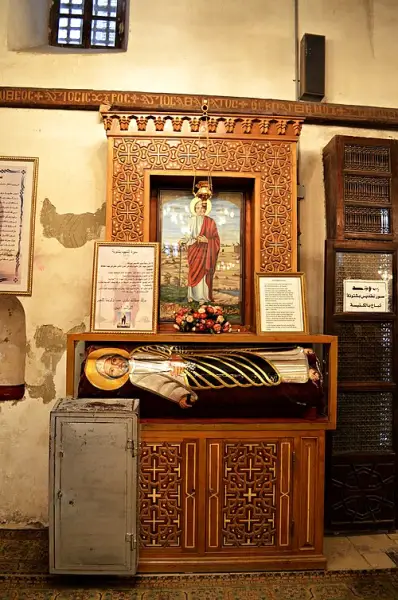
The body of Bashnouna did not remain in the desert. His relics were carried to Cairo and buried in the Church of Saint Sergius — Abu Serga — the ancient basilica built over the cave where the Holy Family is said to have rested, within the old Roman fortress of Babylon at the heart of the Coptic quarter. There, amid the memorials of Egypt's apostolic past, the ashes of a twelfth-century martyr found their shrine, and there his relics are still honoured. The placement is eloquent: a monk of Scetis laid among the foundations of Egyptian Christianity, joining the desert to the city and the medieval church to the church of the apostles. His feast on 24 Pashons, falling on 19 May, is kept in the Coptic Synaxarion, the great collecting of the lives of the saints read through the Coptic liturgical year. Modern Coptic historiography has kept his memory alive; the coptichistory.org tradition carries his Arabic notice, 'the martyr Bashnouna', for a new generation. In an age when the Coptic Church has again been called to number its martyrs, the witness of 1164 reads less like antiquarian interest than like a living inheritance — proof that the profession of the desert and the confession unto death belong to the same unbroken cord.
§ Bashnouna
Timeline
- 1164
A monk of the Monastery of Saint Macarius the Great in Scetes, he is arrested by the Fatimid authorities under the caliph Al-'Āḍid
§ Introduction
- 1164
Refuses under threat of death the demand to convert to Islam
§ Introduction
- 19 May 1164
Burned alive on 24 Pashons 880 A.M. (19 May 1164); his relics are buried at the Church of Saint Sergius in Cairo
§ Introduction
The Record
- Symbols
- Depicted as a Coptic monk; relics honoured at the Church of Saints Sergius and Bacchus, Cairo
- Canonization
- Pre-congregation; venerated in the Coptic Orthodox Church
Prayer
Bibliography
Show 2 sources
- "الشهيد بشنونة" (The Martyr Bashnouna). www.coptichistory.org.
- Coptic Synexarion.
Profile text adapted from the Wikipedia article, licensed CC BY-SA 4.0.
Pray with this saint every day
Save St. Bashnouna to your favorites, read the full profile, and get feast-day reminders in the Saints app.
Get the Saints AppFree on the App Store for iPhone and iPad