
December 1468 – 2 August 1552 (or 1557)·Feast August 2 (15 August N.S.)
St. Basil Fool for Christ
Wonderworker and Fool for Christ of Moscow
Overview
Vasily the Blessed, known also as Basil or Blessed Basil of Moscow, was a Russian fool for Christ — a yurodivy — born at Yelokhovo, at the portico of its Epiphany Cathedral, to a serf family in December 1468; the village now lies within Moscow. His father was Jacob and his mother Anna. First apprenticed to a shoemaker, he came to Moscow at sixteen and there embraced a life of deliberate destitution: whatever he had he gave to the hungry poor whose shame kept them from begging, went about unclothed, and loaded his body with chains. He is remembered for rebuking Ivan the Terrible himself for inattention in church, and was said to carry the gift of prophecy. His death came on 2 August 1552 — some accounts give 1557 — and Metropolitan Macarius of Moscow officiated at his funeral amid a great gathering of clergy. He was buried in the cathedral Ivan raised to commemorate the taking of Kazan, which later took the saint's own name. Formally canonised in 1588, he is honoured as a fool for Christ and wonderworker, with his feast on 2 August.
The Complete Life
A Serf's Son at the Cathedral Door
The life of Moscow's most beloved yurodivy began in circumstances of the humblest order. Basil — Vasily in Russian — was born in December 1468 to a serf family, and the tradition records the place with unusual precision: at Yelokhovo, at the portico of its Epiphany Cathedral, in a village that the growth of Moscow has long since swallowed. Jacob was the name of his father, Anna of his mother; of them nothing further is recorded, save that they were bond-peasants, among those whose labour supported the great estates of fifteenth-century Muscovy. That a saint of the Russian Church should open his life at a church doorstep, the child of the unfree, is itself a small theology: grace taking its stand at the threshold, among those with no claim to the interior. His youth was passed in the ordinary discipline of his class, and he was first set to learn the trade of a shoemaker — work that put leather in his hands and the streets of the town beneath his feet. Neither nobility nor learning marked him out. What the record suggests instead is that the radical call he would later answer grew quietly out of this plain beginning, until the apprentice's bench could hold him no more than the serf's plot could hold his parents' hopes.
§ Life
The Way of Folly
At sixteen Basil left for Moscow, and there his true vocation declared itself. He adopted a manner of life that the Russian Church has long honoured under the name of foolishness for Christ: the deliberate surrender of respect, comfort and even clothing for the sake of the kingdom. He went naked in the Russian seasons and loaded his flesh with chains, the metal dragging at him as a public sign that he had renounced ease and standing alike. His almsgiving had a particular tenderness. Moscow was full of those who were ashamed to beg — the newly poor, the proud fallen on hard days, those whose need was silent — and it was precisely these whom Basil sought out and helped, giving what he had to the hungry who would not ask. In a city organised around rank, the fool for Christ stands as rank's living critique: by becoming nothing in men's eyes, such a witness exposes the vanity of the ladder itself. Basil's version of this vocation seems to have been marked less by theatrical madness than by relentless charity and fearless speech. The tradition remembers him helping, giving, denouncing and praying, his chains rattling through the markets and the church courts alike, until his name became inseparable from the city that had received him as a boy.
§ Life
Prophecy and the Rebuke of Tsars
Two gifts define the spiritual portrait Basil left behind. The first is prophecy: the sources record that he was said to possess the gift of foreseeing what was hidden, the mark of a man so detached from the present order that its future lay open to him. Russian tradition has gathered many anecdotes of his foreknowledge, though the sober record claims only the gift itself. The second is his courage before power. Ivan the Terrible, the most feared sovereign of his century, was rebuked by Basil for not paying attention in church — a scene that sums up the fool's office in a single stroke. The yurodivy could speak where bishops hedged and boyars trembled, because he had already surrendered everything a threat could take; a naked man in chains cannot be stripped again. The episode belongs to a wider pattern in Basil's discipleship: the same freedom that made him open-handed to the ashamed poor made him unflinching before the throne. His spirituality, then, was not eccentricity but a rigorous logic — poverty as liberation, folly as authority, prayer as the one court whose judgement could not be bribed. In him the Russian Church saw the Gospel's paradox made flesh: the weakest man in Moscow holding the strongest to account, and being heard.
§ Life
Death and a Tsar's Church
Basil died on 2 August 1552 — though the tradition preserves an alternative date of 1557 — in Moscow, at an age of eighty-three or eighty-eight depending on which year is taken. The manner of his burial marked how far the fool had risen in the city's esteem. Metropolitan Macarius of Moscow, primate of all Russia, himself served the funeral, and he did so amid a great assembly of clergy; the beggar of the streets was mourned by the hierarchy as a father. He was laid to rest in the church that Ivan the Terrible had commissioned to commemorate his conquest of Kazan — the great multi-domed cathedral that stands beside the Kremlin to this day, and that in time took the saint's own name, becoming Saint Basil's Cathedral, with the wonderworker's grave at its heart. The irony has fed Christian imagination for centuries: the monument of a tsar's military glory now carries the name of the man who rebuked him for inattention at prayer. Basil's last years, poorly documented as they are, close on this note of vindication: the naked prophet honoured at death by the church and the state whose vanities he had spent his life exposing, his shrine fixed forever at the exact centre of the power he had answered.
§ Life
Glorification in 1588
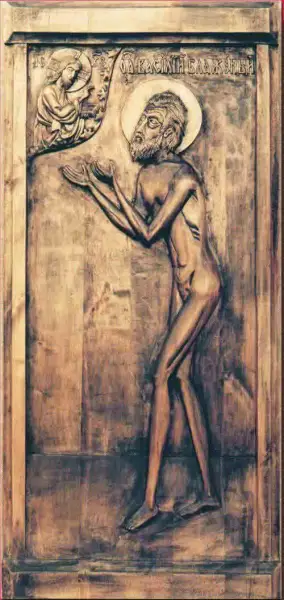
Basil's formal canonisation came in 1588, some three or four decades after his death, when the Russian Orthodox Church glorified him in Moscow. The date is worth setting in context. The later sixteenth century was the era in which the Muscovite church consolidated the cult of its native holy men, and the fool for Christ, a type peculiar to the Slav churches, here received official recognition at the highest level. The glorification confirmed what popular devotion had already decided: that the half-naked figure with chains, whom the respectable had learned to endure, was in truth a wonderworker — one through whom God had acted visibly — and a saint of the whole Russian Church, not a local curiosity. His shrine in the cathedral then bearing his name became his major place of pilgrimage, and his feast was fixed on 2 August, the day of his death, corresponding to 15 August on the revised calendar. Icons and bas-relief images in the cathedral preserve his likeness: the ascetic frame, the chains, the rags or the absence of any clothing at all. The canonisation of a fool is itself a theological statement — the church judging that sanctity may wear madness for a garment — and it placed Basil among the small number of yurodivy elevated to universal veneration.
§ Life
The Saint at the Centre of Moscow
No saint of Russia is more literally central to the nation's image than Basil. The Intercession Cathedral on Red Square — the church raised by Ivan the Terrible and popularly named for the saint — has become the visual emblem of Russia itself, its clustered domes known to the whole world; and it carries his name because the fool for Christ lies within it. A church built to memorialise the conquest of Kazan thus preaches, by its very title, that a serf's son who gave away everything outweighs a tsar's victories. Basil's legacy also lives in the tradition of holy folly he embodies: the Orthodox Church reads him alongside Blessed John of Moscow the Fool-for-Christ, John the Hairy and Xenia of Saint Petersburg as witnesses to a single strange school of sanctity, in which the surrender of reputation becomes a way of following the humiliated Christ. His depicted attributes — rags, chains, nakedness — keep the iconography of that school before the eyes of the faithful. For the ordinary believer, his memory carries a plainer lesson drawn straight from his life: that the poor who are too ashamed to ask are the ones the Gospel especially charges us to find. Moscow's wonderworker remains what he made himself in the sixteenth century: the city's conscience, standing barefoot at its proudest square.
§ Life
Timeline
- Dec 1468
Born in December at the portico of the Epiphany Cathedral at Yelokhovo, to a serf family named Jacob and Anna.
§ Life
- 1484
Moves to Moscow at sixteen, having trained as an apprentice shoemaker, and takes up a life of poverty and ascetic witness.
§ Life
- 1552
Buried in the Moscow cathedral commissioned by Ivan the Terrible after the conquest of Kazan, later named for the saint.
§ Life
- 2 Aug 1552
Dies in Moscow on 2 August (some accounts give 1557); Metropolitan Macarius serves his funeral with many clergy.
§ Life
- 2 Aug 1588
Formally canonized in Moscow by the Russian Orthodox Church.
§ Introduction
The Record
- Symbols
- Dressed in rags·Weighted with chains·Depicted completely naked
- Canonization
- Canonized on 2 August 1588 in Moscow by the Russian Orthodox Church
Prayer
Bibliography
Show 4 sources
- "Blessed Basil of Moscow the Fool-For-Christ", Orthodox Church in America.
- "Василий Блаженный". Brockhaus and Efron Encyclopedic Dictionary (in Russian). 1906.
- Attwater, Donald; John, Catherine Rachel. The Penguin Dictionary of Saints. 3rd edition. New York: Penguin Books, 1993. ISBN 0-14-051312-4.
- Yerusalimsky, K. Yu.; Preobrazhensky, A. S. (2004). "Василий Блаженный". Православная энциклопедия — Т. VII. pp. 123–131. ISBN 5-89572-010-2.
Profile text adapted from the Wikipedia article, licensed CC BY-SA 4.0.
Pray with this saint every day
Save St. Basil Fool for Christ to your favorites, read the full profile, and get feast-day reminders in the Saints app.
Get the Saints AppFree on the App Store for iPhone and iPad