
died 29 June 362·Feast March 22
St. Basil of Ancyra
Priest of Ancyra and Martyr under Julian the Apostate
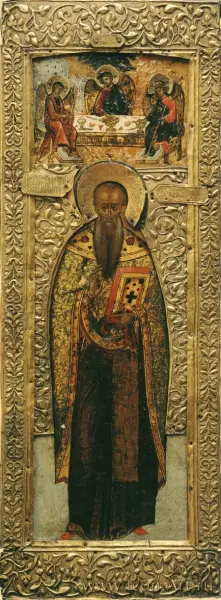
Overview
Basil of Ancyra — Basileios in Greek — was a Christian priest of Ancyra in Galatia, the modern Ankara in Turkey, in the fourth century. Very little about his life is preserved, and what there is comes down in a metaphrastic reworking of his passion, a text the Byzantine compilers titled the Life of the Martyred Priest Basil and polished from older materials. Within that slender record he stands out as a combatant on two fronts, contending with the pagans' teachings and with the Arians, and he defended Bishop Marcellus of Ancyra when the Arians moved to depose that prelate. The Byzantine lexicon known as the Suda adds a different note, calling him Ancyra's bishop and a physician by trade — a claim at variance with the tradition that makes him a priest, and one of several points on which the memory of the man has been reshaped. His end came in the persecution under the emperor Julian, called the Apostate for his attempt to restore paganism. Basil was arrested, tortured, and executed on 28 or 29 June in the year 362. The church honours him as a martyr and a priest — a hieromartyr — on 22 March in both the East and the West, and he is regularly confused, in calendars and in popular usage, with another Basil of Ancyra who was a layman and is commemorated on 1 January.
The Complete Life
A Priest Between Pagans and Arians
Ancyra, the capital of Galatia in central Asia Minor and the modern Turkish city of Ankara, was in the fourth century one of the storm-centres of church politics. It was there that the great council of 314 met to regulate the penitential discipline of the post-persecution church, and it was from there, across the following decades, that the Arian controversy was argued with particular bitterness. Into this arena Basil was ordained to the priesthood. The record of him is thin — very little information about his life survives, and that is contained in a metaphrastic passion, the Life of the Martyred Priest Basil as the title runs, one of the polished re-tellings of earlier passio literature that Byzantine compilers produced. From that source two commitments define him. First, he contended against the teachings of the pagans, the old religion of the empire that was to surge back, briefly and decisively, under Julian. Second, and more personally dangerous, he fought the Arians within the church itself. When the Aian party moved to depose Bishop Marcellus — the prelate of Ancyra whose theology and whose long, embattled episcopate made him a particular target — Basil stood in his defence. Taking the side of a bishop whom the Arians wanted removed was, for a priest of the same city, an act of open alignment in the doctrinal war. The Suda, the tenth-century Byzantine encyclopaedia, complicates the picture by naming him Ancyra's bishop and a physician by trade, testimony either to a different tradition or to the conflation of several men named Basil in the city's memory.
§ Basil of Ancyra (hieromartyr)
Martyrdom under Julian
The emperor Julian, who came to the throne in 361 and earned the epithet 'the Apostate' by renouncing the Christianity of his upbringing and attempting to restore the old gods, did not renew the bloody machinery of Diocletian's persecution. His methods against the church were subtler — the exclusion of Christians from teaching, the favouring of pagan temples, the encouragement of civic pressure — but for individuals who stood prominently in his way the old instruments remained available, and Basil of Ancyra was one of them. Caught up in the persecution, the priest was arrested and tortured, and he was executed on 28 or 29 June in the year 362, within months of Julian's accession. The date is preserved with the slight uncertainty of a day; the year is firm. It is worth noticing what his death meant in context: a priest who had defended his deposed bishop against the Arians, and who had spoken against paganism, was killed at the precise moment when a pagan emperor was attempting to reverse the Christian settlement of the previous half-century. His martyrdom thus united the two fronts on which he had fought. The church that received his memory classified him precisely: not a bishop, as the Suda would have him, but a priest, and therefore a hieromartyr — a martyr in holy orders whose death was the sealing of a ministry rather than the accident of a politics. The menologion tradition of the Orthodox Church preserves his passion, and both the Greek East and the Latin West have kept his day.
§ Basil of Ancyra (hieromartyr)
Commemoration and a Case of Mistaken Identity
Basil of Ancyra is commemorated as a martyr on 22 March in the Western church and in the East alike, a rare exact agreement of calendar across the tradition. He is venerated by the Eastern Orthodox Church and the Roman Catholic Church together, which is itself a sign of his antiquity: his cult belongs to the undivided centuries and required no later process of canonisation, being simply handed on from the age of the persecutions. His afterlife has, however, suffered from a persistent confusion. Another martyr of the same city and the same name — a layman, not a priest, who is likewise said to have died in the persecution under Julian, at Caesarea, and who is commemorated on 1 January — is regularly mistaken for him in calendars and reference works. The two Basils of Ancyra are expressly distinguished in the tradition, and readers are warned not to confuse them; the hieromartyr is the priest of March, the other the layman of January. Compounding the uncertainty, the Suda's description of Basil as a bishop and a physician has fed the blending of the two figures, since a different again Basil of Ancyra — a bishop who wrote on the date of Easter and suffered under Constantius — belongs to the same city and century. The clean line through the tangle is the one the liturgy keeps: a priest of Ancyra, tortured and killed for Christ under Julian in 362, remembered on 22 March. The later references — Catholic Online, the Greek Orthodox Archdiocese of Australia, and the Russian Orthodox Encyclopaedia, together with the old Catholic Encyclopedia article on the persecution — continue to hand on his name.
§ Veneration
The Record
- Symbols
- priestly vestments of a hieromartyr·the instruments of his torture
- Canonization
- Pre-congregation — a hieromartyr of the fourth century venerated in the Eastern Orthodox and Roman Catholic Churches
Prayer
Bibliography
Show 5 sources
- "St. Basil of Ancyra". Catholic Online.
- Suda, beta.151.
- "Holy martyr Basil, Presbyter of the Church of Ancyra". Greek Orthodox Archdiocese of Australia.
- "ВАСИЛИЙ". Православную энциклопедию. (in Russian)
- Bridge, James (1911). "Persecution". In Herbermann, Charles (ed.). Catholic Encyclopedia. Vol. 11. New York: Robert Appleton Company.
Profile text adapted from the Wikipedia article, licensed CC BY-SA 4.0.
Pray with this saint every day
Save St. Basil of Ancyra to your favorites, read the full profile, and get feast-day reminders in the Saints app.
Get the Saints AppFree on the App Store for iPhone and iPad