
330 – 1 or 2 January 379·Feast January 2
St. Basil of Caesarea
Basil the Great, Cappadocian Father and Doctor of the Church
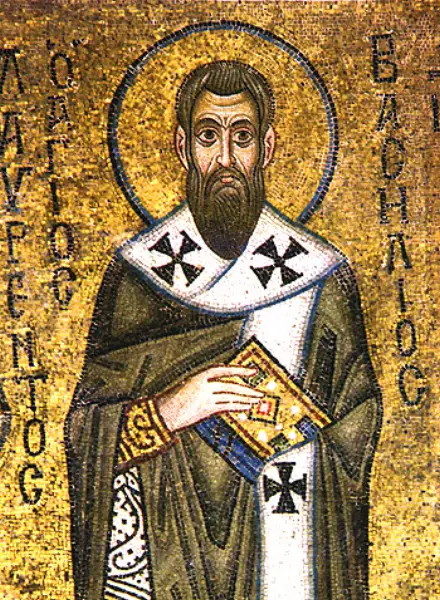
Overview
Basil of Caesarea, called Basil the Great, was a fourth-century bishop, theologian, and monk who led the church of Caesarea Mazaca in Cappadocia from the year 370 until his death on 1 or 2 January 379. Born around 330 into a wealthy and pious Cappadocian Greek family, he was educated at Caesarea, Constantinople, and Athens, where he befriended Gregory of Nazianzus and studied alongside the future emperor Julian the Apostate. A career in rhetoric and law was abandoned after an encounter with the ascetic bishop Eustathius of Sebaste; baptised, Basil gave away his fortune and founded a monastic community on the family estate at Annesi, writing rules of communal life, liturgical prayer, and manual labour that made him, with Pachomius, a father of Eastern monasticism. Ordained deacon in 362 and presbyter in 365, he emerged as the leading defender of the Nicene Creed against Arianism and Apollinarianism, and as bishop he faced down the Arian emperor Valens, whose prefect could not bend him. His Basiliad outside Caesarea — poorhouse, hospice, and hospital in one — is counted among the earliest Christian hospitals for the poor. With Gregory of Nyssa, his brother, and Gregory of Nazianzus, his friend, he makes up the Cappadocian Fathers; he defined the terms ousia and hypostasis and held firmly to the Holy Spirit's divinity and consubstantiality. His principal works include On the Holy Spirit, the Hexaemeron homilies, and the Refutation of Eunomius, and the Byzantine Divine Liturgy that bears his name is still celebrated.
The Complete Life
A Saintly Household of Cappadocia
Basil was born around the year 330 at Caesarea Mazaca in Cappadocia — the modern Turkish city of Kayseri — into a family that was wealthy, Greek in culture, and distinguished for its piety. His parents, Basil the Elder and Emmelia of Caesarea, raised ten children, and of that household an extraordinary number are now venerated as saints: besides Basil himself, his sister Macrina the Younger, his brothers Naucratius and Peter of Sebaste, and Gregory of Nyssa, the youngest of the brothers, who would become one of the great mystics of the church. The faith of the family was bought at a price. Basil's maternal grandfather had been executed as a Christian martyr in the years before the conversion of the emperor Constantine, so that the boy grew up within living memory of the persecution. His paternal grandmother, Macrina the Elder, was a disciple of Gregory Thaumaturgus, the wonder-working bishop who had planted the church of Neocaesarea in Pontus, and it was she who raised Basil and gave him his first formation in the faith. The formal education began at Caesarea itself, around 350–351, where the young Cappadocian showed the talent that would carry him to Constantinople for further study, including the lectures of the celebrated pagan rhetorician Libanius, and finally to Athens, the intellectual capital of the age. There he formed the friendship with Gregory of Nazianzus that would last both their lives, and there, among the students of rhetoric, sat a fellow named Julian, who would one day rule the empire and attempt to undo its Christianity.
§ Early life and education
From Rhetorician to Monk at Annesi
Basil returned from Athens in 356, travelled in Egypt and Syria, and settled at Caesarea to practise law and teach rhetoric — the standard career of a talented young man of his class, and one for which his education had fitted him perfectly. It lasted about a year. His life, as he later described it, was turned upside down when he met Eustathius of Sebaste, that charismatic bishop and ascetic, whose example drew the young rhetorician out of the lecture hall for good. In a letter Basil described the experience as an awakening from deep sleep, in which the wonderful light of Gospel truth showed him the emptiness of the wisdom prized by the rulers of this world. He abandoned law and teaching, was baptised, and in 357 set out for Palestine, Egypt, Syria, and Mesopotamia to study the ascetics and the monastic communities at first hand. He gave his fortune to the poor and tried the solitary life in retreat near Neocaesarea of Pontus, on the Iris river, under Eustathius' mentorship. But solitude did not hold him: he respected the piety of the hermits, yet concluded that the purely solitary life was not his calling, and he and Eustathius would later differ over dogma as well. By 358 he was gathering like-minded disciples, among them his brother Peter, at a monastic settlement on the family estate near Annesi, at the junction of the Iris and Lycos rivers. His widowed mother Emmelia and his sister Macrina established themselves nearby in a community of women devoted to prayer and works of charity, and in this double house — monks and nuns on one estate — Basil wrote the works on communal religious life that would shape the monasticism of the East.
§ Annesi
Presbyter and Bishop against the Arians
Orders came to Basil reluctantly, by ecclesiastical pressure rather than personal desire. In 362 Meletius, bishop of Antioch, ordained him deacon; in 365 Eusebius, the bishop of Caesarea, summoned him and ordained him presbyter, needing his intellectual gifts as an assistant in the doctrinal struggles then dividing Cappadocia. Basil and Gregory of Nazianzus spent the following years combatting Arianism, which threatened to split the Christians of the province. The two friends accepted a great rhetorical contest against the Arians' most accomplished theologians and orators, and in the public debates that followed — presided over by agents of the emperor Valens — they emerged triumphant, an experience that persuaded both men that their futures lay in church administration. After a period of withdrawal and return Basil became administrator of the diocese, and when Eusebius died in 370 Basil was chosen to succeed him, consecrated bishop on 14 June 370. The see brought him the rank of exarch of Pontus, metropolitan over five suffragan bishops, several of whom had opposed his election. As bishop he showed a hot-blooded and somewhat imperious temper joined to generosity and sympathy: he organised a soup kitchen during the famine that followed a drought, reformed thieves and prostitutes, urged his clergy to shun wealth, and risked imperial anger by criticising officials who failed in justice. The emperor Valens, an adherent of the Arian party, sent his prefect Modestus to extract a compromise; Basil's flat refusal drew from the prefect the amazed remark that none before had dared address him so, to which Basil answered that perhaps he had never before dealt with a bishop. Repeated orders for Basil's banishment came to nothing, and when Valens himself attended Basil's Liturgy at Theophany he was moved to donate land for the great charitable complex outside the city.
§ Caesarea
The Trinity, the Poor, and the Cloister
The centre of Basil's thought is the doctrine he spent his strength defending: the full divinity of the Son and of the Holy Spirit against the Arian reduction of both. He defined the terms of the debate — ousia for essence or substance, hypostasis for person or reality — and supplied the church's classic account of three Persons in one Nature. His treatise on the Holy Spirit, appealing to Scripture and the earliest Christian tradition to prove the Spirit's divinity, stands as his principal theological work, though faithful to Eastern usage he hesitated to apply the word homoousios to the Spirit, and was reproached for it as early as 371 by the more zealous of the monks; Athanasius defended him. His spirituality, however, was never merely academic. His famous moral teaching binds possession to obligation: bread stored away is owed to the hungry, clothes hoarded to the naked, and money buried for safekeeping to the poor; the unfairness lies in every act of help withheld. This conviction took institutional form in the Basiliad, the poorhouse, hospice, and hospital outside Caesarea which Gregory of Nazianzus compared to the wonders of the world. In exegesis he admired Origen and required a spiritual reading of Scripture, while ridiculing allegorists for whom water is not water and a fish is whatever fancy wishes; he urged reserve in doctrinal and sacramental matters. He taught the complete equality of men and women, both made in the image of God with one and the same virtue and one and the same nature, and he insisted that no human being is a slave by nature, slavery being for him a consequence of the Fall. The monk's life, as he framed it, joined community, liturgical prayer, and manual labour in a balance that moderated the austerities of the desert.
§ Writings
Illness, the Basiliad, and Death
Basil's last years were consumed by the double burden of a vast ecclesiastical province and a failing body. He suffered from liver disease, and the ascetic practices of his earlier life — the fasts and vigils of Annesi — had strained a constitution never robust — a combination that likely brought his early death at forty-eight or forty-nine. Through these years he carried on the struggle with Arianism on the wider stage, opening connections with the West, seeking the help of Athanasius to overcome Latin distrust of the Homoiousian party, and corresponding with Pope Damasus in the hope of aid against the triumphant Arians — a correspondence chilled by the pope's suspicion of the Cappadocian doctor. He did not live to see the factional disturbances end; the council that would settle the creed of Nicaea met in 381, two years after his death. What survived him at Caesarea was built in stone and brick: the great institute before the gates of the city, called the Ptochoptopheion or Basileiad, which served as poorhouse, hospital, and hospice, and which stood as the lasting monument of his episcopal care for the poor. He died on 1 or 2 January 379, with historians disagreeing on the exact date, and the church of Caesarea — which he had ruled for less than nine years as bishop — mourned a pastor whose administration had been as practical as his theology was exact. His sermons on wealth and property still shape modern Christianity, and his reputation for generosity, political courage, and organisational genius was secure within his own lifetime.
§ Death and legacy
Doctor of the Church and Great Hierarch
Basil's sanctity was never in question and never required a process: he belongs to the pre-congregation age of saints, venerated from the moment of his death in East and West alike. The Church of the East, the Catholic Church, the Eastern Orthodox, Oriental Orthodoxy, the Anglican Communion, and Lutheranism all number him among their saints. In the Western church he bears the title Doctor of the Church, conferred for his contributions to the great debate opened by the Arian controversy over the nature of the Trinity and especially over the divinity of the Holy Spirit — his single greatest contribution being his insistence on the Spirit's divinity and consubstantiality with the Father and the Son. The Eastern Orthodox and Eastern Catholic Churches honour him with Gregory of Nazianzus and John Chrysostom as one of the Three Holy Hierarchs, celebrated together in the Byzantine Rite on 30 January, and with them and Athanasius he is counted among the four Great Greek Church Fathers. The calendar bears the traces of his wide veneration. The East keeps him on 1 January with the Feast of the Circumcision; the Coptic Church on 6 Tobi, corresponding to 14 January, with a further commemoration on 19 January for a miracle at Nicaea; the Lutherans of the Missouri Synod on 10 January together with both Gregories; the Anglicans of the Church of England on 2 January, though the Episcopal Church and Canada's Anglicans keep 14 June. Rome first kept his feast on 1 January, moved it to 14 June in the thirteenth century, and in the revision of 1969 fixed it on 2 January, alongside Gregory Nazianzen.
§ Commemorations
The Rule that Traveled West
Basil's most tangible afterlife is monastic. Through his example and his teaching he brought a notable moderation to the austerities that had previously characterised the monastic life, and he is credited with balancing the duties of work and prayer so that neither swallowed the other — a balance that remains the signature of Basilian monasticism. The Sayings of the Desert Fathers preserve one saying of his; both Barsanuphius and Dorotheus of Gaza appeal to his rule; and historians recognise his influence reaching beyond the East into the Western church, chiefly through his effect on Benedict of Nursia. Scholars such as Anthony Meredith point to Benedict's own epilogue, where the father of Western monasticism directs his monks, besides the Bible, to read the Fathers' confessions, their institutes and lives, and the rule of holy father Basil. The channel of transmission was literary: Basil's teachings, encoded in works such as the Small Asketikon, passed to the West through the translations of Rufinus in the late fourth century, and numerous religious orders of Eastern Christianity, together with the Basilian Fathers of the Roman Catholic Church, take their name from him. His liturgical legacy is equally durable. The liturgy that bears his name, the Divine Liturgy of St Basil — more lengthy than the liturgy of Chrysostom in common use, and differing chiefly in the priest's silent prayers and its hymn to the Theotokos — bears, in the judgement of patristic scholars, the unmistakable personal hand, pen, mind, and heart of Basil; the Coptic Church still uses one of the earliest Eucharistic prayers under his name, which he may himself have brought to Alexandria in 357. In Greek popular tradition he brings gifts to children on his day, 1 January, when the vasilopita is cut and a coin hidden in the bread recalls his gold distributed to the poor.
§ Influence on monasticism
Timeline
- 330
Born at Caesarea Mazaca in Cappadocia into the wealthy family of Basil the Elder and Emmelia.
§ Early life and education
- 350
Receives formal schooling at Caesarea, where he first meets Gregory of Nazianzus.
§ Early life and education
- 356
Leaves Athens after further study, travels in Egypt and Syria, and returns to Caesarea to practise law and teach rhetoric.
§ Early life and education
- 357
After baptism, travels through Palestine, Egypt, Syria and Mesopotamia studying the ascetics, and distributes his fortune to the poor.
§ Annesi
- 358
Founds a monastic settlement on the family estate near Annesi and invites Gregory of Nazianzus to join him.
§ Annesi
- 360
Attends the Council of Constantinople, at first siding with Eustathius and the Homoiousians before emerging as a champion of the Nicene Creed.
§ Annesi
- 362
Ordained deacon by Bishop Meletius of Antioch.
§ Caesarea
- 364
Composes a three-book refutation of the Anomoian Arian Eunomius, bishop of Cyzicus.
§ Writings
- 365
Summoned by Bishop Eusebius and ordained presbyter of the church of Caesarea.
§ Caesarea
- 368
Preaches a homily on the famine that struck the region, and organises a soup kitchen and food distribution for the poor.
§ Writings
- 14 Jun 370
Consecrated Bishop of Caesarea, with the powers of exarch of Pontus and authority over five suffragan bishops.
§ Caesarea
- 371
Reproached by Orthodox zealots among the monks for refusing the term homoousios of the Holy Spirit; Athanasius defends him.
§ Caesarea
- 2 Jan 379
Dies at Caesarea on 1 or 2 January, aged about forty-eight, his liver disease worsened by ascetic practices.
§ Commemorations
- 1250
During the thirteenth century the Roman calendar moves his feast from 1 January to 14 June, the believed date of his episcopal ordination.
§ Commemorations
- 1969
The revision of the General Roman Calendar transfers his feast to 2 January, kept together with Saint Gregory Nazianzen.
§ Commemorations
In Their Own Words
I had wasted much time on follies and spent nearly all of my youth in vain labours, and devotion to the teachings of a wisdom that God had made foolish. Suddenly, I awoke as out of a deep sleep. I beheld the wonderful light of the Gospel truth, and I recognized the nothingness of the wisdom of the princes of this world.
Perhaps you have never yet had to deal with a bishop.
The bread you store belongs to the hungry. The clothes you accumulate belong to the naked. The shoes that you have in your closet are for the barefoot. The money you bury deep into the ground to keep it safe, belongs to the poor. You were unfair to as many people as you could have helped and you did not.
Money is the devil's dung.
The very beginning of the soul's purgation is tranquility, in which the tongue is not given to discussing the affairs of men, nor the eyes to contemplating rosy cheeks or comely bodies, nor the ears to lowering the tone of the soul by listening to songs whose sole object is to amuse, or to words spoken by wits and buffoons—a practice which above all things tends to relax the tone of the soul.
We thus become temples of God whenever earthly cares cease to interrupt the continuity of our memory of Him.
Those who love their neighbor as themselves possess nothing more than their neighbor.
For if we all took only what was necessary to satisfy our own needs, giving the rest to those who lack, no one would be rich, no one would be poor, and no one would be in need.
The Record
- Major works
- On the Holy Spirit (De Spiritu Sancto)·Refutation of the Apology of the Impious Eunomius (c. 364)·Hexaemeron, homilies on the six days of creation·Moralia and Asketika, ethical manuals for the world and the cloister·Greater and Lesser Asketikon, monastic rules·The Philocalia of Origen, compiled with Gregory of Nazianzus·Some three hundred letters·The Basiliad, a complex of poorhouse, hospice, and hospital outside Caesarea·The Divine Liturgy of Saint Basil the Great
- Patron of
- Russia·Cappadocia·hospital administrators·reformers·monks·education·exorcism·liturgists
- Symbols
- vested as a bishop with the omophorion·Gospel book or scroll·thin ascetic figure with a long tapering black beard
- Canonization
- Pre-congregation — honoured as a saint from antiquity; titled Doctor of the Church in the West for his teaching on the Trinity and the Holy Spirit
Prayer
Bibliography
Show 8 sources
- Basil the Great, On the Holy Spirit, trans. David Anderson (Crestwood, NY: St Vladimir's Seminary Press, 1980).
- Basil the Great, On Social Justice, trans. C. Paul Schroeder (Crestwood, NY: St Vladimir's Seminary Press, 2009).
- Basil the Great, Address to Young Men On Greek Literature, trans. Edward R. Maloney (New York: American Book Company, 1901).
- Hildebrand, Stephen M. (2014). Basil of Caesarea. Grand Rapids: Baker Academic. ISBN 978-0-8010-4907-1.
- Rousseau, Philip (1994). Basil of Caesarea. Berkeley: University of California Press. ISBN 978-0-520-08238-0.
- Fedwick, Paul Jonathan, ed. (1981). Basil of Caesarea, christian, humanist, ascetic: a sixteen-hundredth anniversary symposium, Part 1. Pontifical Institute of Mediaeval Studies. ISBN 978-0-88844-412-7.
- Silvas, Anna M. (September 2002). "Edessa to Cassino: The Passage of Basil's Asketikon to the West". Vigiliae Christianae 56 (3): 247–259.
- Jackson, Samuel Macauley, ed. (1914). "Basil, Saint, The Great". New Schaff–Herzog Encyclopedia of Religious Knowledge (third ed.). London and New York: Funk and Wagnalls.
Profile text adapted from the Wikipedia article, licensed CC BY-SA 4.0.
Pray with this saint every day
Save St. Basil of Caesarea to your favorites, read the full profile, and get feast-day reminders in the Saints app.
Get the Saints AppFree on the App Store for iPhone and iPad