
1816 – 16 February 1869·Feast February 16
St. Basil of Pavlovsky Posad
Repentant Merchant and Russian Righteous One
Overview
Vasily Gryaznov, honoured as St. Basil of Pavlovsky Posad, was born in 1816 in the village of Evseevo near Moscow, the son of a farmer. His mother taught the children at home from the Psalms and the Horologion, planting a faith that would survive a stormy youth. Working in a factory as a young man he fell in with companions who led him into drinking and vice; he repented and fell again many times, until in a burst of shame he took the surname Gryazny, meaning dirty, as a standing confession of his sin. The repentance held. He began to live as a devout layman, and his reputation spread until people came to him for counsel on the scriptures; in a district thick with Old Believers, his preaching is said to have drawn as many as seven thousand of them into official Orthodoxy. In 1840 the wealthy manufacturer Jacob Labzin sought him out, was converted by him, married Basil's sister Akilina and took Basil into the business. Rich now, Basil lived like a poor devotee, giving money away and endowing schools and almshouses. He dreamed of founding a monastery at Pavlovsky Posad but died on 16 February 1869 before it could be done. A monastery rose over his grave in 1894, and in 1999 he was glorified as a local saint.
The Complete Life
A Farmer's Son in Evseevo
Vasily Gryaznov was born in 1816 in Evseevo, a village of Bogorodskogo County that now belongs to the Pavlovo-Posadsky District outside Moscow. His father, Ivan Semenovich Basil, farmed the land; his mother, Evdokia Zaharovna, kept the household and gave the children their first schooling herself, teaching them from the Horologion and the Psalter. The pattern is a familiar one in the Russia of that century: a pious mother, a book of prayer, and a child formed by both before the world gets its turn. What makes Basil's case notable is how nearly the world won. Sent out to factory work as a youth, he came under the influence of older workmates who initiated him into drinking and what the sources call acts of vice and passion. He was not a man who sinned in ignorance; the accounts stress that he mourned his sins and begged forgiveness again and again, only to be pulled back by the company he kept. The struggle between the psalms of his mother and the habits of the workshop lasted years, and it ended not with a dramatic conversion in a church but with a private act of self-judgement. The boy who had been taught to pray chose a new surname for himself, Gryazny, the Russian word for dirty, so that every introduction would become an accusation and a reminder. That name, softened to Gryaznov, he carried to the end of his life and into the calendar of the saints.
§ Life
Counselor of Workmen and Merchants
Once repentance had taken hold, Basil's life changed direction without changing address. He did not enter a monastery; he remained a layman in a manufacturing district, living as a sacred devotee amid factories and markets. His plight, as the sources call it, became known in the neighbourhood, and something unexpected followed: people began coming to him for advice on the scriptures. A self-educated penitent became a spiritual counsellor, first to ordinary folk and then, in 1840, to one of the most prominent businessmen of the region. Jacob Labzin, whose head-scarf factories made Pavlovsky Posad famous, came to Basil for help and left converted; the two became comrades, Labzin married Basil's sister Akilina, and Basil was taken into the business as a partner. The union of merchant capital and lay holiness bore practical fruit. Basil handed his wealth over to the needy, and joining forces with his sister and her husband, he founded schools and almshouses for the district. His most ambitious dream was a monastery at Pavlovsky Posad, a project he did not live to see. It is worth pausing over the scale of his religious influence in his own lifetime: the area contained many Old Believers, communities separated from the official church since the seventeenth century, and his sermons are credited with bringing as many as seven thousand of them into communion with the Moscow hierarchy. No clergyman in the district could claim as much.
§ Life
Death and the Monastery Over His Grave
Basil's last years were those of a man whose plans outran his time. The wealth that came with partnership in the Labzin enterprises did not soften him; contemporaries remembered a merchant who lived like a devotee, donating what he earned and pouring the surplus into schools and almshouses rather than into his own house. The great project of founding a monastery at Pavlovsky Posad stayed with him to the end, and it is one of the quiet ironies of his story that the monastery was eventually built — but only after his death, and over his own grave. He died on 16 February 1869, still a layman, still bearing the surname that announced his past. The people among whom he had lived did not forget him. Prayer at his grave began at once, both in thanksgiving for a righteous life and in the search for direction in ordinary affairs, the kind of popular cult that in Russia so often precedes official recognition. His work among the poor was carried forward by Jacob Labzin and by Basil's sisters, so that the almsgiving did not stop with the almsgiver. It took a quarter of a century for the building he had dreamed of to rise: in 1894 the Pokrovsko-Vasilevskogo Monastery was constructed over the place where he was buried, and that monastery still serves as his shrine. The man who wanted to found a house of prayer became, in death, the reason one stood.
§ Legacy
Glorified in 1999
Basil's path to the calendar ran through the devotion of the district rather than through the machinery of a diocesan cause. For the thirty years after his death the memory of the righteous layman was kept alive locally, and after 1894 the monastery over his grave gave that memory a fixed centre, a place where pilgrims could come, pray at the tomb and ask the kind of practical counsel he had given in life. Local veneration of this kind was interrupted by the Soviet period, when the monastery, like nearly every religious house in the country, passed out of church hands, and when a 1925 anti-religious pamphlet by Ivan Shpitsberg even attacked the cult of the holy Vasily Gryaznov as a device for defending the textile magnates of the Moscow region. The revival came at the end of the century. In 1999 the Russian Orthodox Church recognized Basil as a locally venerated saint, the category of glorification used for holy men and women whose cult is rooted in a particular place rather than spread through the whole church. His day of commemoration is 16 February on the Orthodox calendar, the anniversary of his death. In the Pavlovo-Posadsky District he is still praised as a native son, and the Pokrovsko-Vasilevsky Monastery remains the centre of his cult, the shrine of a repentant workman turned merchant-saint.
§ Legacy
Timeline
- 1816
Born at Evseevo in Bogorodskogo County, son of the farmer Ivan Semenovich Basil
§ Life
- 1840
Manufacturer Jacob Labzin turns to him for spiritual guidance; the two become close friends and partners
§ Life
- 16 Feb 1869
Died at Pavlovsky Posad, his cherished plan of founding a monastery there unrealized
§ Life
- 1894
The Pokrovsko-Vasilevskogo Monastery is raised over his grave and serves as his shrine
§ Legacy
- 1999
Glorified as a locally venerated saint of the Russian Orthodox Church
§ Legacy
The Record
- Major works
- Founded schools and almshouses at Pavlovsky Posad with his sister and brother-in-law
- Patron of
- Patron of the Pavlovo-Posadsky District·Those struggling against drunkenness and vice·Penitents
- Symbols
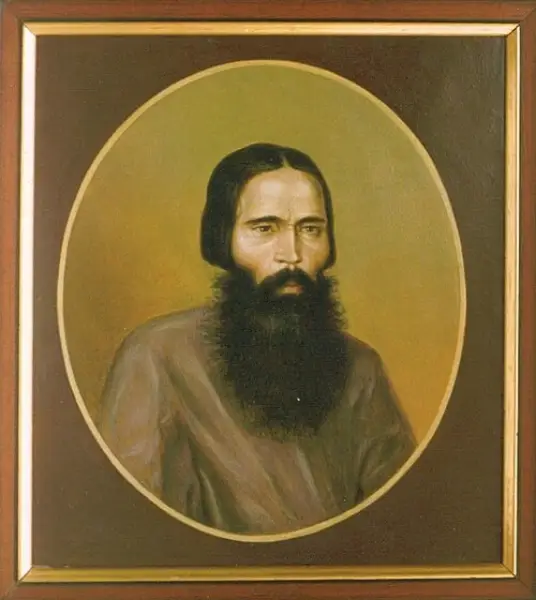
- Layman's dress of a Russian merchant·Icon shows him with beard and cross
- Canonization
- Glorified as a locally venerated saint by the Russian Orthodox Church in 1999
Prayer
Bibliography
Show 4 sources
- "February 16/March 1". Orthodox Calendar.
- "Buys Kingdom of Heaven". About Anna Il'inskaya. Moscow. 2003. ISBN 5-87468-227-9.
- Shpitsberg, Ivan (1925). Svyatoy Vasilii Gryaznov: zashchita podmoskovnykh akul tekstil'noy promyshlennosti. Moscow: Nauchnoe o-vo Ateist.
- Pokrovsko-Vasilevsky Monastery site (in Russian).
Profile text adapted from the Wikipedia article, licensed CC BY-SA 4.0.
Pray with this saint every day
Save St. Basil of Pavlovsky Posad to your favorites, read the full profile, and get feast-day reminders in the Saints app.
Get the Saints AppFree on the App Store for iPhone and iPad