
died 26 March 944 (or 952)·Feast March 26
St. Basil the Younger
Byzantine Holy Man and Visionary of Constantinople
Overview
Basil the Younger is a Byzantine Greek holy man and visionary whose death is placed on 26 March, in 944 or else 952, the earlier of the two dates being generally preferred. Everything known of him comes from a Greek saint's life written by his disciple Gregory, and modern scholars are divided over whether Basil, or even Gregory, ever existed at all — several leading Byzantinists judge the work largely pious fiction built on a real tenth-century backdrop. The Vita opens with Basil living as a grass-eating hermit in Asia Minor; arrested as a suspected spy, he is tortured before the palace official Samonas, thrown to a lion and then into the sea, and rescued by dolphins. He spends the rest of his long life in Constantinople, sheltered successively by a poor couple named John and Helena, by the eunuch courtier Constantine Barbaros, and by the Paphlagonian brothers Anastasios and Constantine Gongylios. He is shown rebuking the emperor Romanos I for avarice and lust, converting an ambitious Kosmas to the hermit life, and foretelling the revolt of Constantine Doukas and the Rus' attack of 941. His fame rests above all on the visions attached to his name, especially the aerial toll houses seen by his servant Theodora after her death, a text of immense influence on Orthodox teaching about the soul's passage after death.
The Complete Life
Hermit, Suspect, Castaway
The Vita presents Basil's story as beginning in the countryside of Asia Minor, where he lived as a boskos, a grass-eating hermit of the most austere kind, anonymous and unknown. His removal from that solitude came by force. Taken for a spy, he was arrested and dragged to Constantinople, where the parakoimomenos Samonas — the most powerful official at the court of Leo VI — had him interrogated under torture and thrown before a lion. The beast, the story runs, did him no harm, and Basil would not so much as speak his own name. He was then cast into the sea, and here the legend turns strange and beautiful: dolphins bore the insensible monk to shore at Hebdomon, outside the city walls. From there he made his way back into Constantinople, where a poor couple, John and Helena, gave him shelter in their house. The chronology the Vita gives for this episode does not quite hold, since it places the events around 896 while Samonas did not hold his office until 907, and a very similar arrest story is told of Niketas the Paphlagonian elsewhere. That inconsistency is typical of the work. Yet the ninth- and tenth-century world it sketches — a police apparatus hunting informants, a court run by eunuchs, fishermen and poor households taking in holy men — is drawn with a concreteness that scholars credit. Whatever the truth of the man, the setting is real.
§ Move to Constantinople
A Prophet in the Houses of the Powerful
When John and Helena had died, Basil took up residence in the house of Constantine Barbaros, Samonas's successor as parakoimomenos, in the Arkadianai quarter; this remained his home for the rest of his life, broken only by a week passed in the Great Palace and a stay with Anastasios and Constantine Gongylios, the Paphlagonian brothers, by the Harbour of Eleutherios. All three of those who sheltered him were eunuchs of the imperial administration, a detail that fixes the milieu precisely. At the palace Basil showed the fearlessness that made his reputation. He rebuked the emperor Romanos I to his face for greed and lechery, and the Vita notes that the emperor, who was indulgent towards monks, took no offence. He also persuaded a man named Kosmas, who nurtured imperial ambitions, to give them up for the hermit's life near Nicomedeia — a story apparently built on the historical Kosmas the Monk and his famous vision of 933. The prophecies attributed to him cluster around the great upheavals of the reign: the revolt of Constantine Doukas in 913, which the Vita says he announced beforehand; the dynastic future of the imperial family, including his mid-930s prediction that Helena Lekapene would bear a daughter and then a son named Romanos, fulfilled by the birth of Romanos II in 938; and the coming of the Rus' fleet in 941, foretold, the text claims, four months in advance. He is even said to have learned by divine revelation of a coup planned by the emperor's son-in-law Romanos Saronites, whom he tried in vain to dissuade.
§ Move to Constantinople
The Toll Houses of Theodora
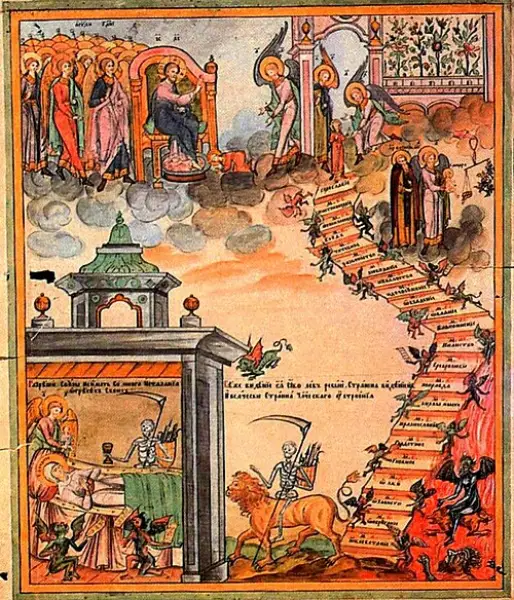
The passage of the Vita that has most shaped Orthodox piety concerns not Basil himself but his servant Theodora. Soon after her death his disciple Gregory asked whether she had been saved, and Basil answered by granting him a vision that begins at the dying woman's bedside, ringed by dark figures holding registers of her sins. As the soul quits the body, two angels set her good deeds in the balance against the evil that has been written down, until Basil appears and adds a scarlet purse of gold — his prayers — to the scale. The demons withdraw, and the ascent begins. The soul must pass twenty-one toll houses stationed through the air, each assigned to a particular sin: slander, envy, falsehood, wrath, pride, idle chatter, usury, avarice, drunkenness, malice, magic, gluttony, heresy, adultery, murder, theft, fornication and cruelty among them. At the fifth station Theodora's own merits run out, and only Basil's intercession carries her onward. The angels instruct her that every baptised person travels with a guardian angel recording the good and a demon recording the evil, and that sins can be erased before death only by confession and penance. The vision closes with Theodora entering heaven and beholding God. Whatever one makes of its theology, the passage became the classic Byzantine statement of the interim judgement of the soul, and its imagery pervades Orthodox funeral rites and the literature of the Particular Judgement to this day.
§ Vision of Theodora
Death and Burial by an Improbable Hand
Basil's death is placed on 26 March, in Lent, a date satisfied by either 944 or 952, scholars judging the earlier year the likelier. His biographer Gregory supplies the circumstances of the burial: Constantine Barbaros, his old patron, is said to have buried him in a private church of the Theotokos that stood on the Asian side of the strait facing the capital. Here the Vita betrays itself, for Barbaros vanishes from every other record after the failed revolt of Leo Phokas in 919, decades before either possible death date. Scholars trace the story to a notice in the chronicle of Pseudo-Symeon, according to which the father of Barbaros possessed a modest suburban property near the sea close to the capital, a holding that Leo VI afterwards made into a monastery; the hagiographer, it seems, borrowed the setting and gave his hero a burial at the hands of a man long gone. Such chronological impossibilities, together with the long silent gaps that separate the three parts of the work, are the chief reasons historians doubt the whole. The broader picture is nonetheless not nothing: the Vita breathes the air of tenth-century Constantinople, knows the great families and their fortunes, and preserves, beneath layers of legend, the memory of a circle of holy men attached to the households of the imperial bureaucracy. Even sceptical readers concede that scraps of evidence make a real Basil just possible.
§ Death and burial
A Saint Preserved in Twenty-Four Manuscripts
Whatever the verdict on the man, the book is undeniable. The Vita sancti Basilii iunioris survives, whole or in part, in twenty-four manuscripts spanning the twelfth to the nineteenth century, an unusually rich tradition that shows how widely the visions were read. The fullest witness is the sixteenth-century Greek codex 249 of the Moscow Synodal Library, 385 folios long, the text used for the modern critical edition. An abridged thirteenth-century version, Parisinus gr. 1547, was published by François Combefis in the Acta Sanctorum of 1668; the Iviron codex 478 from Mount Athos keeps the visions without the biography and was printed at Odessa in 1911. A Middle Bulgarian translation of the fourteenth century, made by a certain Father Peter, lay unnoticed until 1975 in codex 20N of St Catherine's Monastery at Sinai. Despite these partial publications, no critical edition existed until 2014, when Denis Sullivan, Alice-Mary Talbot and Stamatina McGrath produced the Moscow version with an annotated English translation. The work's proportions explain its character: of some 301 printed pages, only 38 carry Theodora's vision while 162 carry the visions of the Resurrection and Last Judgement. As one scholar put it, the author plainly cared less about Basil than about the apocalyptic material his name could carry, and that material — above all the toll houses — remains his living legacy in Orthodox tradition.
§ Manuscripts
Timeline
- 896
Brought to Constantinople from Asia Minor as a suspected spy, tortured by Samonas, cast before a lion and into the sea, and rescued by dolphins
§ Move to Constantinople
- 913
The rebellion of Constantine Doukas, which the Vita says Basil foretold
§ Predictions and visions
- 914
During the regency of Zoe Karbonopsina, from 914 to 919, he stays as a guest of the Gongylios brothers near the Harbour of Eleutherios
§ Move to Constantinople
- 919
Constantine Barbaros, who had sheltered and patronized Basil, vanishes from the historical record once the revolt of Leo Phokas has failed
§ Move to Constantinople
- 931
After the death of Romanos I's son Christopher, the Vita's third part opens, set among seven people of imperial standing at the palace
§ Predictions and visions
- 938
In the mid-930s Basil prophesies that Helena will bear a daughter and then a son named Romanos, born in 938
§ Predictions and visions
- 941
Foretells the Rus' attack on Constantinople four months before it happens
§ Predictions and visions
- 26 Mar 944
Dies on 26 March during Lent, a date that may correspond to 944 or 952, with 944 more likely
§ Death and burial
- 956
The Vita is composed between about 956 and 959 by Basil's pupil Gregory
§ Date of composition
- 1668
François Combefis publishes the abridged Parisinus gr. 1547 manuscript in the Acta Sanctorum
§ Manuscripts
- 1975
A 14th-century Middle Bulgarian translation of the Vita is discovered in codex 20N at St Catherine's Monastery, Sinai
§ Manuscripts
- 2014
A critical edition of the Moscow version with an annotated English translation is published
§ Manuscripts
In Their Own Words
Basil the Younger is firmly grounded in the historical reality of the tenth [century], and his hagiographer gives the impression of knowing that reality at first hand. ... [Yet] even if Basil was real, he had more in common with an imaginary fifth-century holy fool than with his sainted monastic contemporaries.
The Record
- Major works
- Subject of the Vita sancti Basilii iunioris, preserved in 24 manuscripts from the 12th to the 19th century
- Patron of
- Patron invoked in the Orthodox tradition on the soul's passage after death·Visionaries and spiritual elders
- Symbols
- Monk's habit of a Byzantine elder·The aerial toll houses shown in iconography of the toll-houses vision·Dolphins, from his rescue at sea
- Canonization
- Pre-congregation; subject of the medieval Vita sancti Basilii iunioris, venerated in the Byzantine tradition
Prayer
Bibliography
Show 5 sources
- Sullivan, Denis F.; Talbot, Alice-Mary; McGrath, Stamatina, eds. (2014). The Life of Saint Basil the Younger: Critical Edition and Annotated Translation of the Moscow Version. Harvard University Press.
- Rydén, Lennart (1983). "The Life of St. Basil the Younger and the Date of the Life of St. Andreas Salos". Harvard Ukrainian Studies 7: 568–586.
- Marinis, Vasileios (2017). Death and the Afterlife in Byzantium: The Fate of the Soul in Theology, Liturgy, and Art. Cambridge University Press.
- Magdalino, Paul (1999). "'What we heard in the lives of the saints we have seen with our own eyes': The Holy Man as Literary Text in Tenth Century Constantinople". In The Cult of the Saints in Late Antiquity and the Middle Ages. Oxford University Press: 83–112.
- Angelidi, Christine (2015). "The Dreams of a Woman: An Episode from the Life of Andrew the Fool". In Myriobiblos: Essays on Byzantine Literature and Culture. De Gruyter: 25–38.
Profile text adapted from the Wikipedia article, licensed CC BY-SA 4.0.
Pray with this saint every day
Save St. Basil the Younger to your favorites, read the full profile, and get feast-day reminders in the Saints app.
Get the Saints AppFree on the App Store for iPhone and iPad