
1st century – 68·Feast April 15
St. Basilissa and Anastasia
Roman Matrons Who Buried the Apostles
Overview
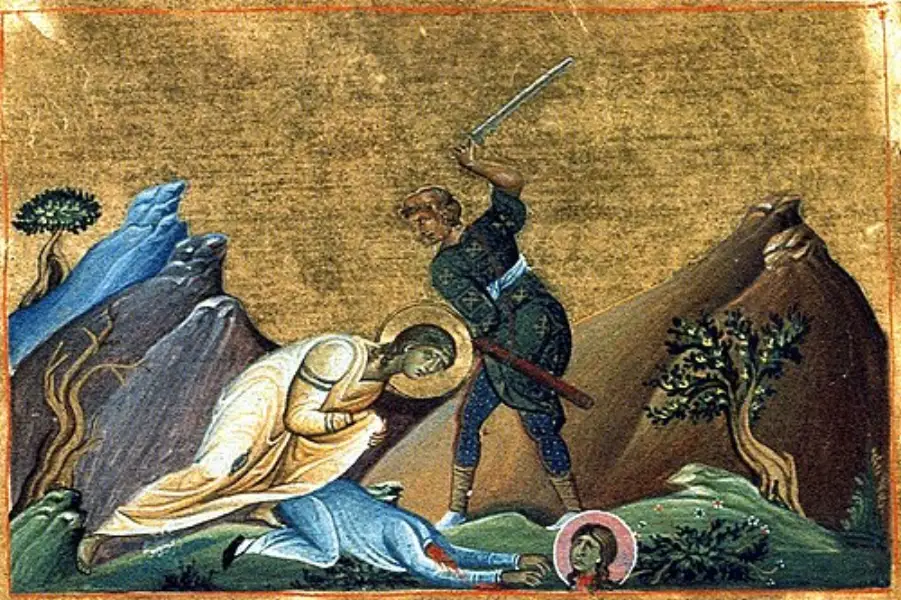
Basilissa and Anastasia belong to the first age of Rome's Christian martyrs, dying in the year 68 under Nero. They stand among the very first converts to Christianity in the century after Christ, and the old accounts describe them as Roman matrons of the highest rank and considerable fortune. Tradition connects them closely to the apostles: they were disciples of Peter and Paul and may have received baptism at their hands. When the two apostles were martyred in Rome on a single day in 67, the two women are said to have seen to their honorable burial, and the ground where they laid the apostles was destined to become, in time, St. Peter's Basilica and St. Paul's great church beyond the walls. Their devotion drew further danger upon them. Arrested for gathering the relics of other slain Christians and for burying their bodies, they would not deny their faith. Nero's sentence condemned them to the sword in 68, but not before torture of extraordinary cruelty: their tongues were torn out, their skins raked with hooks, fire was applied to them, and their breasts and feet were cut away. Their relics rest today in the church of Santa Maria della Pace in Rome. Both the Orthodox and Catholic Churches venerate them, their feast falls on April 15, and tailors honor them as patron saints. A statue of Basilissa stands in the colonnade around St. Peter's Square.
The Complete Life
Women of Rank at the Church's Birth
Basilissa and Anastasia belonged to the first generation of Roman believers, converts made within living memory of the crucifixion. The tradition that preserves them is spare but pointed about their standing: they were women of the Roman senatorial class, possessed of great riches, moving in circles where contact with the apostles was possible. They attached themselves to Peter and Paul as disciples, and some accounts hold that it was one or other of the apostles who baptized them. This detail, whatever its historical weight, places the two women at the very center of the primitive Roman community, among the households that gave the young Church its money, its meeting places, and its social protection. It also places them in the path of danger. A woman of rank who followed an executed Galilean preacher, and who kept company with his emissaries, had much to lose and nothing to gain in the eyes of the city. Their story is a reminder that the earliest Church in Rome was not built only upon slaves and the poor; matrons with property and position heard the preaching and staked everything on it, quietly and without the later shelter of numbers or law.
§ Basilissa and Anastasia
Buriers of the Dead, Beheaded for Christ
The decisive moment in the two women's story came in the year 67, when Peter and Paul were put to death at Rome on the same day. Basilissa and Anastasia are credited with providing the apostles honorable burial, and the places where they laid them became, over the centuries, the great basilicas that mark those graves today: St. Peter's on the Vatican hill and St. Paul Outside the Walls on the Ostian road. The service did not end there. Continuing to gather the remains of Christians who had been executed and to bury their mutilated bodies, the two matrons made themselves conspicuous precisely where Nero's persecution was most savage, and the burials may have exposed them to further attention from the authorities. They were arrested. Brought before the tribunal, they declined to renounce what they believed. The punishment recorded is among the most brutal in the early martyrologies: before their deaths their tongues were wrenched out, hooks raked their flesh, fire was applied to their bodies, and their breasts and feet were severed. In 68, by order of Nero, both were put to death with the sword. The Church has ever since read their end as the price of a work of mercy, the burial of the dead, performed for the bodies of the apostles and of nameless others.
§ Basilissa and Anastasia
Patrons of the Needle and the Thread
The veneration of Basilissa and Anastasia has crossed the ancient division between the Orthodox and Catholic Churches, both of which honor them as martyrs with a common feast on April 15. Their relics are kept in the church of Santa Maria della Pace in Rome, a small jewel of the Renaissance near Piazza Navona, so that the women who buried the apostles now rest a short walk from the basilicas their devotion helped to found. In the Catholic tradition they are invoked as patron saints of tailors, a patronage whose exact origin the sources do not explain but which has given the two Roman matrons an unbroken place in the devotional life of a humble trade. Their memory also stands in stone at the heart of Catholicism: among the statues of the saints that line Bernini's colonnade overlooking St. Peter's Square is one of Basilissa, so that pilgrims arriving to visit the apostle's tomb pass, often unknowingly, the figure of the woman said to have carried his body to its grave. For a church that numbers among its works the burial of the dead, the two women remain an early and complete pattern: rank surrendered, wealth spent, bodies honored, and life given rather than the faith denied.
§ Basilissa and Anastasia
Timeline
- 67
Peter and Paul are martyred in Rome on the same day; the two Roman matrons, their disciples, may have given them honourable burial.
§ Introduction
- 68
Arrested for collecting the relics of martyred Christians and burying their bodies.
§ Introduction
- 68
Tortured — tongues torn out, skins scraped, burned — they refuse to recant their Christian faith.
§ Introduction
- 68
Beheaded with swords in Rome by order of Nero; their relics now rest at Santa Maria della Pace.
§ Introduction
In Their Own Words
Roman matrons of high rank and great wealth
The Record
- Patron of
- Tailors
- Symbols
- Swords, instruments of their martyrdom
- Canonization
- Pre-congregation
Prayer
Bibliography
Show 5 sources
- "Saints Basilissa and Anastasia". Monza, Italy: Daily Compass. 15 April 2020.
- Holweck, Frederick George (1924). A Biographical Dictionary of the Saints. Vol. 1. London: B. Herder Book Company. p. 138.
- Dunbar, Agnes B.C. (1901). A Dictionary of Saintly Women. Vol. 1. London: George Bell & Sons.
- "Ss. Basilissa and Anastasia of Rome". Englewood, New Jersey: Antiochian Orthodox Christian Archdiocese.
- "Sts Anastasia and Basilissa of Rome". Aleteia.
Profile text adapted from the Wikipedia article, licensed CC BY-SA 4.0.
Pray with this saint every day
Save St. Basilissa and Anastasia to your favorites, read the full profile, and get feast-day reminders in the Saints app.
Get the Saints AppFree on the App Store for iPhone and iPad