
c. 555 – c. 620·Feast November 26
St. Basolus
Benedictine Monk and Hermit of Reims
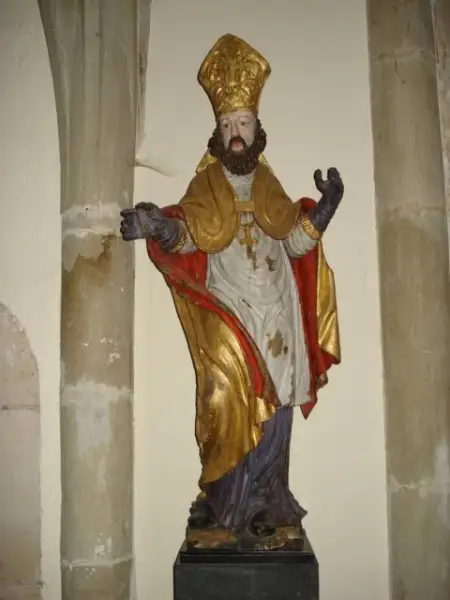
Overview
Basolus, also called Basle, was a French monk and hermit of the late sixth and early seventh centuries, born in the countryside near Limoges. Leaving his native district, he entered the monastic life at Verzy, a village in the Champagne region south of Reims, where he lived as a Benedictine. Drawn afterward to a still more solitary path, he withdrew to a hill close to Reims and passed some forty years there as a hermit, a span of quiet enclosure that became the defining fact of his memory. His long retreat made him one of the recognizable solitary figures of Merovingian Gaul, a land in which hermits dotted the forests and hills around the old Roman towns. After his death, widely placed around the year 620, an abbey at Verzy took his name, St-Basle, and kept his cult alive for centuries. Both the Catholic and the Orthodox churches honour him, and his feast is kept on November 26. Beyond these outlines little of his life can be told, leaving a saint whose fame rests on the endurance of forty years of prayer.
The Complete Life
Born near Limoges
Basolus first saw light in the district around Limoges, in west-central France, probably in the middle decades of the sixth century. Limoges in his day was an old episcopal city with a Christian pedigree reaching back to martyr times, and the surrounding Limousin countryside had already given the Church bishops, monks and solitaries. That a boy of that region should later be found in the far north-east, at Verzy near Reims, points to a journey of several hundred miles, whether made for study, for refuge or simply in search of a stricter rule of life. Why he made that journey is not explained; what is established is the sequence: a birth near Limoges, a novitiate lived near Verzy, and finally the hill. For a saint of Merovingian Gaul such silence is normal; the lives of most hermits of that age survive only as a name, a place and a feast day.
§ Introduction
Monk and Hermit
The two halves of Basolus's calling are given plainly. First he became a monk near Verzy, embracing cenobitic life under a rule, with psalms, manual work and obedience. Verzy stood on the Montagne de Reims, a wooded ridge whose cellars and slopes already harboured religious houses, and a Benedictine identity is claimed for him by the tradition. Then, as so many monks of Gaul did, he passed from the common life to the solitary one, settling on a hill near Reims itself, the metropolitan city of northern Gaul. There he remained for forty years. A span of four decades in one place, in prayer and fasting, made his hill a landmark of holiness for the whole region; pilgrims and the faithful would have known of the recluse outside the walls. It is this long fidelity, rather than any recorded miracle or writing, that his cult commemorates. He belongs among the hermit saints whose endurance itself was the sermon.
§ Introduction
The Abbey of St-Basle
Basolus died around the year 620, and his memory settled quickly into the landscape. An abbey at Verzy, the district of his monastic beginnings, took his name, St-Basle, and stood as his shrine and his witness for centuries of French history. The house of St-Basle in fact entered the wider story of the Frankish church, its name attached to councils and to the politics of kings, though none of that later prominence belongs to the hermit himself. His cult crossed confessional lines: he is counted a saint in both the Catholic and the Orthodox churches, a mark of his antiquity, since saints who died before the divisions of later centuries are honoured on both sides. His feast is kept on November 26. In the churches of the region his image appears among the monks and solitaries of early Gaul. That a man of whom so little is known should still be named in litanies and calendars more than fourteen centuries after his death is itself the legacy: the Church kept the name of the hermit of Reims.
§ Introduction
Timeline
- 555
Born near Limoges; later becomes a monk near Verzy and a hermit for forty years on a hill by Reims
§ Introduction
- 620
Dies around this year after four decades of eremitical life
§ Introduction
The Record
- Symbols
- Hermit's habit·Hill outside Reims
- Canonization
- Pre-congregation; honoured in both the Catholic and the Orthodox traditions
Prayer
Bibliography
Show 3 sources
- St. Basolus - Saints & Angels - Catholic Online
- Latin Saints of the Orthodox Patriarchate of Rome
- November 26 - today's saints
Profile text adapted from the Wikipedia article, licensed CC BY-SA 4.0.
Pray with this saint every day
Save St. Basolus to your favorites, read the full profile, and get feast-day reminders in the Saints app.
Get the Saints AppFree on the App Store for iPhone and iPad