
c. 320 – c. 413·Feast January 19
St. Bassianus of Lodi
Bishop of Lodi and Friend of Saint Ambrose
Overview
Bassianus, born around 320 in Syracuse to Sergius, the city's prefect, was sent to Rome for his education. There a priest named Giordano converted him to Christianity, over the strong opposition of his parents. When his father pressed him to renounce the faith and come home, Bassianus refused and fled to a kinsman, Urso, Bishop of Ravenna, settling as a hermit near Sant'Apollinare in Classe. Around 373, on the death of Lodi's bishop, he was summoned to fill the see and was consecrated by Ambrose of Milan together with Urso of Ravenna. As bishop he built a church in honour of the Apostles, consecrated in 381 with Ambrose and Felix of Como present, took part in the Council of Aquileia that same year, and possibly in the Milan council of 390 that condemned Jovinian. His signature stands beside Ambrose's on a letter to Pope Siricius, and in 397 he was at Ambrose's deathbed. A shepherd known for care of his flock and a reputation for healing the sick, Bassianus died around 413 and is the patron of Lodi, Bassano del Grappa and Pizzighettone.
The Complete Life
A Prefect's Son in Syracuse and Rome
Bassianus was born at Syracuse in Sicily around the year 320, the son of Sergius, who held the office of prefect of the city. The household was thus one of the administrative aristocracy of the late empire, wealthy, Roman in culture, and in all likelihood still attached to the old gods when Bassianus was a boy. Sent to Rome to finish his studies, the young Sicilian came under the influence of a priest named Giordano, through whose word he became a Christian. The conversion split the family. His parents set themselves against it, and his father, wanting his son to give up the new faith, summoned him back to Syracuse with the demand that he apostatize. Bassianus answered by flight rather than denial. He made his way to Ravenna, where a relative, Urso, held the episcopal see, and under that protection he settled into the hermit's life near the basilica of Sant'Apollinare in Classe. The choice of solitude was a common one for converts of rank in the fourth century: it removed them from the reach of family pressure and placed their new loyalty beyond recall. For Bassianus it proved the threshold of an unexpected career.
§ Biography
Consecrated for Lodi
The hermit of Classe was not left in obscurity. Around 373 the church of Lodi, a small city on the plain south of Milan, lost its bishop; the clergy and people turned to Bassianus, and he accepted the burden. His consecration was performed by two hands at once, so to speak: Ambrose of Milan, the greatest bishop of the western empire, joined with Urso of Ravenna, the relative who had sheltered Bassianus in his flight. The double patronage announced that the former runaway was now firmly within the network of the north Italian episcopate. As bishop he proved a builder, raising a church in honour of the Apostles at Lodi and consecrating it in 381, with Ambrose himself present together with Felix of Como, another of that generation of pastoral founders. The record of Bassianus's episcopate is that of a conscientious diocesan: construction, consecration, and the councils through which the church of his day settled its affairs. He was, by the memory Lodi kept of him, a caring shepherd, and he was believed to carry the gift of healing the sick.
§ Biography
Councils and the Ambrose Circle
Bassianus's ministry unfolded inside the great controversies of the late fourth century. In 381 he took part in the Council of Aquileia, the gathering at which Ambrose and the Italian bishops broke the back of Arianism in the West; a new bishop of Lodi lending his name to that verdict was a public act, for Arian sympathy had run strong in the cities of the Lombard plain. He may also have attended the Council of Milan held around 390, the assembly that condemned Jovinian's teaching against fasting and the superiority of virginity. His signature stands next to Ambrose's on a letter addressed to Pope Siricius, a document of the concerted action with which the Italian bishops addressed Rome in that era. Above all, the sources remember him as Ambrose's friend: in 397, when the bishop of Milan lay dying, Bassianus was at his side. A Sicilian who had studied in Rome, hidden at Ravenna and governed at Lodi, he belonged fully to that circle of northern Italian churchmen who carried the church of Ambrose into the fifth century.
§ Biography
Death and Reputation
Bassianus governed the church of Lodi for roughly four decades, an exceptionally long episcopate that carried him from the reign of Valentinian I nearly to the fall of the imperial court from Milan. He died around the year 413, a few years after Ambrose, and left behind a diocese with a new basilica, a settled tradition of orthodoxy, and the memory of a pastor. The trait Lodi treasured was his care for the flock: he was recalled as a shepherd of genuine solicitude, and popular devotion credited him with the charism of healing the sick, a reputation which in late antiquity attached to bishops whose tombs became places of prayer. No writings of his survive, if any were made; his monument was the church he built and the see he served. His death closed the apostolic age of Lodi's history, and it opened the longer history of his cult, for the people among whom he had lived refused to let his memory pass. Within a century his successors were building their authority, in part, on his name.
§ Biography
Veneration
Bassianus belongs to the vast company of pre-congregation saints, honoured from the centuries before the papacy reserved formal canonization to itself. His cult, centred on his tomb, was secure in Lodi from early times, and both the Roman Catholic and the Eastern Orthodox churches count him among their saints. The dramatic chapter of his veneration came in the twelfth century. In 1158 the forces of Milan destroyed Lodi outright, and amid the ruin the saint's relics were carried off to Milan for safekeeping. When Frederick Barbarossa intervened and ordered Lodi rebuilt, the relics came home again in 1163 and were placed with solemnity within Lodi cathedral of the Assumption, whose crypt still holds them in veneration. His feast on January 19 is kept as a civic as well as religious occasion in Lodi, marked by the fair of St. Bassianus. He is the patron of Lodi and of Bassano del Grappa and Pizzighettone, and is invoked against leprosy.
§ Veneration
Legacy
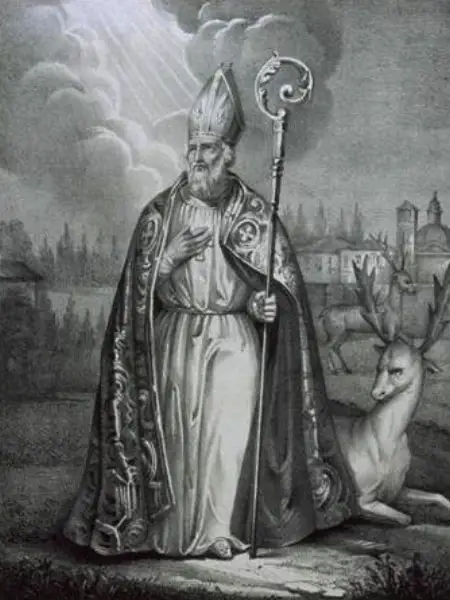
The legacy of Bassianus is written into the stones and calendar of Lodi. The cathedral whose crypt still holds his relics is the city's principal monument, and the January fair bearing his name has been for centuries a fixed point of Lodi's year, a survival of the medieval saint's feast as market and festival alike. Iconographically he carries the deer, an emblem whose legend connects the saint with the gentleness and solitude of that animal, along with the standard episcopal robes and crozier. His cult spread along the routes of medieval Lombard piety, giving him a place among the patrons of Bassano del Grappa and Pizzighettone as well as of Lodi itself. Historically, his friendship with Ambrose has preserved his name in the scholarship on that towering figure: the letter he co-signed to Pope Siricius and his presence at Ambrose's death in 397 make him a witness, cited by modern editors and biographers of Ambrose, to the inner life of the north Italian church. A convert, a refugee, a hermit and finally a bishop of forty years, Bassianus spans in one life nearly the whole range of fourth-century Christian experience.
§ Veneration
Timeline
- 320
Born at Syracuse in Sicily, son of Sergius, the city's prefect
§ Introduction
- 373
Chosen to succeed Lodi's late bishop and consecrated by Ambrose and by Urso of Ravenna
§ Biography
- 381
Consecrated his church dedicated to the Apostles at Lodi, with Ambrose and Felix of Como present
§ Biography
- 381
Took part in the Council of Aquileia
§ Biography
- 390
Perhaps attended the Council of Milan, at which Jovinian's teaching was condemned
§ Biography
- 397
Stood at the deathbed of his friend Ambrose, bishop of Milan
§ Biography
- 413
Died around this year, recalled as a caring shepherd believed to heal the sick
§ Biography
- 1158
His relics were carried off to Milan after Milanese forces destroyed Lodi
§ Veneration
- 1163
After Barbarossa decreed Lodi's rebuilding, the relics returned and were enshrined in the Cathedral of the Assumption
§ Veneration
The Record
- Major works
- Church of the Apostles at Lodi (builder)
- Patron of
- Lodi·Bassano del Grappa·Pizzighettone·Against leprosy
- Symbols
- Deer·Episcopal attire
- Canonization
- Pre-congregation; venerated in the Roman Catholic and Eastern Orthodox churches
Prayer
Bibliography
Show 6 sources
- Paulinus of Milan. Life of Saint Ambrose, (Mary Simplicia Kaniecka, trans.), Arx Publishing, LLC, 2020, p. 54, n.5
- Morabito, Giuseppe. "San Bassiano Vescovo", Santi e Beati, February 1, 2001
- Van den Akker sj, A., "Bassianus van Lodi", Heiligen
- Walsh, Michael J. A New Dictionary of Saints: East and West, Liturgical Press, 2007, p. 89, ISBN 9780814631867
- Cambielii, P., "Lodi Celebrates St. Bassianus", Dooid Magazine, January 2019
- Schäfer, Joachim. "Bassianus von Lodi", Ökumenisches Heiligenlexikon
Profile text adapted from the Wikipedia article, licensed CC BY-SA 4.0.
Pray with this saint every day
Save St. Bassianus of Lodi to your favorites, read the full profile, and get feast-day reminders in the Saints app.
Get the Saints AppFree on the App Store for iPhone and iPad