
c. 179 – 250·Feast December 5
St. Bassus of Nice
Early Bishop of Nice and Martyr under Decius
Overview
Bassus of Nice was a bishop and martyr of the third century, traditionally counted the earliest bishop of Nice to be known by name. His life, reckoned from about 179 to 250, fell in the decades when the church of the Mediterranean coast of Gaul was taking root under the shadow of the empire. Active on the Côte d'Azur, he shepherded the young Christian community of Nice before the storm of the Decian persecution broke. Refusing to sacrifice to the Roman gods, he was put to death with deliberate cruelty: seared with red-hot blades and then pierced from head to feet by two great shipbuilding nails, one driven through each foot. The manner of his passion, with its ugly echo of crucifixion, fixed itself in the memory of the Church. After his death his body was carried to Cupra Marittima on the Adriatic coast of Italy, whose people took him as their patron; in 1922 or 1923 he was also proclaimed the second patron of Nice. His feast is kept on December 5, and he is honoured as a martyr of the ancient church of Gaul.
The Complete Life
A Third-Century Bishop of Gaul
Bassus belongs to the first generations of Christianity in Roman Gaul, the church planted in the Greek trading cities of the Mediterranean coast long before it reached the interior of the province. His dates, given as approximately 179 to 250, would make him a man of the turn of the third century, born in the reign of Commodus and dying under Decius. Nothing certain survives of his family, his conversion or his formation for ministry. What the tradition of Nice preserves is his office: he is reckoned the earliest bishop of that city whose name has come down, which is to say that he stands at the head of a catalogue of bishops reaching unbroken to the present. To hold the episcopate of a small coastal see in the Severan age meant presiding over a congregation of merchants, freedmen and the poor, celebrating the mysteries in private houses, and keeping the peace in a community that imperial law still treated with suspicion. That a church so young could already have a named bishop, and could remember his name after eighteen centuries, tells of a community whose roots ran deeper than its persecutors imagined.
§ Introduction
Ministry on the Côte d'Azur
The record places Bassus's activity on the Côte d'Azur, the Ligurian coast where Greek Massalia had founded trading posts centuries before, and where the Latin name Nicaea, given to the town after a victory of Rome, marked a modest civic community at the edge of the empire's sea. His mission, as far as the sources allow us to speak, was episcopal: teaching, baptizing, and gathering the scattered faithful of the coast under one altar. The churches of this shore lived from the sea trade, and their congregations would have included sailors and merchants who carried the faith from port to port. That Nice venerates Bassus as its second patron today, and that his cult could be formally renewed in the twentieth century, shows that the memory of his pastoral charge never wholly faded. He governed his small church through the years of comparative quiet that preceded the persecution, years in which the Christian population of Gaul grew steadily. It was this growth that the emperor Decius set out to arrest, and it was Bassus's refusal to deny the faith he had preached that carried him to martyrdom.
§ Introduction
The Decian Passion
The trial of the church came in the year 250. The emperor Decius had issued an empire-wide edict requiring every inhabitant of the Roman world to sacrifice to the gods and to obtain a certificate attesting that they had done so; refusal was to be punished, and bishops were the most visible of those who could not comply. Bassus, as the shepherd of Nice, was arrested for his faith and put to death. The manner of his passion, preserved in the tradition, was savage even by the standards of Roman execution: blades heated red in the fire were pressed upon him, and two great nails of the shipwrights were then driven through his body, one piercing either foot. The choice of such implements was an outrage with a meaning, for nails of that kind belonged to the shipwrights of the coast, and the piercing of the feet travestied the crucifixion of the Lord whom the bishop confessed. Christian memory treasured exactly this correspondence, reading in the bishop's wounded feet the prints of his Master's. Bassus thus entered the martyrologies of the Church, his feast fixed on December 5, and his death became the founding witness of the church of Nice.
§ Introduction
Two Cities, One Saint
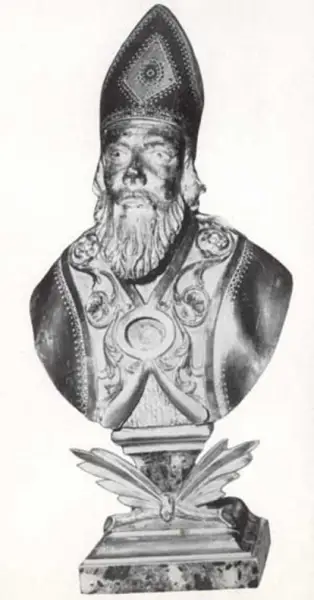
The body of the martyred bishop was carried across the peninsula after his death and came to rest at Cupra Marittima on the Adriatic coast of Italy, where the community received him as its patron saint. The translation belongs to the common pattern of the early Middle Ages, when relics moved along the sea routes of Italy and the cults of martyrs of one shore took root on another. Thus a bishop of the Ligurian coast came to be the heavenly protector of a town on the Marche littoral, and the feast of December 5 was kept in both places. His connection with his own see endured as well: in 1922 or 1923 Nice formally proclaimed Bassus its second patron saint, a civic as much as religious act that joined the ancient martyr to the modern city. For the historian of the Gallic church his chief significance lies in his office, since as the earliest named bishop of Nice he anchors the episcopal succession of that see in the age of the persecutions. A bust of the saint preserves his image, and he remains one of the few third-century bishops of Gaul of whom both the ministry and the manner of death are remembered.
§ Introduction
Timeline
- 179
Born around this year, later serving the church at Nice
§ Introduction
- 250
Put to death in the Decian persecution, burned with heated blades and nailed through the feet
§ Introduction
- 1922
Chosen second patron saint of Nice, an honour the article dates 1922 or 1923
§ Introduction
The Record
- Patron of
- Cupra Marittima·Nice (second patron)
- Symbols
- Shipbuilding nails·Hot blades·Bishop's vestments
- Canonization
- Pre-congregation; venerated as a martyr of the Decian persecution
Prayer
Bibliography
Show 4 sources
- Catholicsaints.info: Saint Bassus of Nice
- P.D. Faustino Mostardi, San Basso da Nizza a Cupra, under the auspices of the Comitato Festeggiamenti San Basso Cupra Marittima, Este, 1962
- Saint Bassus
- Nice-Historique, p. 245
Profile text adapted from the Wikipedia article, licensed CC BY-SA 4.0.
Pray with this saint every day
Save St. Bassus of Nice to your favorites, read the full profile, and get feast-day reminders in the Saints app.
Get the Saints AppFree on the App Store for iPhone and iPad