
died 3rd or 4th century·Feast May 20
St. Baudilus
Martyr of Nîmes and Apostle of the Three Fountains
Overview
Baudilus is honored as a martyr by the Catholic Church, and his cult is bound up above all with the southern French city of Nîmes, though it later spread widely through Spain and even into Central Europe. The Catholic Encyclopedia calls him the true apostle of Nîmes, noting that writers have placed his martyrdom at the close of the third century, and with less plausibility at the close of the fourth; another tradition assigns his death to the reign of Julian the Apostate. According to the legend, Baudilus was a Christian, possibly a deacon, who arrived in Nîmes during a pagan festival held on the oak-covered hills near the city in honor of the god Veiovis, a ceremony that a nineteenth-century local scholar, Abbé Azaïs, described as involving animal sacrifice. Baudilus denounced the rite and overthrew the statue of the god. Enraged pagan priests had him flogged and then beheaded with an axe. Where his severed head struck the ground three times, three springs of water were said to have gushed forth, and an oratory known as the Trois-Fontaines was later raised on the spot. His widow recovered his body and carried it to Valsainte, where an existing Christian community buried him. Valsainte became a pilgrimage destination: a fourth-century church rose over the martyr's grave, a monastery followed in 511, and pilgrimage continued until the seventeenth century. Baudilus remains the patron of Pozaldez and Poitiers, and churches under his many names — Baudile, Boal, Baudelio, Baldiri — stand across France, Spain, and beyond.
The Complete Life
A Stranger Who Confronted the Old Gods
The legend of Baudilus presents him as a newcomer to Nîmes rather than a son of the city. He was a Christian, and by some accounts a deacon, who entered Nîmes on a day when the surrounding hills were given over to a pagan festival. The rites honored Veiovis and were celebrated by the Salii or Agonales; the slopes, once wooded with oaks, had by then given way to vineyards, and crowds gathered on the hillsides to watch the priests at work. Writing in 1872, Abbé Azaïs held that the ceremony included the sacrifice of animals. Into this scene walked Baudilus, and he did not come as a spectator. He openly condemned the festival as an offense against the one God, and when words were not enough he laid hands on the object of the cult, toppling the statue of the god to the ground. The act was deliberate and public, a direct collision between the new faith and the old at the very heart of local religious life. His gesture recalls the confrontations of the earliest missionaries of Gaul, and indeed he stands within that lineage: Saint Saturnin had been sent to Gaul by Pope Fabian around 245, and had converted Saint Honestus of Nîmes, later martyred at Pamplona. Yet the Catholic Encyclopedia reserves for Baudilus alone the title of true apostle of Nîmes, judging his witness to be the decisive one in the city's conversion. What his mission lacked in length it supplied in intensity; a single afternoon of prophetic defiance secured his place in the memory of the Gallic church.
§ Life
The Axe, the Three Fountains, and the Tomb at Valsainte
The priests of the overturned god did not wait for the law to answer the insult. According to the legend they seized Baudilus, whipped him, and then put him to death by decapitation with an axe. The manner of his end fixed the date of his cult in the memory of Nîmes, though not with certainty: the Catholic Encyclopedia reports that some place his martyrdom at the end of the third century, others, with less reason, at the end of the fourth, while a further tradition assigns it to the reign of Julian the Apostate, the emperor who attempted to restore paganism. The story then passes from history into wonder. His severed head, it is said, bounced three times upon the ground, and at each impact a spring of water broke forth. An oratory was later built upon those springs and named the oratoire des Trois-Fontaines, the Oratory of the Three Fountains. His body did not remain at the place of execution: his wife gathered it and carried it to a spot called Valsainte, where a colony of Christians already lived and gave the martyr burial. Valsainte became a place of pilgrimage, and its sanctity endured for more than a millennium. A church was raised over the spot in the 300s; in 511 a monastery joined it, and the two houses lasted until the seventeenth century. In Nîmes itself, the crypt of Saint Baudilus, at the corner of the rue des Moulins and the rue des Trois Fontaines, still marks the alleged ground of his martyrdom, keeping the legend anchored to the streets of the city.
§ Life
A Cult Carried from the Rhône to Castile and Catalonia
The veneration of Baudilus outgrew Nîmes to a remarkable degree. Within France he is the patron of a string of churches, including Sainte-Baudile at Noves, Saint-Baudile at Fabrègues, and Saint-Baudile at Neuilly-sur-Marne, and his patronage extends to Pozaldez and Poitiers; churches under his invocation are found in Germany as well. His major shrines are the crypt of Saint Baudile in Nîmes and a shrine at Zamora in Spain. It was in Spain, however, that his cult achieved its widest diffusion, carried by his reputation as a thaumaturgus, a worker of wonders. His name took local root in a profusion of forms — Baudelio, Baudilio, Boal in Spanish, Boi and Baldiri in Catalan — and parishes and hermitages under those names spread across Castile-Leon, Catalonia, and La Rioja. The Mozarabic church of San Baudelio de Berlanga at Caltojar in Soria and the Mudéjar church of San Baudilio at Samboal in Segovia testify to the medieval depth of the devotion; a ruined monastery at Sambol in Burgos lent its name to one of the streams crossed on the pilgrim road to Compostela. In Salamanca the parish of San Boal stands beside the Palacio de San Boal. Robert Southey, in the notes to his poem Roderick, remarked that the people of Zamora kept a good part of the saint's relics but had so corrupted his name to Boal that he was scarcely known by his own. Devotion reached as far as the lands of the present Czech Republic and Slovakia, a reach remarkable for a martyr whose life is known only through legend.
§ Veneration in France
Timeline
- 290
Martyrdom of Baudilus at Nîmes, placed by some writers at the end of the third century after he toppled a pagan statue.
§ Life
- 362
An alternative tradition places his martyrdom during the reign of Julian the Apostate.
§ Life
- 400
A church was built at Valsainte, the burial place of Baudilus, which had become a site of pilgrimage.
§ Life
- 511
A monastery was founded at Valsainte over the martyr's tomb, surviving until the seventeenth century.
§ Life
- 878
The relics of Saint Bausile were reportedly discovered (invention des reliques) according to a French source on the cult.
§ External links
- 1872
Abbé Azaïs described the pagan festival at which Baudilus was killed as involving animal sacrifice.
§ Life
In Their Own Words
The true apostle of Nîmes was St. Baudilus, whose martyrdom is placed by some at the end of the third century, and, with less reason, by others at the end of the fourth.
The Record
- Patron of
- Patron of Pozaldez·Patron of Poitiers·Patron of various churches in France, Germany, Spain, the Czech Republic and Slovakia
- Symbols
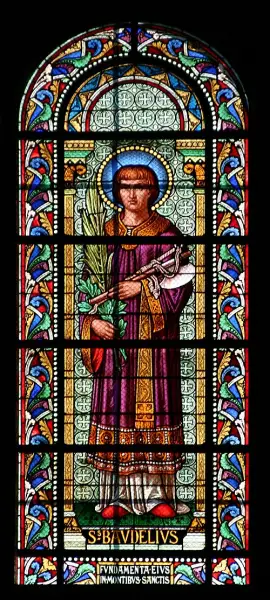
- Dalmatic·Severed head with three fountains·Axe (instrument of his martyrdom)
- Canonization
- Pre-congregation; venerated as a martyr from late antiquity
Prayer
Bibliography
Show 6 sources
- La crypte de Saint Baudile, Nîmes.
- Catholic Encyclopedia, entry on Nîmes.
- Samboal — study of the church of San Baudilio.
- Robert Southey, The Poetical Works of Robert Southey: With a Memoir. Boston: Houghton, Mifflin, and Company, 1880, p. 368.
- Palacio de San Boal, Salamanca (archived March 30, 2008, at the Wayback Machine).
- Riqueza natural: La iglesia de San Baudilio, una joya mudéjar declarada Bien de Interés Cultural. nortecastilla.es.
Profile text adapted from the Wikipedia article, licensed CC BY-SA 4.0.
Pray with this saint every day
Save St. Baudilus to your favorites, read the full profile, and get feast-day reminders in the Saints app.
Get the Saints AppFree on the App Store for iPhone and iPad