
c. 700 – c. 740·Feast November 10
St. Baudolino
Hermit of Forum Fulvii on the Tanaro
Overview
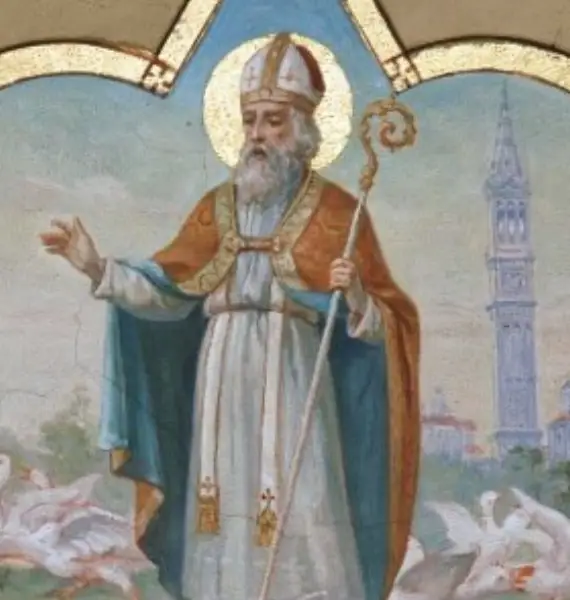
Baudolino was a hermit of the early eighth century who lived at Forum Fulvii, now Villa del Foro, on the lower reaches of the Tanaro river in north-west Italy, in the age of the Lombard king Liutprand. Tradition makes him the son of a noble family whose wealth he renounced entirely, giving everything to the poor before withdrawing to a wretched hut near the river. His reputation reached the royal court: Paul the Deacon, writing some forty years after his death, describes a man of wonderful holiness distinguished for many miracles and endowed with clairvoyance and prophecy, and records how Liutprand sent to him when a hunting accident left the king's nephew dying. Baudolino died around 740 and was buried at Forum Fulvii. Four centuries later the founders of Alessandria claimed his remains for their new city, and he has been its patron ever since, remembered in art as a bishop seated among the geese, deer, and other creatures that his legend says gathered to hear him.
The Complete Life
A Nobleman's Son on the Tanaro
Baudolino's story opens in Forum Fulvii, a settlement on the lower reaches of the Tanaro in the north-west of the Italian peninsula, in the decades around the year 700, when the Lombard kingdom under Liutprand governed the region. The tradition preserved by later writers holds that he came from a noble family, a circumstance that makes the shape of his life easier to grasp: he was born to privilege in a warlike and unstable age, and he threw it away. Nothing survives about his parents, his education, or the moment of his conversion. What the earliest account assumes, and what every later retelling repeats, is the renunciation. Before he was known as a holy man, he was known as the heir of a house; after he gave the whole of his fortune to the poor, he was known only as the man in the hut by the river. For the citizens of Alessandria who would later venerate him, that single movement from inheritance to poverty was the key to everything else in his life, the act by which a gentleman of the Lombard world became a hermit whose prayers kings were said to seek.
§ Life
The Hut by the River
Having given away his wealth, Baudolino withdrew to a miserable hut near the Tanaro and lived there as a hermit. The word the sources use for his dwelling is deliberately contemptuous: this was no monastery with lands and dependents but a shelter at the edge of cultivation, chosen, it seems, for its remoteness from the society he had abandoned. There he remained for the rest of his life, and there his reputation for holiness grew. Solitude of this kind was a demanding vocation in the Lombard kingdom, an era of dynastic violence and frequent war, and those who embraced it were few. The hermit's day of prayer, fasting, and manual want stood as a silent reproach to the armed nobility among whom he had been raised. Yet his isolation was not absolute. The story that fixed his fame involves an approach from the outside world: when the king himself had need of intercession, it was to this hut beside the river that his messenger was sent. The hermit who had refused the company of men could not refuse their need, and it was in answering that need, at a distance and without leaving his cell, that Baudolino's particular gift became known.
§ Life
Clairvoyance, Prophecy, and the Hunt
Paul the Deacon, the Lombard historian who set down the earliest account a generation after the hermit's death, credits Baudolino with the gifts of clairvoyance and prophecy and calls him distinguished for many miracles. Only one of those miracles is told in detail, and it concerns the royal court. Liutprand was hunting in the forest near Forum when his nephew Aufusus was accidentally struck by an arrow. The king sent to the hermit asking him to pray for the boy's life, and the messenger brought back an answer that must have seemed like insolence: the saint already knew why the man had come, and the thing asked could not be done, for the boy was already dead. Aufusus was indeed dead, and Liutprand understood from the answer that his correspondent possessed the spirit of prophecy. The story shows what the age valued in a holy man: not learning or office but a knowledge that operated outside the ordinary channels of report. Later tradition added a gentler emblem to this austere gift. In the images that grew up around his memory, geese, deer, and other animals are shown gathered about the hermit, listening to him as if to a second Francis centuries before Francis was born.
§ Iconography
Death and First Testimony
Baudolino died around the year 740 and was buried at Forum Fulvii, the place of his retreat, where his grave became the center of local remembrance. He left no writings, no monastery, and no successors; the entire documentary tradition about him descends from a single page. That page was written remarkably early by the standards of Italian hagiography: Paul the Deacon completed his history of the Lombards roughly forty years after the hermit's death, close enough to living memory to give the account its unusual authority. It is Paul who preserves both the royal episode and the verdict of wonderful holiness, and it is Paul's testimony, not the later elaborations, that anchors Baudolino in history. Everything after the burial is the work of the twelfth century and later, when a new city adopted the old saint and the monks who kept his shrine began to fill the silences of the record. The sober earliest account knows nothing of episcopal rank or monastic profession, and the contrast between that spare first page and the ornate legends that followed is itself part of his story, a measure of how much a community will add to the little it has been given.
§ Life
Patron of a City Not Yet Built
Baudolino's afterlife belongs to Alessandria, raised in 1168 as the Lombard League's stronghold facing the Holy Roman Empire. The people of Forum Fulvii were resettled in the new city and carried the saint's remains with them, making a hermit who had died four centuries before the city's founding its heavenly founder in effigy. In 1174, according to tradition, he appeared upon the bastions and put the besieging Imperial troops to flight, and in 1189 a church rose in his honour under the care of the Humiliati. Those monks, and the Dominicans who replaced them after the Humiliati were suppressed in 1571, elaborated the scanty early record with anachronisms, imagining him a member of their own orders or an archbishop of a see that had not existed in his lifetime. In 1786 he was proclaimed principal patron of the city and diocese. When his church closed in 1803 his remains passed to Sant'Alessandro, and in 1810 to a chapel of his own in the new cathedral, where they remain. Umberto Eco, a son of Alessandria, returned the saint to literature in 2000, letting his fictional hero meet Baudolino in the fog of the Frescheta woods and borrow his clairvoyance for a miracle of his own.
§ Remains and legend
Timeline
- 700
Born around this date, by tradition into a noble family of Forum Fulvii on the lower Tanaro.
§ Life
- 740
Died at his hermitage and was laid to rest at Forum Fulvii.
§ Life
- 1168
Alessandria was founded as a stronghold of the Lombard League, and the people of Forum brought the saint's remains with them to the new city.
§ Remains and legend
- 1174
By tradition he appeared on the walls of Alessandria and routed the Imperial army that was besieging it.
§ Remains and legend
- 1189
A church was raised in his honour at Alessandria under the government of the Humiliati.
§ Remains and legend
- 1571
When the order of the Humiliati was suppressed, the Dominicans took over their church and his cult there.
§ Remains and legend
- 1786
Named the foremost heavenly patron of Alessandria and of its diocese.
§ Remains and legend
- 1803
Upon the closing of his church, his relics passed to Sant'Alessandro.
§ Remains and legend
- 1810
His relics were moved once more, this time to a chapel bearing his name inside Alessandria's new cathedral.
§ Remains and legend
- 2000
Umberto Eco published the novel Baudolino, whose hero meets the saint as a boy in the fog-bound woods near Alessandria.
§ Remains and legend
In Their Own Words
a man of wonderful holiness…who was distinguished for many miracles
I know for what cause you are coming, but that which you have been sent to ask cannot be done since the boy is dead.
The Record
- Patron of
- Alessandria
- Symbols
- shown dressed as a bishop·geese, deer, and other animals gathered about him
- Canonization
- Pre-congregation; venerated at Alessandria since the citizens translated his remains in 1168 and proclaimed principal patron of the city and diocese in 1786.
Prayer
Bibliography
Show 3 sources
- Borrelli, Antonio. "San Baudolino di Alessandria Eremita." Santi, beati e testimoni – Enciclopedia dei Santi.
- Paulus Diaconus. Historia Langobardorum. Liber VI.
- Paul the Deacon. History of the Lombards. Translated by William Dudley Foulke, 1907. Book 6.
Profile text adapted from the Wikipedia article, licensed CC BY-SA 4.0.
Pray with this saint every day
Save St. Baudolino to your favorites, read the full profile, and get feast-day reminders in the Saints app.
Get the Saints AppFree on the App Store for iPhone and iPad