
622 – 659·Feast October 1
St. Bavo of Ghent
Nobleman Turned Recluse and Patron of Ghent
Overview
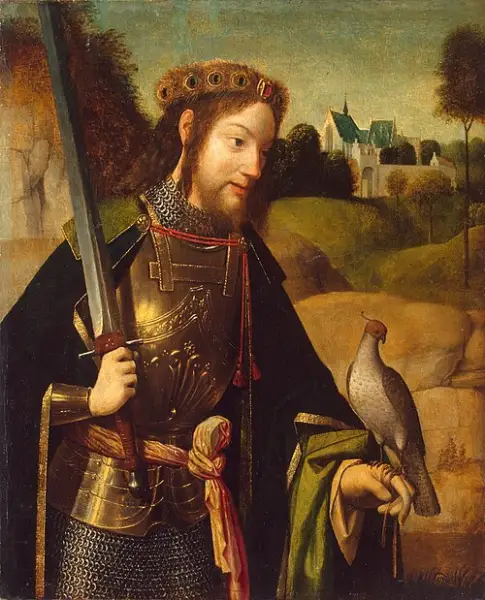
Bavo of Ghent, born Allowin around 622 to a Frankish noble family of the Hesbaye near Liège, exchanged a dissolute aristocratic life for the rigors of a missionary and hermit under the guidance of Saint Amand. A wild young aristocrat of the Brabant region, he contracted an advantageous marriage and fathered a daughter, and as a soldier he lived in a disorderly and undisciplined fashion. His wife's death became the hinge of his life: moved by a sermon of Saint Amand on the emptiness of material things, he returned home, gave away his wealth to the poor, and received the tonsure at Amand's hands. For a time he accompanied Amand on missionary journeys through France and Flanders. Confronted by a man he had once sold into slavery, Bavo sought to atone in the most public way imaginable, having the man he had wronged walk him to the town jail in chains. He then built an abbey on his own lands and became a monk, distributing what remained of his belongings and dwelling as a hermit — first inside a hollow tree, then in a forest cell beside the abbey. He died around 659, and his relics found their resting place within the Ghent abbey, in what is now Belgium. Venerated in both the Catholic and Orthodox churches with a feast on October 1, he is the patron of Ghent, its diocese, Haarlem, and Lauwe, and his emblem — a knight with sword and falcon — made him the patron saint of falconry.
The Complete Life
Allowin of Hesbaye: A Nobleman's Wild Youth
Bavo entered the world as Allowin, a son of the Frankish nobility, born in the Hesbaye region near Liège around the year 622. His family stood high enough in the aristocracy of the Brabant area that his future seemed assured by birth alone, and his youth followed the pattern of his class rather than of the cloister. He was, by the account that has come down to us, a wild young aristocrat. He arranged a marriage that was advantageous in worldly terms, and from this union came a daughter. As a soldier he lived without discipline, in a manner the sources describe as disorderly, and his name became attached to the ordinary excesses of a fighting nobleman of the seventh century. Nothing in these years foretold sanctity. Yet the very completeness of his worldly life gave his later conversion its force, for he had tasted everything that rank, arms, and money could offer and found it hollow. The Frankish world of his upbringing was still only partly Christianized, a society in which old loyalties and new faiths contended, and aristocrats like Allowin were the arbiters of that contest. His household, his marriage, and his military service placed him firmly within the old order. What broke that order open was grief. The death of his wife removed the bond that had anchored his secular life, and in the space it left behind he became capable of hearing an entirely different account of what mattered. The man who would be remembered as Bavo, patron of Ghent, began as Allowin the prodigal, and the distance between those two names measures one of the most dramatic conversions of the early medieval Low Countries.
§ Vita
A Sermon on the Emptiness of Things
The pivot of Bavo's life was a sermon. Saint Amand, the great missionary bishop whose long career stretched from about 584 to 679, preached on the emptiness of material things, and the widowed nobleman heard in those words a verdict on his own life. Shortly after losing his wife, Bavo resolved upon reform. Returning to his house, he undertook a systematic dismantling of his former existence: he distributed his wealth to the poor, keeping nothing back for himself, and then received the tonsure from Amand's own hands, the rite that marked his entry into the clerical state and the end of Allowin. The conversion was thorough in a way that few aristocratic conversions of the age dared to be, for it did not stop at pious patronage. Bavo did not simply endow a monastery and continue to live as a lord; he gave away the substance of his lordship itself. The moral logic of his act ran deeper than generosity. He came to understand that his past held debts that alms alone could not settle, and one encounter made this vivid. In the course of his missionary travels he met a man whom, years before, he had sold into slavery. Wishing to atone for that earlier deed, Bavo had the man walk him to the town jail in chains, publicly reversing their old relationship and accepting humiliation in place of mastery. It was an extraordinary gesture, theatrical in the best medieval sense, and it sealed his reputation as a penitent in the fullest meaning of the word. From that point his life belonged wholly to God.
§ Vita
Missionary Journeys with Saint Amand
Bavo's conversion did not retire him from the world at once. For some time after receiving the tonsure he took part in Saint Amand's preaching journeys across France and Flanders, walking the roads of a still half-pagan countryside as a companion of one of the great evangelists of the Merovingian era. Amand's missions planted Christianity across regions where the old cults lingered, and Bavo served within that enterprise as a living demonstration of its power: here was a nobleman who had abandoned everything to follow the preaching he had once ignored. The years on the road with Amand gave Bavo his religious formation, and they also supplied the dramatic center of his legend, for it was during this period of traveling that he encountered the man he had formerly sold into slavery and performed his public penance, led by a chain to the town jail. When the period of itinerant mission came to an end, Bavo gave it a permanent form. On his own grounds he built an abbey, a foundation that would anchor Christian life at Ghent for centuries, and there he became a monk. He went further still in the disposal of his estate: he distributed his remaining belongings to the poor, holding back nothing of his inheritance, so that the abbey stood not as a monument to his rank but as the product of his renunciation. His relics were later housed at the abbey in Ghent, in present-day Belgium, which remained the center of his veneration and gave him the name by which he is universally known.
§ Vita
The Hollow Tree and the Forest Cell
The final shape of Bavo's sanctity was eremitical. Having founded his abbey and become a monk, he did not settle into the routine of communal life but pressed on toward a harder solitude, sheltering as a hermit first in the hollow of a tree and then in a cell in the woods beside the abbey. The imagery is stark and deliberate: the man who had lived in a noble house chose a dead tree for his dwelling, and the soldier who had ridden with falcon and sword chose the silence of the woods. This progression from community to solitude mirrors the spirituality of the early medieval Low Countries, in which the cloister was often only a stage on the way to the desert, however small that desert might be. Bavo's asceticism was not an escape from obligation but its completion; he had already discharged his duties to his family, his dependents, and his society by giving away his goods, and he was free to seek God alone. The forest cell beside the abbey kept him within reach of the brothers while removing him from their company, a compromise typical of recluses who lived on the edge of monastic communities. His spiritual lineage ran through Amand, whose sermon had first turned his heart, and whose own missionary labors modeled a life spent entirely for God. In art this spirituality was translated into the attributes of his former life, the falcon and the sword, now carried by a penitent in a recluse's habit, and in the popular imagination his conversion scene became the most depicted moment of his story. The purse or money bag he holds in many images recalls that in medieval Ghent taxes were paid on his feast day.
§ Veneration
Patron of Two Cities and Saint of the Painters
Bavo's afterlife has been chiefly civic and artistic. He is the patron saint of Ghent and of its diocese, of Zellik and Lauwe in Belgium, and of Haarlem in the Netherlands, and his feast of October 1 is kept in both the Catholic Church and the Eastern Orthodox Church. Saint Bavo Cathedral in Ghent, the Sint-Bavokerk and the Cathedral of Saint Bavo in Haarlem — the latter housing depictions of the saint saving the city from the Kennemers in a legend dated to 1274 — and churches in Heemstede, Lauwe, Zellik, Wilrijk, and Mishawaka, Indiana, all bear his name, and the football club VVSB is named for him. Wilrijk, a suburb of Antwerp, places his portrait on its municipal arms. In Christian art he usually appears in the guise of a knight bearing falcon and sword, and because of the falcon he came to be regarded as the patron saint of falconry. The best-loved scene is that of his conversion, a moment around which many stories gathered; Rubens painted the scene around 1623, Hieronymus Bosch included him with purse and falcon in a Last Judgment detail, a North Netherlandish limestone sculpture of about 1460 stands in the Metropolitan Museum of Art, and Rembrandt's Saint Bavo belongs to the years 1662 to 1665. According to the chronicler Rodulfus Glaber, even the city of Bamberg owes him its name, meaning 'Mount of Bavo'. In medieval Ghent, taxes fell due on his feast day — the reason artists so often place a purse or money-bag in his hands.
§ Legacy
Timeline
- 622
Born Allowin near Liège in the Hesbaye to a Frankish noble family.
§ Vita
- 659
Died at Ghent after years as a recluse; his relics were housed at the abbey there.
§ Vita
- 1274
Legendary deliverance of Haarlem from the Kennemers, later a favored subject in art depicting Bavo.
§ Images
- 1662
Rembrandt paints his Saint Bavo, a canvas dated between 1662 and 1665.
§ Legacy
The Record
- Major works
- Founded an abbey on his own grounds at Ghent
- Patron of
- Patron of Ghent·Patron of the Diocese of Ghent·Patron of Haarlem·Patron of Lauwe and Zellik·Patron saint of falconry
- Symbols
- Falcon·Sword·Greaves and military or aristocratic garb·Purse or money bag
- Canonization
- Pre-congregation; venerated by the Roman Catholic and Eastern Orthodox churches
Prayer
Bibliography
Show 6 sources
- Tait, William (1840). Tait's Edinburgh Magazine. Edinburgh: W. Tait, p. 298.
- Butler, Alban (1866). The Lives of the Saints, Volume X: October. 'Saint Bavo, Anchoret, Patron of Ghent. October 1.'
- McClintock, John; Strong, James (1889). 'Bavo.' Cyclopaedia of Biblical, Theological, and Ecclesiastical Literature, Vol. 11. New York: Harper and Brothers, p. 384.
- Monks of Ramsgate (1921). 'Bavo.' Book of Saints. CatholicSaints.Info.
- 'The Artist's Saint Bavo to be Shown for the First Time since its Recent Cleaning and Restoration.' Getty Museum, June 3, 2009.
- Attwater, Donald and Catherine Rachel John (1993). The Penguin Dictionary of Saints, 3rd edition. New York: Penguin Books.
Profile text adapted from the Wikipedia article, licensed CC BY-SA 4.0.
Pray with this saint every day
Save St. Bavo of Ghent to your favorites, read the full profile, and get feast-day reminders in the Saints app.
Get the Saints AppFree on the App Store for iPhone and iPad