
c. 730 – after 785·Feast February 19
St. Beatus of Liébana
Asturian Monk and Commentator of the Apocalypse
Overview
Beatus of Liébana, born around 730, was a monk, theologian, and author whose name is inseparable from one book: his Commentary on the Apocalypse, a compilation of patristic opinion on the Book of Revelation. He lived at the monastery of Santo Toribio de Liébana in Cantabria, in the Kingdom of Asturias, the only part of Spain that remained under Christian rule after the Muslim conquest, and he was probably its abbot. Scholars believe he was among the many monastic refugees who moved north into that surviving Christian territory, leaving southern and central Spain as it fell under Islamic control. He was well known to his contemporaries: he corresponded with the scholar Alcuin and was a confidant of Queen Adosinda, daughter of Alfonso I and wife of King Silo of Asturias, and he stood by when she professed as a nun in 785 — the final contemporary notice of him. A later Life of Beatus was exposed as a seventeenth-century fraud. His Commentary, written in 776 and revised in 784 and again in 786, drew chiefly on authorities such as Augustine, Tyconius, Ambrose, Irenaeus, and Isidore of Seville. Most unusually for a theological work, it seems to have been designed for illustration from the start, and its twenty-six lavishly decorated surviving copies are among the greatest monuments of Mozarabic art. Beatus also led the fight against Spanish adoptionism, and it was through him that Iberia came to believe it had been evangelized by the Apostle James.
The Complete Life
Champion of Christ's Person Against Adoptionism
The controversy that brought Beatus into the wider current of Carolingian theology began in Spain itself. Elipandus, Bishop of Toledo, together with Bishop Felix of Urgell, advanced a Spanish form of adoptionism — the teaching that for Christ, sonship to God was a matter of adoption. In their account, Christ as man became God's adopted son through grace, a formulation meant to underline the distinction between his divinity and his humanity. Beatus became a vocal and leading opponent of the teaching, and he was in good company: Alcuin and Paulinus II of Aquileia took the same side. Their fear was Christological and profound — that this account would split the person of the Redeemer so completely that the incarnation would cease to be real, and many theologians suspected the Spanish doctrine was simply Nestorianism, the old heresy of Nestorius, returned in new dress. The dispute grew heated enough to reach the highest levels. In 794 Elipandus retaliated, denouncing Beatus to the Gallic bishops in a letter, labeling him a false prophet and accusing him of having falsely proclaimed the imminent end of the world. The charge reveals how closely Beatus's apocalyptic scholarship was bound up with the debate. In response to the controversy Charlemagne assembled the Council of Frankfurt in 794, where the gathered bishops condemned adoptionism as heresy, and in 798 Pope Leo III confirmed that judgment. Beatus had thus helped carry a provincial Spanish quarrel to a decision binding on the whole Latin Church, defending what he understood to be the undivided unity of Christ's person.
§ Adoptionism controversy
Reading as Communion and the Map of the Apostles
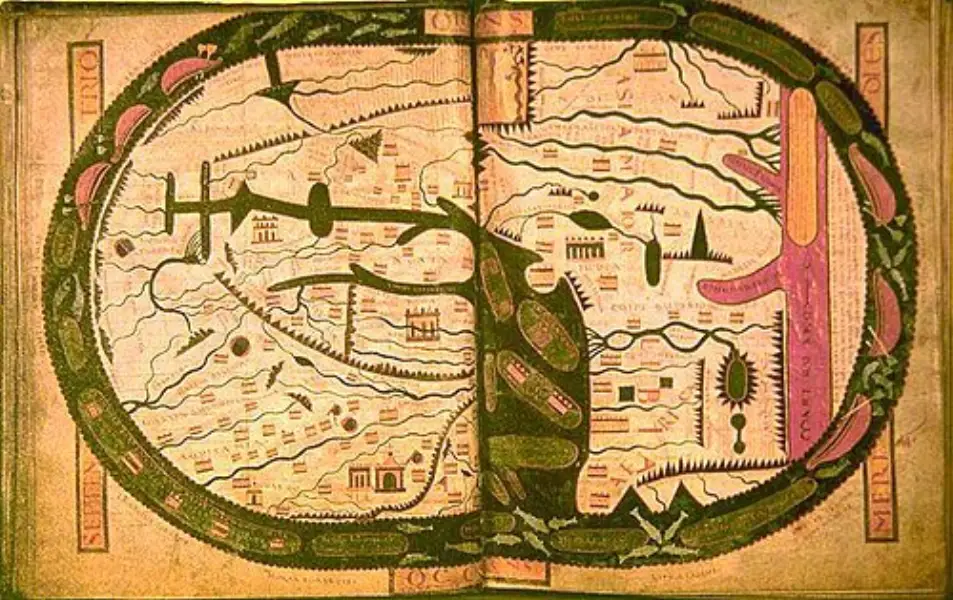
For Beatus, engagement with sacred books was not a scholarly pastime but a liturgical act. He regarded the reading of the sacred book as itself the body, so that whoever reads it is made one with Christ — an understanding of study as a form of communion, in which the written word functions like the eucharistic one. This conviction explains the peculiar character of his great work. Strangest of all for a work of theology, the evidence suggests illustration was in his plan from the beginning: the original drawings are credited to him, perhaps even their first execution, though they are lost. The most striking fruit of that vision is the world map placed in the second book of the Commentary, a document of special interest to historians of cartography. Where the ordinary medieval map stopped at Europe, Asia, and Africa, his added a fourth, unknown land besides. Its original purpose was evangelical: it pictured the apostles at work in every quarter of the globe, that fourth land included, a cartographic sermon on the universality of the Gospel before the end times. The original map is lost, but several copies survive, all oriented to the east and all showing paradise with four rivers flowing from it. In Beatus's imagination, Scripture, image, and geography served a single end — the contemplation of Christ's victory — and the reader who opened his Commentary was invited not merely to learn about the Apocalypse but to be drawn into it.
§ Beatus map
The Beatus Manuscripts: Medieval Spain's Apocalypse in Color
The Commentary on the Apocalypse, written in 776 and revised in 784 and again in 786, is a work of erudition rather than of great originality, assembled principally from extracts of the authorities — Augustine, Tyconius, Ambrose, Irenaeus, and Isidore among them. He leaned most heavily on the lost commentary of Tyconius, which supplied much of his text, and later versions of the work added Jerome's commentary on the Book of Daniel along with other material. Yet this unassuming compilation became one of the most influential books of the Iberian Middle Ages, popular throughout the peninsula up to about the thirteenth century. It survives in at least thirty-two manuscripts from the ninth through the thirteenth centuries, conventionally known simply as 'a Beatus'; no contemporary copy of the work remains, some manuscripts exist only in fragments, and twenty-six of them are lavishly decorated, recognized as among the finest examples of Mozarabic illumination. Masterpieces such as the Morgan Beatus and the Saint-Sever Beatus — the latter painted around 1050 at the Abbey of Saint-Sever in Aquitaine — preserve the spectacular miniature cycles of monstrous cavalry, lion-headed fire-breathing horses, and visionary beasts that made the Apocalypse visible to medieval readers. Beatus also left an enduring doctrinal mark on Spain: it appears to have been he who established in the Spanish mind the conviction that it was the Apostle James who evangelized Iberia — the belief that would one day draw pilgrims to Santiago de Compostela.
§ Apocalypse commentary
Timeline
- 730
Born around this year, likely one of the monastic refugees who moved north after Iberia fell to Muslim armies.
§ Introduction
- 776
Composed the first version of his Commentary on the Apocalypse, a compendium chiefly drawing on Tyconius and other Church authorities.
§ Apocalypse commentary
- 784
Issued a revised edition of the Commentary on the Apocalypse.
§ Apocalypse commentary
- 785
Was present when Queen Adosinda, wife of Silo, took her vows as a nun — the latest surviving record of his life.
§ Introduction
- 786
Produced a second revision of the Commentary; later versions appended Jerome's commentary on Daniel.
§ Apocalypse commentary
- 794
Elipandus of Toledo branded him a pseudo-prophet in a letter to Gaul's bishops; that year Charlemagne's Council of Frankfurt condemned adoptionism.
§ Adoptionism controversy
- 798
Pope Leo III confirmed the judgment treating adoptionism as heresy.
§ Adoptionism controversy
The Record
- Major works
- Commentary on the Apocalypse (776, revised 784 and 786)·The Beatus world map (second book of the Commentary)
- Symbols
- Illustrated Apocalypse manuscripts (the 'Beatus' codices)·World map with a fourth continent and paradise at the east
- Canonization
- Pre-congregation; venerated in the Catholic Church and the Eastern Orthodox Church
Prayer
Bibliography
Show 7 sources
- Beazley, Charles Raymond (1911). 'Beatus.' Encyclopædia Britannica, 11th ed., Vol. 3, p. 584.
- Cavadini, John C. (1993). The Last Christology of the West: Adoptionism in Spain and in Gaul 785–817. Philadelphia: University of Pennsylvania Press.
- Collins, Roger (2000). The Arab Conquest of Spain: 710–797. Oxford: Blackwell.
- Williams, John (1992). 'Purpose and Imagery in the Apocalypse Commentary of Beatus of Liébana.' In The Apocalypse in the Middle Ages, ed. Richard Kenneth Emmerson. Ithaca: Cornell University Press.
- Wolf, Kenneth B. (2003). 'Beatus of Liébana.' In Medieval Iberia: An Encyclopedia, ed. E. Michael Gerli. New York: Routledge.
- Woodward, David (1987). 'Medieval Mappaemundi.' In Cartography in Prehistoric, Ancient and Medieval Europe and the Mediterranean. Chicago: University of Chicago Press.
- Piera, Montserrat (2010). 'Beatus of Liébana (d. 798).' The Oxford Dictionary of the Middle Ages. Oxford University Press.
Profile text adapted from the Wikipedia article, licensed CC BY-SA 4.0.
Pray with this saint every day
Save St. Beatus of Liébana to your favorites, read the full profile, and get feast-day reminders in the Saints app.
Get the Saints AppFree on the App Store for iPhone and iPad