
died c. 112·Feast May 9
St. Beatus of Lungern
Hermit of the Dragon Cave above Lake Thun
Overview
Beatus of Lungern, also called Beatus of Beatenberg or Beatus of Thun, is venerated as an early Christian monk and hermit and remembered in tradition as the first apostle of Switzerland. One legend makes him the son of a king of the Scots, though rival traditions put his birth in Ireland. He was a convert, said to have been baptized in England by Saint Barnabas, then, it is said, was raised to the priesthood at Rome by Saint Peter himself. Sent out from Rome with a companion named Achates to bring the Gospel to the Helvetii, the pair pitched their camp in Argovia near the Jura and won many of the local people to the faith. Beatus next went southward into the heights over Lake Thun and settled as a hermit in the caves above the present village of Beatenberg — a site that now bears his name — where, tradition states, he fought and defeated a dragon. His grave lies between the monastery and the cave entrance, and he is said to have died at an advanced age in the year 112. Modern historians caution that his story has probably been woven together with other holy men of the same name — Beatus of Vendôme above all, and an Abbot Beatus chartered by Charlemagne in 810, and that the earliest accounts of his life date only from the tenth and eleventh centuries. His cult nonetheless survived the Reformation, and his mountain remains a place of pilgrimage.
The Complete Life
A King's Son from the Celtic World
The story of Beatus of Lungern begins across the sea from the Alps, in the Celtic lands of the early Church. One strand of the legend gives him a Scottish king for a father, while another points instead to Ireland; the divergence itself reflects how ancient and how uncertain the memory of his origin is. What the accounts agree upon is that he was a convert to the Christian faith, and that his baptism came in England at the hands of Saint Barnabas, the apostolic companion of Paul. The claim is chronologically daring, for it places Beatus within reach of the apostolic generation, and it sets the pattern for a legend that repeatedly joins the hermit of the Alps to the greatest figures of the first Christian century. That pattern culminates in the tradition that he was ordained a priest in Rome by Saint Peter the Apostle himself, receiving his mission directly from the chief of the apostles. Whether any of this can stand as history is doubtful: the earliest written accounts of his life date from no earlier than the tenth and mid-eleventh centuries and have never been historically authenticated, and his story has likely been woven together with other saints who bore the same name. Yet the legend preserves a truth of a different order. Someone brought the faith into the mountains above Lake Thun, and the Church there remembered him as a royal son of the islands who traded a crown for a cave, a memory the people of Beatenberg have never surrendered.
§ Life
Sent to the Helvetii with Achates
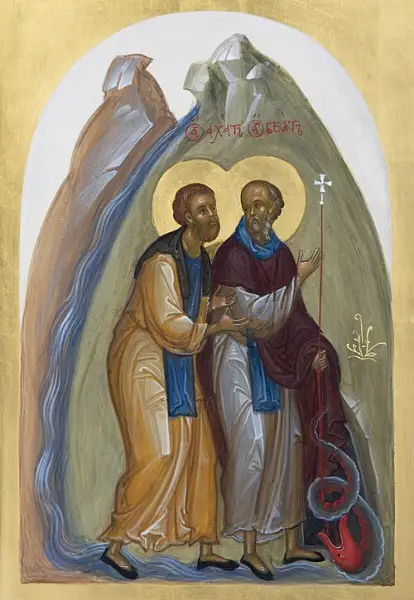
According to the legend, Beatus did not remain in Rome after his ordination. He went out in the company of a fellow missionary, Achates, to bring the faith to the Helvetii, the ancient people whose name still lives in the Latin word for Switzerland, Helvetica. It is a striking commission: two men dispatched into the mountainous country between the Jura and the Alps, carrying a new faith into villages that had known the gods of Rome and, before them, older powers altogether. The missionaries pitched their camp in Argovia, hard by the Jura range, in the northern reaches of the territory, and there they worked with such effect that many of the locals were converted. Achates is remembered alongside Beatus in devotion — the two appear together in icons, and Saint Achatus of Thun is honored as his fellow laborer — which suggests that the tradition preserved the essentially shared, communal character of the mission rather than crediting a lone hero. From these beginnings in Argovia the faith is said to have taken root among the Helvetii, earning Beatus the traditional title of apostle of Switzerland. The claim is contested by historians, who point out that Saint Gall probably more justly deserves that honor, but the title reflects the conviction that Beatus's preaching was the first planting of Christianity in that corner of the Alps. The mission ended not in a bishop's chair but in withdrawal: having preached, Beatus turned south and upward, toward solitude above the waters of Lake Thun.
§ Life
The Cave, the Dragon, and a Grave Above the Lake
The last chapter of Beatus's life unfolds in the mountains above Lake Thun, in the limestone caverns that now bear his name as the Saint Beatus Caves, near the village of Beatenberg. There he took up a hermitage, and there tradition locates his most famous exploit: the cave, it is stated, is where he fought a dragon. The motif belongs to a family of legends in which holy men confront the powers of the old world made flesh, and whatever its origin, it fixed itself indelibly upon the place and upon the arms of the community of Beatenberg, whose coat of arms depicts the saint's battle with the beast. Beatus probably occupied the cave not in the second century but in the ninth, a sobering correction that does not diminish the hold of the story on the landscape. He lived and died as a hermit, and he is said to have died at an old age in the year 112, concluding a life that legend stretched across the whole apostolic era. His grave lies between the monastery and the cave entrance, a site deliberately placed on the threshold between the human institution and the wild solitude he chose, so that pilgrims coming to pray pass between the two halves of his life. Art shows him either as an aged reader within his mountain grotto or as a monk locked in combat with the dragon — images that hold together the scholar, the solitary, and the spiritual warrior that tradition made of him.
§ Life
Pilgrims, Protestants, and the Mountain That Bears His Name
The afterlife of Beatus of Lungern has been shaped by the geography of Swiss religious history. Augustinian canons settled a monastery near the mouth of the Saint Beatus Caves, anchoring devotion to the hermit at the site of his dwelling, and his cultus was widespread throughout the Middle Ages. The Reformation tested it severely: pilgrims making their way to the cave were driven back at spear-point by Zwinglian Protestants, and the site fell into a long period of turmoil. After that upheaval, Beatus's relics and the heart of his cult were carried to the chapel at Lungern in Obwalden, in the Catholic heartland of the Alps — a migration that gave the saint the form of his name by which he is chiefly known today. The mountain where he lived until his death still bears his name, Beatenberg, and it remains a place of pilgrimage. In the modern era the site has taken on a second, more worldly fame: roughly a kilometer of the caverns has been opened, lit, and made ready for visitors, and the monastery grounds now house a restaurant and gift shop, so that crowds again climb toward the hermit's cave, much as the medieval pilgrims did. In the Eastern Orthodox tradition Beatus is honored as a venerable hermit and is depicted in icons alongside Saint Achatus of Thun, and in the Roman Catholic Church his feast is kept on May 9, the apostle of Switzerland whose history is debated but whose mountain is not.
§ Veneration
Timeline
- 112
Died at an advanced age at his hermitage above Lake Thun, as the legend recounts.
§ Life
- 810
An Abbot Beatus received a charter from Charlemagne confirming Irish monks would run Honau Abbey; scholars suggest conflation with him.
§ Introduction
- 850
The cave hermitage above Lake Thun probably belongs to the ninth century rather than to the era the legend implies.
§ Life
- 1000
Earliest written accounts of his life, none earlier than the tenth and mid-eleventh centuries, survive unauthenticated.
§ Historicity
- 1530
Reformation-era Zwinglian Protestants expelled pilgrims from his cave; afterwards his relics were moved to the chapel at Lungern.
§ Veneration
The Record
- Patron of
- Honored as the first apostle of Switzerland (by tradition)·Patron of Beatenberg
- Symbols
- An old man reading in a mountain cave·A monk fighting a dragon
- Canonization
- Pre-congregation; venerated in the Roman Catholic and Eastern Orthodox churches
Prayer
Bibliography
Show 4 sources
- Rabenstein, Katherine (August 1999). 'Beatus of Beatenberg (RM).' Saints O' the Day for July 16.
- Jones, Terry. 'Beatus of Lungern.' Patron Saints Index.
- Lopez-Ginistry, Claude. 'Saint Beatus.' Orthodoxy's Western Heritage — Mission in the Alps. Orthodox America.
- 'Unique caving experience on Lake Thun.' www.beatushoehlen.swiss.
Profile text adapted from the Wikipedia article, licensed CC BY-SA 4.0.
Pray with this saint every day
Save St. Beatus of Lungern to your favorites, read the full profile, and get feast-day reminders in the Saints app.
Get the Saints AppFree on the App Store for iPhone and iPad