
8th century·Feast September 9
St. Beccel
Hermit of Crowland and disciple of Guthlac
Overview
Beccel, also known as Bettelin of Crowland, was an eighth-century hermit and saint of the Fenland monastery of Crowland, then part of the Mercian kingdom, and a follower of Guthlac. Drawn by reports of Guthlac's holiness, he traveled to Crowland to be taught by him and remained in his service for fifteen years, until the master's death in 714. His discipleship was not untroubled: early in his training he suffered an affliction of murderous thoughts against Guthlac and struggled to master them, a trial recorded in the sources on Guthlac's life. When Guthlac lay dying, Beccel received his last counsel, and together with Pega, the saint's sister, he oversaw the burial. The scene is preserved in the Old English poem on Guthlac, in Felix's Latin life of the saint, and, more briefly, in the Anglo-Saxon Chronicle. Tradition adds a striking earlier chapter: a nobleman married to an Irish princess, driven to the religious life by tragedy in a forest, and some speculate he had been a king before becoming a hermit. His relics were carried to Staffordshire for safekeeping before the Vikings destroyed Crowland.
The Complete Life
The Lord of the Forest Tragedy
Before he was a hermit, the tradition preserves an earlier and darker story. Beccel, then called Bettelin, was a nobleman, and he had married an Irish princess. The two were traveling together through a forest when his wife went into labor. He left her to seek help, but found none, and when he returned to the place he had left them, both his wife and her newborn child had been killed and eaten by wolves. The catastrophe stripped his life of its whole arrangement at a stroke: rank, marriage, and future all became meaningless in the space of a single absence. His answer was to leave the world. He became a religious, and the path by which he did so led him to the most famous holy man of the Mercian fens. Medieval hagiography loves such turning points, and some scholars doubt the details of this one; there is even speculation, recorded in the sources on his life, that Beccel may have been a king who laid down his crown rather than merely a lord who laid down his estate. What is certain is that by the early eighth century he had abandoned everything and attached himself to Guthlac of Crowland.
§ Biography
Fifteen Years with Guthlac
Beccel came to Crowland because of stories. Reports of Guthlac's holiness had spread through Mercia, and impressed by them, he traveled to the island hermitage in the fens to put himself under the saint's instruction. There he remained for fifteen years, serving the man he had chosen as master, until Guthlac's death in 714. The sources are candid that the schooling was not serene. Early in his training he suffered an onset of thoughts of violence against Guthlac, and he fought to master them. The confession is remarkable: hagiography usually flatters its subjects, but the account of Guthlac's circle preserved this blot and this battle, and preserved them, it seems, because the struggle itself was the point. A disciple who had never been tempted would teach future monks little; a disciple who had wanted his master dead and had refused the desire taught them everything about the discipline of the heart. Fifteen years of such combat, carried on in the wet solitude of the fens under the eye of a renowned ascetic, formed the hermit whom the churches would later honor. Whatever dreams of solitude had brought him there, his vocation proved to be service.
§ Biography
The Deathwatch and the Burial
In 714 the long discipleship reached its end. Guthlac was dying, and Beccel took his master's final advice at the bedside, receiving from the dying saint the counsel that concluded their years together. With Pega, Guthlac's sister and herself a figure of the Fenland saints, he oversaw the burial. The event secured an unusual literary afterlife: it is recorded in the second of the Old English poems on Guthlac, in Felix's Latin Life of Saint Guthlac, and to a lesser extent in the Anglo-Saxon Chronicle and the fifteenth-century Historia Croylandensis. Felix adds a detail of great tenderness: Beccel beheld lights in the darkness on the eve of Guthlac's death, and once more as the saint passed, the darkness of the fens broken twice by a brightness that marked the coming and the going of a soul. For a disciple whose training had included the torment of violent thoughts against this same master, the light at the deathbed must have read as vindication, both of Guthlac and of the fifteen years of service given him. Beccel's own death is not recorded; he passes out of the sources as he entered them, in the shadow of a greater name.
§ Biography
Relics, Feast, and a Case of Mistaken Identity
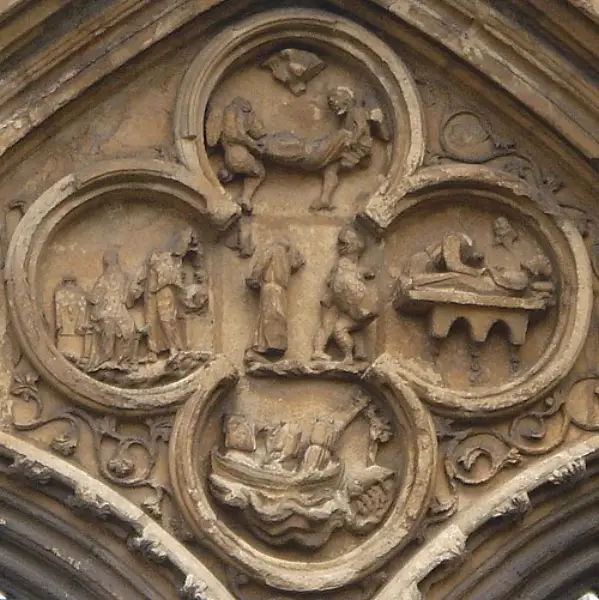
Beccel's cult survived the destruction of the community that had formed him. His relics were carried out of the fens to Staffordshire before Viking raiders destroyed Crowland Abbey, a rescue that kept his memory alive in the west Midlands while the Fenland house passed through fire. The Roman and Eastern Orthodox churches commemorate him on 9 September, and a quatrefoil scene from Crowland Abbey keeps his image among the saints of the house. His afterlife in the sources, however, is tangled with another man's. He is sometimes confused with Bettelin of Stafford, a confusion invited by the common name and by the relics' journey into Staffordshire, and modern readers of the Guthlac materials must sort the two figures apart. The speculation that he had been a king, and the forest tragedy that was told to explain his entry into religion, belong to the same widening circle of story: a disciple known chiefly as Guthlac's servant attracted, over time, a biography of his own. It is a familiar shape in English hagiology, where the companion of a great saint becomes the center of a lesser but stubborn devotion, kept alive by a feast day and by bones carried out of the reach of raiders.
§ Veneration
The Record
- Canonization
- Pre-congregation; venerated by the Roman Catholic and Eastern Orthodox churches on 9 September.
Prayer
Bibliography
Show 5 sources
- Felix. Vita Guthlaci, chaps. 35 and 50.
- Colgrave, Bertram, ed. and trans. Felix's Life of Saint Guthlac. Cambridge: Cambridge University Press, 1985.
- Floyd, J. Arthur. "A Fenland Hermit." The Messenger of the Sacred Heart, vol. 36, Apostleship of Prayer, 1901, p. 435.
- Hutchison-Hall, John Ellsworth. Orthodox Saints of the British Isles: Volume III, July-September. St. Eadfrith Press, 2014.
- Olsen, Alexandra. "Saint Pega and Saint Guthlac, Hermits."
Profile text adapted from the Wikipedia article, licensed CC BY-SA 4.0.
Pray with this saint every day
Save St. Beccel to your favorites, read the full profile, and get feast-day reminders in the Saints app.
Get the Saints AppFree on the App Store for iPhone and iPad