
672/3 – 735·Feast May 25
St. Bede the Venerable
Doctor of the Church and Father of English History
Overview
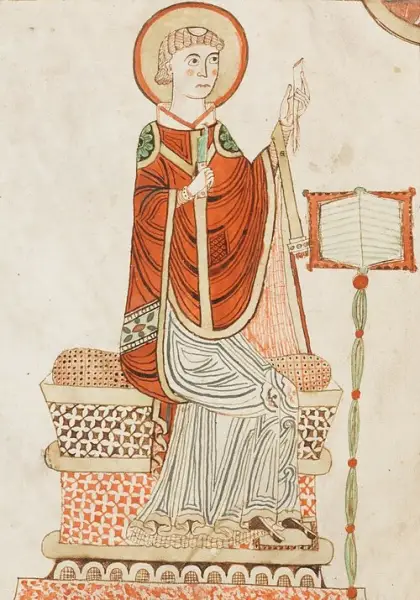
Bede, a Northumbrian Benedictine monk of the twin monastery of Monkwearmouth–Jarrow, was the outstanding scholar of the early Middle Ages in Britain and the first native of Great Britain to be named a Doctor of the Church. Born in 672 or 673 on lands belonging to the monasteries, he was entrusted to Monkwearmouth at the age of seven as an oblate, educated by Benedict Biscop and then by Ceolfrith, whom he probably followed to Jarrow in 682. Both survived the plague of 686 that killed most of the community. Ordained deacon at about nineteen — well below the canonical age, a sign of exceptional ability — and priest at thirty by Bishop John of Hexham, Bede spent his life in a round of prayer, monastic discipline and the study of Scripture, completing more than sixty books. His learning embraced the Latin and Greek Fathers, computus, metrics, natural science, and poetry in Latin and English. His masterpiece, the Historia Ecclesiastica Gentis Anglorum, finished around 731, earned him the lasting title of father of English history, and his adoption and promulgation of the Anno Domini dating of Dionysius Exiguus is the reason it is now universal. He died at Jarrow on 26 May 735, dictating a translation of the Gospel of John to the last. Venerated from the ninth century as 'Venerable', he was translated to Durham Cathedral, canonised and declared a Doctor in 1899 by Leo XIII, and is the patron of English writers and historians.
The Complete Life
An Oblate of Monkwearmouth–Jarrow
Almost everything known of Bede's life comes from the last chapter of his own Ecclesiastical History, completed around 731, in which he lets it be known that his fifty-ninth year had arrived, pointing to a birth in 672 or 673; a supplementary source is the letter of his disciple Cuthbert describing his death. He was born, in his own words, on the lands of his monastery, the twin houses of Monkwearmouth and Jarrow in what is now Tyne and Wear, and a later tradition points to Monkton, two miles from the Jarrow site. He says nothing of his family, but the noble company he kept points to a house of some substance, and the appearance of his name in a Lindsey king-list has been taken as a further hint of gentle birth. At the age of seven he was sent by his family as a child oblate to Monkwearmouth, to be educated by Benedict Biscop and afterwards by Ceolfrith, in a practice then common in Ireland and probably among the Germanic peoples of Britain. When Ceolfrith founded the sister monastery at Jarrow in 682, Bede most likely moved there with him. The dedication stone of the Jarrow church, dated 23 April 685, survived into modern times, and since boys were expected to help with menial tasks, it is possible the young Bede lent a hand in building it. In 686 plague broke out and killed most of the community; the Life of Ceolfrith records that only two survivors could sing the full office, the abbot himself and a young boy, almost certainly the fourteen-year-old Bede, and the two kept the entire round of prayer going alone until others could be trained.
§ Childhood
Deacon at Nineteen, Priest at Thirty
Bede's progress through holy orders was precocious. In about 692, in his nineteenth year, he received the diaconate from John, his diocesan bishop at Hexham, although the canonical minimum age for the diaconate was twenty-five; his early ordination may mean his abilities were judged exceptional, though it is also possible that the rule was frequently ignored. Whether he held any minor orders below the diaconate is unrecorded. A decade later, in his thirtieth year around 702, he was advanced to the priesthood, again by Bishop John. Around this same period, in about 701, he produced his first works, De Arte Metrica and De Schematibus et Tropis, both written for the classroom — the earliest evidence of a teaching vocation that would occupy him for life. From this point his life outwardly changed little: save for occasional journeys to abbeys elsewhere, to York's archbishop, and to King Ceolwulf of Northumbria, his days ran in the monastic rhythm of prayer, rule, and scriptural study, and contemporaries judged him the most learned man of his age. Inwardly, however, that hidden life produced a stream of more than sixty books. When about eighteen he had probably met Adomnán, abbot of Iona, during the latter's visit to Monkwearmouth and Jarrow, an encounter that may have first awakened his lifelong interest in the Easter dating question, the controversy that would run through so much of his writing.
§ Youth
Making a Nation's Church Legible: The Ecclesiastical History
Bede's masterwork, the Historia Ecclesiastica Gentis Anglorum, completed around 731 with the aid of Albinus, abbot of St Augustine's Canterbury, was designed with a deliberate purpose: to show the growth of one united church throughout England. Its five books open with geography and Roman Britain, take in the mission of Augustine in 597, trace the disastrous setback when the pagan Penda killed the Christian king Edwin, and follow the recovery of the faith in Northumbria under Oswald and Oswy to the climax of the Council of Whitby, before closing with mission in Frisia and the long Easter dispute. He dedicated the work to King Ceolwulf, who had requested and read an earlier draft, a correspondence showing the monastery's ties to the Northumbrian nobility. Bede also meant his pages to teach through spiritual example and to give honest delight, and he included miracles because, following Gregory the Great, he believed faith awakened by wonders was a stepping stone toward a higher faith. His method was critical for its age: he named his informants, acknowledged correspondents such as Nothhelm and Daniel of Winchester, quoted sources at length, and added a brief autobiographical note in imitation of Gregory of Tours. He also helped popularise dating forward from the birth of Christ, adopting in his chronology the Anno Domini system of Dionysius Exiguus, an innovation first given wide currency through his work. Modern historians have not been uncritical — his Northumbrian patriotism, his reticence about Wilfrid, and his harshness toward the native British church are all noted — yet Stenton judged him to have reached, in an age of mere registration of fact, the very conception of history.
§ Intent
A Monk Between Altar and Scriptorium
The spirituality that animated Bede's enormous output was monastic, patristic, and exegetical. In his own day he was as famous for his biblical commentaries as for his history — the theological books won him the name of Doctor Anglorum and, in the end, his canonization. He began with the scriptural books the fathers before him had left least examined, including the Gospels of Mark and Luke, Revelation, the Catholic Epistles and Acts, and then turned to Genesis, Samuel, Ezra and Nehemiah, the tabernacle and the temple, Tobit, Proverbs, the Song of Songs, and Habakkuk, works especially shaped by Gregory the Great, along with homilies on the Gospels for the great seasons of the liturgical year. His exegesis employed the allegorical method, reading Scripture for its spiritual senses, and modern study has shown how central such reading was to the whole world-view of early medieval scholars. His own words show that he understood his task as opening the doctrine of the fathers to his pupils and readers; he learned Greek, attempted Hebrew, and studied Jerome's Vulgate alongside the Latin and Greek Fathers, being the first to speak of Jerome, Augustine, Gregory and Ambrose as the four Latin Fathers. A prayerful discipline underlay all of it. He enjoyed music and was accomplished as a singer and reciter of vernacular poetry, and his fame reached Notker of St Gall, who marveled that God, having raised the sun in the east on the fourth day, raised up Bede in the west in the world's sixth age like another sun to light the whole earth.
§ Theological works
Dying with the Gospel on His Lips
Bede's last years were busy ones, undertaken against declining health. In 735 the see of York was elevated to an archbishopric, and Bede travelled to York that year to visit Ecgbert, his former pupil, now bishop there, very likely discussing the proposal for the elevation; he had hoped to visit again in 734 but had been too ill to make the journey. He had also travelled to Lindisfarne, and called at the monastery — otherwise unknown to us — of a monk called Wicthed, and his wide correspondence implies other journeys now untraceable. He never saw Rome, as his autobiographical chapter makes clear. His final labor was a translation of the Gospel of John into English, on which he worked for the last forty days of his life. The letter of his disciple Cuthbert preserves the close of that life. Bede fell ill before Easter, his breathing failing in repeated bouts though with scarcely any pain; in his final days it worsened and his feet swelled, yet he continued to dictate, spending one night awake in prayer and dictating again the next day. On the Wednesday, at three o'clock, he had a box brought and handed round to the priests of the house the little hoard it held: pepper, napkins, and incense. That night he dictated his last sentence to a boy named Wilberht, and died soon after, on 26 May 735, the Feast of the Ascension, by the day-reckoning of his time. Cuthbert's letter further preserves the vernacular verses called Bede's Death Song, a five-line piece that became the most copied surviving work of Old Northumbrian verse.
§ Final years
From Venerable to Doctor of the Church
No cult is attested in eighth-century Northumbria, perhaps because Bede died on the feast of Augustine of Canterbury, but veneration grew powerfully thereafter, chiefly through Boniface and Alcuin, who promoted it on the continent — Boniface repeatedly wrote back to Northumbria asking for copies of Bede's works, and Alcuin, taught at the York school founded by Bede's pupil Ecgbert, praised him as a model for monks and circulated his writings widely. At home the cult flourished in the tenth-century monastic revival and by the fourteenth century had reached many of England's cathedrals; Wulfstan, Bishop of Worcester, dedicated a church to him in 1062 as his first act after consecration. Toward 1020 his remains were carried from Jarrow into Durham Cathedral to rest in Saint Cuthbert's tomb, and in 1370 they were translated again to a shrine in the Galilee Chapel; the Reformation swept that shrine away, though the bones stayed in the chapel, were lifted again in 1831 and laid in the tomb that holds them now. Other relics were claimed by York, Glastonbury and Fulda. The epithet 'Venerable', attached to his name by the ninth century and the subject of a charming legend of an angel completing his unfinished epitaph, became commonplace by the eleventh and twelfth centuries. In 1899 the Vatican formally recognized his scholarship and sanctity: Leo XIII inscribed him among the saints and proclaimed him a Doctor of the Church, the first native of Great Britain so honored, and the only Englishman among the Doctors until John Henry Newman in 2025. His feast entered the General Roman Calendar on 27 May, kept by the Orthodox on the same day and by Anglicans and Episcopalians on 25 May.
§ Veneration
The Historian Who Taught Europe to Date
Bede's posthumous reputation has never declined. Thomas Carlyle ranked him above every historian since Herodotus, Walter Goffart grants him a privileged and unrivalled place among the first historians of Christian Europe, and around 160 medieval manuscripts of the Historia survive, with the work first printed between 1474 and 1482, probably at Strasbourg. Medieval writers from the Anglo-Saxon Chronicle to William of Malmesbury, Henry of Huntingdon and Geoffrey of Monmouth built upon him, and both Protestant and Catholic controversialists drew on his works in the wars of religion. His non-historical writings on grammar, chronology and the Bible fed directly into the Carolingian Renaissance: his homilies were collected by Paul the Deacon for the monastic office and used by Boniface in his missions, and several commentaries entered the Glossa Ordinaria. His scientific reach was equally durable — On the Reckoning of Time expounded the spherical earth, the causes of the varying length of daylight, and the relation of the tides to the moon, and his Easter table extended that of Dionysius Exiguus while carrying the Anno Domini count into general use. He is the only Englishman to appear in Dante's Paradise, named among the theologians in the same canto as Isidore of Seville. Today he is patron of Beda College in Rome, which prepares older men for the priesthood; the annual Jarrow Lecture has been held at St Paul's Church, Jarrow since 1958; Jarrow Hall museum occupies the site where he lived; and a Tyne and Wear Metro station bears his name.
§ Modern legacy
Timeline
- 673
Born on the Northumbrian estates of the double monastery of Monkwearmouth–Jarrow, probably into a family of means.
§ Childhood
- 682
The sister monastery of Jarrow was founded by Ceolfrith, and Bede probably transferred there with him.
§ Boyhood
- 23 Apr 685
The dedication stone of the new Jarrow church carries this date; Bede likely helped with menial work on the building.
§ Boyhood
- 686
Plague struck Jarrow; Bede, then about fourteen, and Ceolfrith were the only two able to sing the full office.
§ Boyhood
- 692
Ordained a deacon at about nineteen by Bishop John of Hexham, below the canonical age of twenty-five.
§ Youth
- 701
Wrote his first works, De Arte Metrica and De Schematibus et Tropis, for classroom use.
§ Adulthood
- 702
Became a priest in his thirtieth year, again ordained by Bishop John.
§ Adulthood
- 703
Composed De Temporibus, his first introduction to the principles of Easter computus and a chronology of the world.
§ Historical and astronomical chronology
- 708
Monks at Hexham accused him of heresy over his calculation of the age of the world; he defended himself in a letter.
§ Adulthood
- 723
Finished On the Reckoning of Time, a longer computus treatise that proved influential across the Middle Ages.
§ Historical and astronomical chronology
- 725
Wrote the Greater Chronicle as a chapter of On the Reckoning of Time, which circulated as a separate work.
§ Chronicles
- 731
Completed the Historia Ecclesiastica Gentis Anglorum, dedicated to King Ceolwulf of Northumbria.
§ Historia ecclesiastica gentis Anglorum
- 734
Wrote his last surviving work, a letter to his former student Ecgbert of York, being too ill to visit him.
§ Adulthood
- 26 May 735
Died at Jarrow on the Feast of the Ascension after dictating his English translation of John's Gospel, and was buried there.
§ Final years
- 1020
His remains were carried from Jarrow to Durham Cathedral to share the tomb of St Cuthbert.
§ Veneration
- 1370
A shrine in Durham's Galilee Chapel received his remains; the Reformation later swept it away.
§ Veneration
- 1831
His bones were lifted from the chapel floor and reinterred in a new Durham tomb, still in place today.
§ Veneration
- 1899
Leo XIII enrolled Bede among the saints and named him a Doctor of the Church — the first native of Great Britain so honored.
§ Veneration
In Their Own Words
All is finished.
Facing that enforced journey, no man can be more prudent than he has good call to be, if he consider, before his going hence, what for his spirit of good hap or of evil after his day of death shall be determined.
It is very seldom that we have to pause to think of the meaning of a sentence.
The first and greatest of England's historians.
The greatest historical writer since Herodotus.
Should history tell of good men and their good estate, the thoughtful listener is spurred on to imitate the good; should it record the evils ends of wicked men, no less effectually the devout and earnest listener or reader is kindled to eschew what is harmful and perverse, and himself with greater care pursue those things which he has learned to be good and pleasing in the sight of God.
It is told that there was then such perfect peace in Britain, wheresoever the dominion of King Edwin extended, that, as is still proverbially said, a woman with her new-born babe might walk throughout the island, from sea to sea, without receiving any harm.
The Record
- Major works
- Historia Ecclesiastica Gentis Anglorum (Ecclesiastical History of the English People)·De Temporibus and De Temporum Ratione (On Time / On the Reckoning of Time)·De Natura Rerum (On the Nature of Things)·De Arte Metrica and De Schematibus et Tropis (schoolroom works on metre and biblical rhetoric)·Biblical commentaries on Genesis, Samuel, Ezra-Nehemiah, Tobit, Proverbs, Song of Songs, the Gospels, Acts, the Catholic Epistles and Revelation·Homilies on the Gospels·Verse and prose Lives of St Cuthbert·Lives of the Abbots of Wearmouth and Jarrow·Martyrology·Bede's Death Song (Old English, attributed)
- Patron of
- Patron of English writers and historians·Patron of Jarrow, Tyne and Wear·Patron of Beda College, Rome, San Beda University, and San Beda College Alabang
- Symbols
- Holding the Historia Ecclesiastica Gentis Anglorum·A quill·A biretta
- Canonization
- Canonised and declared a Doctor of the Church in 1899 by Pope Leo XIII, Rome
Prayer
Bibliography
Show 12 sources
- Colgrave, Bertram; Mynors, R.A.B., eds. (1969). Bede's Ecclesiastical History of the English People. Oxford: Clarendon Press.
- Plummer, C., ed. (1896). Venerabilis Baedae Opera Historica, 2 vols.
- Bede (2004). Bede: The Reckoning of Time. Translated by Faith Wallis. Liverpool: Liverpool University Press.
- Blair, Peter Hunter (1990). The World of Bede. Cambridge: Cambridge University Press.
- Brown, George Hardin (1987). Bede, the Venerable. Boston: Twayne.
- Campbell, J. (2004). 'Bede (673/4–735).' Oxford Dictionary of National Biography. Oxford University Press.
- Farmer, David Hugh (1978). The Oxford Dictionary of Saints. Oxford: Oxford University Press.
- Goffart, Walter A. (1988). The Narrators of Barbarian History (A.D. 550–800). Princeton: Princeton University Press.
- Higham, N.J. (2006). (Re-)Reading Bede: The Historia Ecclesiastica in Context. Routledge.
- Stenton, F.M. (1971). Anglo-Saxon England, 3rd ed. Oxford: Oxford University Press.
- Ward, Benedicta (1990). The Venerable Bede. Harrisburg, PA: Morehouse Publishing.
- Wallace-Hadrill, J.M. (1988). Bede's Ecclesiastical History of the English People: A Historical Commentary. Oxford: Clarendon Press.
Profile text adapted from the Wikipedia article, licensed CC BY-SA 4.0.
Pray with this saint every day
Save St. Bede the Venerable to your favorites, read the full profile, and get feast-day reminders in the Saints app.
Get the Saints AppFree on the App Store for iPhone and iPad