
fl. c. 850·Feast October 31
St. Bega
Irish princess and anchoress of St Bees
Overview
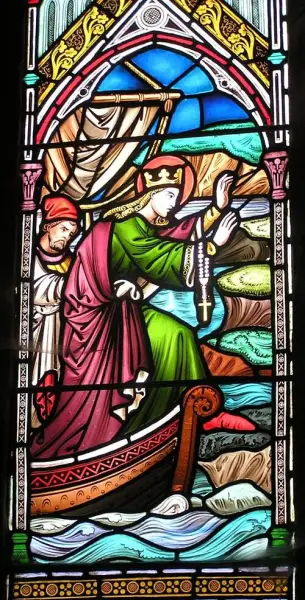
Bega belongs to the company of Northumbria's medieval saints: an Irish-born figure whose cult centered on the Cumbrian coast at the town that still bears her name, St Bees. According to her Life, a thirteenth-century collection of saints' lives that belonged to Holmcultram Abbey, she was an Irish princess promised in marriage to a Viking prince, the son of the king of Norway, who valued her virginity too highly to accept the match. She fled across the Irish Sea, landed on the Cumbrian coast, and raised for her use a virgin's cell in a woodland grove beside the water, dwelling there for years in strict seclusion until pirates pushed her onward to Northumbria, where she received sacred vows. Her emblem was a bracelet, said to have been given her in Ireland by a heavenly being and left behind at St Bees, where it worked wonders for centuries. Nine miracles are recorded in her Life, the most famous being the snow miracle, in which a boundary dispute was settled when snow covered every field except the priory's lands. Modern scholarship suspects she never existed as a historical person, but her cult, her bracelet, and her feast at St Bees endured from the Anglo-Saxon church into modern times.
The Complete Life
A Princess of Ireland
The Life of St Bega opens in Ireland, where its heroine is introduced as a princess of the early medieval kingdom, a woman of rank whose hand was worth a treaty. The match proposed for her was royal in its own right: her suitor was a Viking prince, described in the manuscript as the son of the king of Norway, one of the Northmen who were settling and raiding across the Irish Sea in the ninth century. Bega, however, had already set her heart elsewhere. The Life emphasizes that she prized her virginity, and the prospect of a political marriage to a heathen warlord was, for her, not an honor but a siege. Her family's intentions, whatever they were, could not outweigh a resolve that the text presents as divinely favored. The most likely setting for these events, historians of the legend note, would be after the middle of the ninth century, when Viking power in Ireland made such alliances and such flights plausible. The princess who appears at the opening of her story, cornered by an arrangement she cannot accept, becomes in the next scene a fugitive on the water; the Life wastes no time between the betrothal and the boat, and neither did she.
§ Biography
The Virgin Cell by the Sea
Bega fled across the Irish Sea and came ashore on the Cumbrian coast at the place now called St Bees. The land she found was covered in thick forest, well suited, as the Victoria County History summarizes her Life, to a solitary existence. Wishing to give her days to God, she raised a virgin's cell in a grove beside the sea and lived there through many years of strict enclosure. The hermitage was not a temporary refuge awaited a better opportunity to return; it was the positive form of her vocation, the enclosed life chosen as freely as marriage was refused. Only a new menace ended it. Pirates began to frequent the coast, and the tradition records that death held no terror for her, nor mutilation, nor the loss of her scanty goods; what she dreaded was the loss of her virginity, the treasure she counted heaven's rarest gift to a woman. By divine command, the account says, she hastened her departure, leaving behind the bracelet that was her one possession of price. In Northumbria she was admitted to sacred vows, and the Life goes on to claim a part in founding Hartlepool Abbey, though modern historians judge that detail a composite drawn from other women's stories.
§ Biography
Nine Miracles and a Bracelet
The manuscript from Holmcultram Abbey preserves nine miracles wrought through Bega's influence, and together they sketch the ministry she exercised after her death: a patroness of the vulnerable and a terror to violent men. In the first, a raider from Galloway set out to steal a horse on her land; his mother warned him, he scoffed, and arrows found him as he rode off. In the third, the horses of Godard of Millom's men strayed onto the monks' pasture and would not be moved; their hooves were found nearly severed, and Godard in penance gave the field to the monastery. In the seventh, three men of Workington imprisoned in Egremont Castle for a killing in a drunken brawl confessed their sins to her and were rescued, finding sanctuary at St Bees. In the ninth, two sick brothers, after a vision at Tynemouth, traveled to her in a cart and returned home healed, leaving the cart behind in gratitude. Above all stands the snow miracle, when a lawsuit over the priory's lands was decided by a fall that whitened every field but the priory's own. The register records further wonders in 1310 and 1313, including an Irish boy given his sight in her chapel.
§ Miracles
Cult, Relic, and Recognition
Bega was never subject to a formal process of canonization; she belongs to the company of saints the Church simply received. Her cult is attested early and continuously in the north-west: the village name Kirkeby Becok appears in the charters of St Bees Priory from the reigns of Henry II and Richard I, and the phrasing of the earliest charters points to a pre-Norman church already dedicated to her. At the granting of the priory's first charter, one witness signed as Gillebecoc, a devotee of Bega, evidence that her cult was alive before the Benedictines came. The bracelet she left behind functioned as the cult's beating heart; oaths were sworn upon it, and as late as the account roll of 1516-1517 it still received pilgrims' offerings. The church of Bassenthwaite, built around 950, is dedicated to her, as is the Catholic church of St Begh in Whitehaven. Full recognition by Rome came in our own time: the 2004 Martyrologium Romanum, the current calendar of saints, includes her with a celebration on 6 September, confirming in the Church's official record a devotion that the Irish Sea coasts have kept for more than a thousand years. An Orthodox parish in Braithwaite also worships under her patronage.
§ Veneration
The Saint Who May Have Been a Bracelet
Modern scholarship has opened a remarkable question about Bega: whether she existed at all. Present-day students of the devotion have come to see in her less a historical woman than the focal point of a local cult. Robert Bartlett's article in the Dictionary of National Biography handles her as mythical, and Philip Carter's summary records the verdict that the contradictions among the medieval texts, together with the weight given to her jewelry, show the abbess to be a fiction; the likelier reading makes Bega the personification of a Cumbrian devotion organized around the bracelet, whose Old English name, beag, may even echo in her own. The dubious seventh-century date given in the Life, and the legend that she founded a convent rather than living as a solitary, were propagated by early modern and Victorian local historians against the evidence, and John Todd's careful review of 1980 dismantled them. Yet the legend has proven generative in its own right. Melvyn Bragg made her the heroine of his novel Credo; a millennium play filled the priory in 2000; a poem by Lorna Goodison reached the Guardian; and the Latin hymn recovered from a fifteenth-century book of hours was sung again at St Bees in 1981. Whatever the historians decide, the coast keeps her name.
§ Modern scholarship
Timeline
- 850
Likely period, after this date, of her traditional flight across the Irish Sea to the Cumbrian coast at St Bees, as Viking settlements spread through Ireland.
§ Biography
- 950
The parish church of Bassenthwaite, dedicated to St Bega, was built and still holds regular services today.
§ Veneration
- 1310
The register of St Bees Priory recorded many miracles worked through her prayers and merits, before many eyewitnesses.
§ Miracles
- 1313
An Irish boy was reported to have received his sight in her chapel at St Bees, witnessed by the whole community.
§ Miracles
- 1400
Around this date her feast was recorded as kept 'in albs' at St Mary's Abbey, York, the mother house of the priory.
§ St Bega's Day
- 1516
An account roll recorded offerings of 67s. 9d at the bracelet of St Bega, showing the cult still drew pilgrims.
§ Legacy
- 1539
The Benedictine priory of St Bees was dissolved; the Sandford manuscript preserved her miracles in English afterwards.
§ Miracles
- 1981
The Latin hymn to St Bega received its first modern performance at St Bees Priory, in a setting by Hugh Turpin.
§ Hymn to St Bega
- Nov 2000
Jill Hudson's millennium play, The Bracelet of St Bega, was staged in the priory over three nights in November.
§ Modern interpretations
- 2004
The Martyrologium Romanum recognized her among the saints, assigning her celebration to 6 September.
§ Veneration
In Their Own Words
Ranulf le Meschin had endowed the monastery with its lands, but a lawsuit later developed about their extent. The monks feared a miscarriage of justice. The day appointed for a perambulation of the boundaries arrived - and, lo and behold, there was a thick snowfall on all the surrounding lands but not a flake upon the lands of the priory.
What can that little old woman do to me?
The Record
- Major works
- Oracio ad Sanctam Begam
- Symbols
- bracelet (armilla)·emblem of virginity
- Canonization
- Pre-congregation; recognized as a saint in the 2004 Martyrologium Romanum, with celebration on 6 September.
Prayer
Bibliography
Show 6 sources
- Todd, John M. "St Bega - Cult, Fact and Legend." Transactions of Cumberland and Westmorland Antiquarian and Archaeological Society, vol. 80, 1980.
- Bartlett, Robert. "Cults of Irish, Scottish and Welsh saints in twelfth-century England." Britain and Ireland, 900-1300: Insular Responses to Medieval European Change. Cambridge: Cambridge University Press, 1999, p. 71.
- Farmer, David. Oxford Dictionary of Saints. Oxford, 1992, p. 44.
- Vita et Miracula S Bege Virginis in Provincia Northanhimborum. British Library, Cott. MS. Faustina B IV. Translated by G. C. Tomlinson. Carlisle: S. Jefferson, printer, 1842.
- Wilson, James, ed. "Vita et Miracula S. Bege Virginis in Provincia Northanhimbrorum." The Register of the Priory of St Bees. London: Surtees Society, 1915, pp. 497-520.
- Carter, Philip. "Myth, legend, and mystery in the Oxford DNB." Oxford Dictionary of National Biography, 2004.
Profile text adapted from the Wikipedia article, licensed CC BY-SA 4.0.
Pray with this saint every day
Save St. Bega to your favorites, read the full profile, and get feast-day reminders in the Saints app.
Get the Saints AppFree on the App Store for iPhone and iPad